














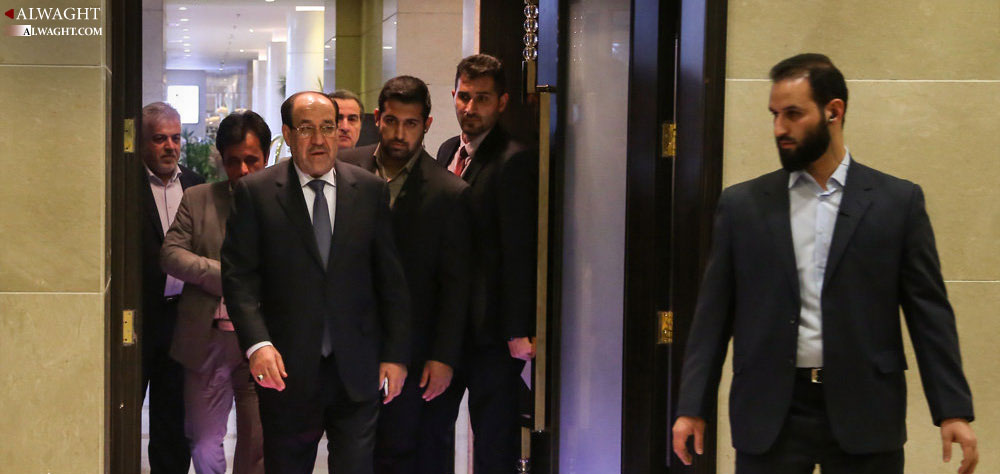


Alwaght- A visit of the former Iraqi Prime Minister Nouri al-Maliki to Tehran on Tuesday, January 3, was highly meaningful from some aspects. Majorly because it was coincided with many of West Asia’s very significant developments, including liberation of northern Syrian city of Aleppo which turned on their heads many of equations in favor of the Axis of Resistance led by the Islamic Republic of Iran.
The trip was preplanned and came as the current atmosphere across the region became positive and promising following Aleppo recapture and its effects on gains in Iraq’s ISIS-held city of Mosul. Just after liberating Aleppo and cleansing it of terrorists, Prime Minister Haider al-Abadi of Iraq announced launching the second phase of Mosul reclaiming operation. The step, of course, was incentivized by an augmented morale after Syria retook its major northern city from the terrorists, and also a further coordination of the Resistance camp in Syria and Iraq, especially that Iraq shows a considerable will and interest to move closer to convergence with the Axis of Resistance with its elements including Iran, Syria, Lebanon, and Palestine.
In addition to beginning the second stage of the Mosul assault, another factor effective in al-Maliki's Iran visit was the upcoming Iraqi parliamentary elections. Currently, he leads State of Law Coalition, Iraq's largest parliamentary bloc. He eyes saving the present majority in the country’s legislative body. But, he said that there was no guarantee he could become PM for third time.
In fact, the former Iraqi PM is well aware that if he continues leading the parliament’s largest alliance, he can thwart raising and actualizing any measures inside the Council of Representatives, another title for the parliament, meant to work against Baghdad-Tehran closeness. On the other side, al-Maliki’s decline to demand post of the PM despite leading a parliamentary majority stems from a will to protect the Shiite unity in the country. At the same time, some of sides in the Sadrist Movement are not that much favoring al-Maliki’s becoming PM for third time. He is aware of this fact and prefers to save the coalition’s unity and coherence rather than allowing it being cracked by discords. Even the Sadrist Movement's chief Sayed Muqtada al-Sadr in some messages has warned that once Nouri al-Maliki is picked PM afresh, he will resume Baghdad protests, a move earlier pursued by the Sadrist Movement against al-Abadi amid the operation to retake Mosul.
So al-Maliki’s decline to announce bid for prime minister post seemed a wise move. In a recent press conference, he said that he will not become candidate for new term as PM of the country. This posture comes in line with Tehran's efforts to push Sadrist Movement and al-Maliki-led camp closer to each other in a bid to preserve the Shiite unity in Iraq. Apparently, his Iran visit is motivated by Iraq's election atmosphere and an interest to announce support for unity among the Shiite political movements in the upcoming parliamentary poll. Such a pro-unity stance can have promising achievements for him, not to mention its positive influences on domestic convergence of the State of Law Coalition.
As a staunch supporter of Iran in Iraq, the former PM has always enjoyed Tehran’s backing. His performance has always been noticeable for the Islamic Republic. For example, after the former Iraqi dictator Saddam Hussein was arrested and tried, al-Maliki boldly approved his execution order, although Jalal Talibani, the former Iraqi president, failed to sign the warrant. Al-Maliki warned that if the execution does not take place exactly on the Eid Al-Adha night, Saddam Hussein could escape out of the country with a Qatari planning and assistance. He warned that even if the former president is not handed in for execution, his special guards will step in for hanging. Furthermore, his resistance to the US pressures to obtain capitulation agreements with Iraq was another bright record of al-Maliki in office, which drew Iran’s admiration. Therefore, as a political leader close to the Islamic Republic , Nouri al-Maliki holds close ties with Iran and his recent Tehran visit is driven by Aleppo and Mosul developments as we as Iraq’s atmosphere of parliamentary election.










