



Alwaght- The visit to Kazakhstan and Turkmenistan of the Iranian President Masoud Pezeshkian can be seen as one of the most important diplomatic moves of the recent months. The visit went beyond a ceremonial one or solely for participating in symbolic meetings, signaling redefinition of the Iranian look to Central Asia. Analyzing the comments by the senior Iranian officials suggests that the two-day mission of the president was successful.
Meanwhile, Pezeshkian, outlining the outcomes of his visits to Kazakhstan and Turkmenistan, said the meetings and consultations held during the trips had produced positive results in advancing the Islamic Republic’s core policy of strengthening and improving neighborhood relations.
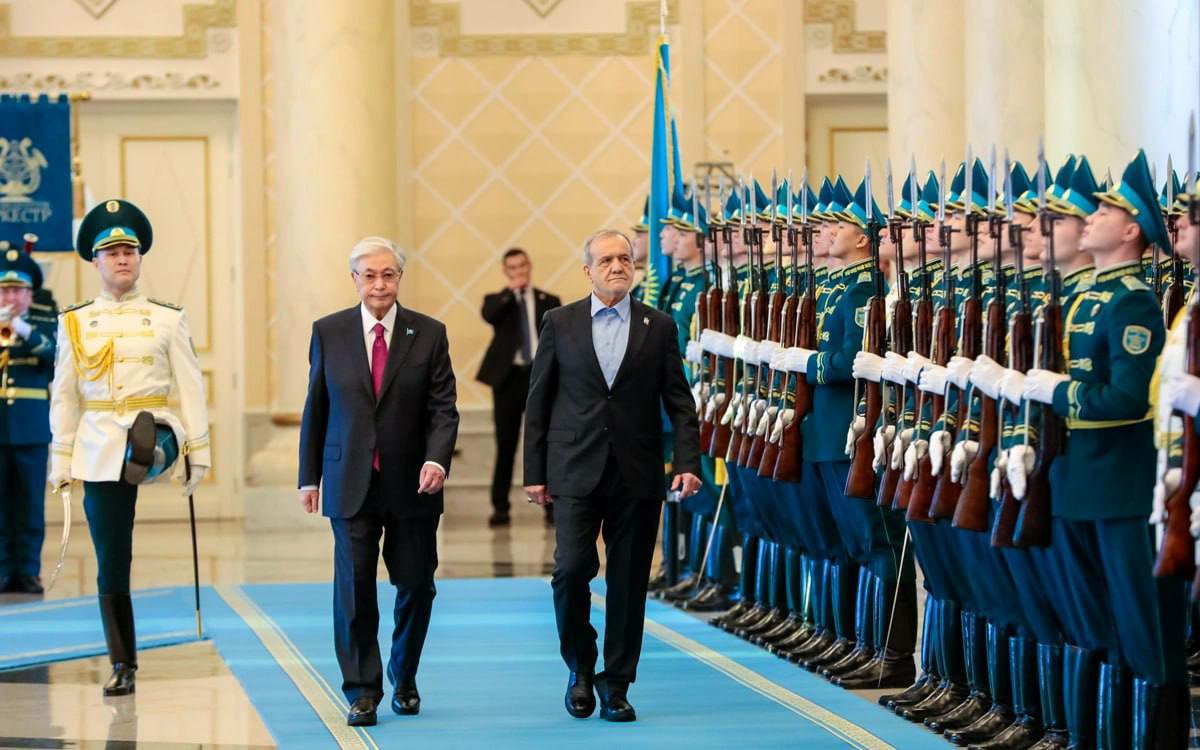
During his visit to Kazakhstan, Pezeshkian met with President Kassym-Jomart Tokayev and thanked him for his hospitality. He described relations between Tehran and Astana as closely aligned and convergent on many regional and global issues, stressing that the two countries have maintained strong cooperation across political, economic, and cultural fields. He added that the sides have reached valuable agreements, noting that bilateral accords will pave the way for further expansion of trade and economic ties between Iran and Kazakhstan.
Pezeshkian also attended a joint Iran–Kazakhstan business forum during the trip and visited an advanced hospital in the country.
Pezeshkian said the one-day visit to Kazakhstan yielded notable achievements, adding: "In Kazakhstan, 14 cooperation documents were signed, agreements were reached on many necessary measures, and our trade delegation met with Kazakh businesspeople and achieved favorable understandings."
Agreements signed by officials from the two countries included a mutual legal assistance treaty in criminal matters; a cooperation program between the foreign ministries to strengthen diplomatic and international engagement; accords on intellectual property and judicial cooperation; a strategic cooperation agreement in transport and logistics; cooperation in the health and medical sector; and a media cooperation agreement.
A key outcome of the recent high-level visit has been a breakthrough on a critical economic front: streamlining transit between Iran and Kazakhstan. The two nations signed an amendment protocol to modernize their existing international transport agreement. This revision specifically focuses on regulations governing the movement of passengers and cargo, with the stated aim of smoothing transit procedures and improving service quality.
Analysts indicate these operational changes will lead to a more efficient use of existing transit corridors. The updated protocol is designed to significantly cut through administrative bottlenecks, enhancing the reliability and speed of cross-border logistics.
The signed documents are framed as part of a broader effort to expand bilateral relations and forge new avenues of cooperation. Both governments anticipate that this revitalized transit framework will act as a catalyst for deeper economic, cultural, and social ties, providing a tangible boost to mutual development.
A tour going beyond bilateral relations
The visit to Kazakhstan immediately after visiting Kazakhstan was not just about participating in an official meeting. Beside addressing the international "Peace and Trust Summit" and outlining the Iranian stances about the international developments, Pezeshkian held meetings with a number of the leaders of other countries, adding diplomatic weight to his Central Asia tour and showing that Iran is pursuing a multi-faceted and active diplomacy at the heart of Central Asia.
On the sidelines of the Peace and Trust Summit, Pezeshkian met with Gurbanguly Berdimuhamedov, the National Leader of Turkmenistan, saying Iran was pleased to see Turkmenistan, under his leadership, extend its constructive approach across the region and beyond “so that we can all move forward together in strengthening trust, peace, and regional security.” The Berdimuhamedov, for his part, said relations between the two countries in various fields, including trade and commerce as well as cultural and humanitarian cooperation, are very strong and constructive, expressing hope that cooperation would further expand in the future.
Pezeshkian also met with Serdar Berdimuhamedov, President of Turkmenistan, where he underscored the stability of bilateral relations over the past decades. He openly criticized delays in the implementation of some agreements, particularly in the gas sector and transit corridors, and called for direct action by the Turkmen side. Berdimuhamedov, while highlighting the deep cultural and historical ties between the two nations, welcomed broader cooperation.
In a separate meeting with Iraqi President Abdul Latif Rashid, Pezeshkian described the Shalamcheh–Basra railway project as one of Iran’s top priorities and stressed the need to counter the destabilizing policies of the Israeli regime in the region. Rashid, in turn, emphasized the importance of expanding security, trade, industrial, scientific, and cultural cooperation between the two countries, saying: "We must share our experiences and strengthen exchanges and visits by various delegations, even on the most detailed areas of cooperation."
In his meeting with Shahbaz Sharif, Pezeshkian stressed the need for expansion of border markets and removing the obstacles ahead of transportation and transit. The two sides emphasized on joint countering of security threats.
The two sides described the development of connectivity routes, the facilitation of commercial transit, and the enhancement of economic cooperation as key prerequisites for expanding bilateral relations.
A meeting with Myanmar’s Prime Minister Nyo Saw revealed a lesser-seen dimension of Iran’s diplomacy. In the talks, Pezeshkian stressed that Iran and Myanmar possess significant technical and economic capacities for cooperation, adding that Tehran’s membership in ASEAN could serve as a complementary channel for strengthening engagement. The Myanmar side, for its part, expressed interest in cooperation in the oil, technical, and banking sectors.
Undoubtedly the most significant meeting of the trip was Pezeshkian’s talks with Russian President Vladimir Putin, which took on added importance amid complex geopolitical conditions and in the wake of the recent attack by the US and the Israeli regime on Iran. In the meeting, the Iranian president underscored Tehran’s determination to implement the comprehensive strategic cooperation agreement between Iran and Russia, saying: "We are determined to put the agreement we have signed into practice and expect the Russian side to accelerate and finalize the implementation of these mutual commitments." Expressing satisfaction with the strong and steadily expanding Tehran–Moscow ties, Pezeshkian also thanked Russia for its support of Iran in international forums.
Putin, welcoming the meeting with the Iranian president, described the signing of the comprehensive agreement as a turning point in bilateral relations and a highly significant development. Referring to the positive and growing trajectory of ties, he said trade between Iran and Russia increased by 13 percent last year and by eight percent in the first nine months of this year. He added that joint cooperation in power generation and the development of corridor infrastructure would continue, noting that cooperation on gas and electricity transfers to Iran is also under review.
Iran getting foothold in Central Asia
Pezeshkian’s visits should be regarded as a turning point in Iran's diplomacy and a step beyond an official mission or a symbolic attendance of a meeting. They showed that Tehran has begun to review its foreign policy priorities, once again putting Central Asia at the center of its strategic focus. This region, which was given relatively less attention, now with its economic and geopolitical capacities can significantly enhance Tehran's role in regional and international equations.
At a time when global transit routes are being reshaped and competition among major powers is intensifying, diplomatic engagement in Central Asia is transforming Iran from a “passive state” into an “active and influential actor,” enhancing its capacity for practical involvement in major regional issues.
Pezeshkian’s meeting with Putin reflects another dimension of this shift. Held after the signing of the Iran–Russia Comprehensive Cooperation Treaty, the talks underscored the continuation of strategic convergence between Tehran and Moscow and highlighted Iran’s desire to play an active role in Eurasia’s security and economic architecture.
At the same time, Iran’s shared membership with Central Asian republics in multilateral organizations such as the Shanghai Cooperation Organization and the Eurasian Economic Union is laying the groundwork for broader multilateral engagement and increasing Tehran’s diplomatic weight in the region.
Economic experts say that the Islamic Republic views Eurasia as a gateway to global trade and an opportunity to counter American sanctions aimed at isolating Iran from international markets. After years of limited presence in the markets of Commonwealth countries, Iran can now, through regional cooperation, meet mutual needs as a cost-effective complement to its partners.
This approach has also paved the way for exporting non-oil goods, helping Iran to advance its plans to depart from single-product economy and diversity its economy. Additionally, enjoying massive transit capacities, Iran has special attraction to the Central Asian countries, preparing the ground for influence and expansion of economic and political cooperation in the region.