
















Alwaght- At the time being, the situation in Syria, both in national and international aspects, has gotten quite complicated. Internally, there are talks about ethnic groups, foreign terrorism, and proxy war on behalf of regional and international powers. Internationally, the interests of foreign players are an issue worth pointing out. On this basis it is understandable that for making any move in this complex and multi-layered situation, one needs further understanding of it. The issue of reaching an agreement for a ceasefire in Syria is not new, but all previous attempts have failed. Di Mistura is the third representative of the United Nations that has been chosen to resolve the crisis in Syria. His predecessors, Kofi Annan and Lakhdar Brahimi, both failed in their mission and resigned. Therefore it is clear that this complex situation cannot be solved only with systems of linear equations.
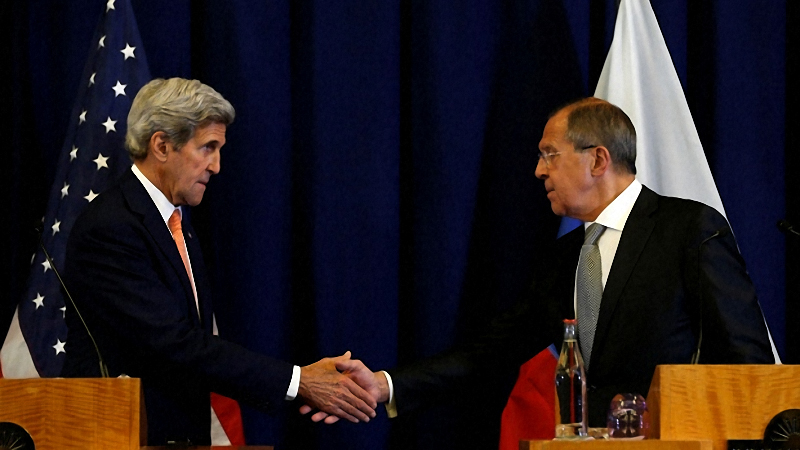
Regarding current ceasefire in Syria, if US and Russia intended to resolve the crisis of Syria on their own, and regardless of the role of regional players such as Iran, Turkey, and Saudi Arabia, it is clear that both Moscow and Washington do not have enough understanding about the region and its issues. But it is a different story if a carefully timed strategy to rule out the regional powers is being adopted by the US and Russia in order to simplify the equation of power in Syria and make certain moves in that country. It is clear that Moscow does not trust Washington on the issue of Syria.
Russia believes that even in these negotiations, US’ goals and objectives about ceasefire are not transparent, and US is not honest. On the other hand, the US accuses Russia of not being cooperative, because it does not accept US’ policies. It Seems that US’ stance on Syrian ceasefire could be considered a simple distraction, because, naturally every country aims to achieve its own goals. Before 2011 crisis, the US had almost no influence in Syria; in fact it was relying on its allies such as Saudi Arabia and Turkey to dictate its policies in Syria. Due to this, the US is currently looking for leverage or a trustworthy power to be able to rely on it for the future of Syria. That being said, Washington imposed destruction in Syria, through countries such as Turkey, Saudi Arabia, and even Qatar.
Due to this complicated situation and because of the lack of policies or strategies, ceasefire between the US and Russia was not taken seriously, even from the very beginning. In fact, political and analytical circles of the world were quite skeptical towards this attempt.
Another issue that has complicated the matters further more, was the US elections. Currently, the US is busy with its elections, and it seems very unlikely for Washington to make investments on the issue of Syria. Thus, the complexity of the scene in Syria, and the issues of the groups that are involved (over 100 groups are engaged in the Syrian crisis), have made resolving the crisis in Syria very hard.
With these difficulties, it is unlikely that the global superpowers, Russia and the US can solve this issue on their own. Currently, the main decision makers on Syrian crisis are the country's public opinion and government, both of which have been ignored. As it seems for the foreign players, the opinion of Syrian people is not of importance in the current situation. On this basis, it is unlikely that this ceasefire in Syria will achieve its goals.
Syrian-Syrian peace-negotiations involving all parties, especially the government's political opponents, are less likely to fail. Although this kind of negotiation may also not be the best option, because currently, the armed opposition has control over some parts of Syria.
In conclusion, the recent Moscow-Washington ceasefire is doomed to failure like the ones in the past, and it cannot be declared more important than any prior attempts. Moreover, because of high casualty toll, widespread damages, and displacement of a large portion of Syrian population, it is currently very difficult to resolve the crisis in Syria.
Nosratollah Tajik - Former Iranian Ambassador in Jordan










