















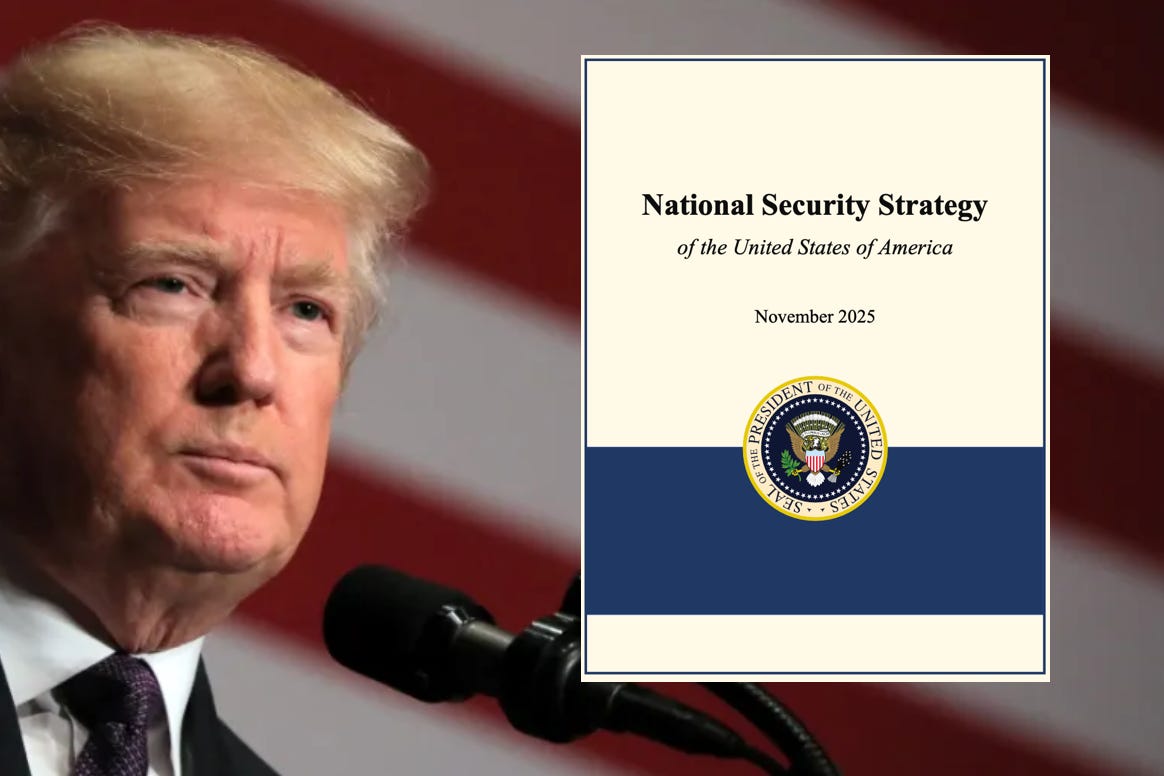


Alwaght- Publishing the new US national security doctrine under Donald Trump should not be seen as a mere conventional review of the American strategic documents, but a practical and theoretical push to adapt to the coordinates of the transitioning international order. It is an order in which such concepts as American hegemonic order and Pax Americana (American peace) are more than any other time being questioned.
From the end of the Cold War to the first decade of the 2000s, the US managed to establish itself as dominant power in the global order; a power that, relying on the military superiority, network of coalitions, multilateral institutions, and advancing liberal democracy discourse, produced a somehow sustainable order. But the erosion of the structural advantages, rise of new emerging powers, particularly China, and Washington's failure in its West Asia interventions, have pushed this model to a period of demise.
The Trump doctrine was forged precisely at the moment when US's globalist leadership could no longer respond to new realities. Washington was caught between two options: reforming the liberal order to accommodate rising powers, or retreating from hegemonic commitments and redefining American role on a more limited scale. Trump’s choice was unequivocally the latter.
This document marks a fundamental pivot away from the discourse of global leadership toward a nationalism centered on security and a form of relative isolationism, a shift traceable in both its language, conceptual priorities, and underlying political philosophy. Unlike the national security strategies of the Clinton, Bush, and Obama eras, which framed American interests as intertwined with stabilizing the global liberal order, the Trump doctrine rests on the assumption that US’s active engagement in managing the international system has become less an asset and more an imposed burden. From this vantage point, while the US has been footing the bill for Europe’s security against Russia or protecting allied Arab regimes in the Persian Gulf, rivals like China, India, and Brazil have focused on capital accumulation and advancement.
Consequently, the US no longer defines itself as the guarantor of the global order or the provider of public goods such as maritime security, financial stability, and support for international institutions. Instead, it measures its international presence by a short-term calculus of profit and loss. The Trump doctrine can be seen as a response to American hegemonic decline, one that, rather than denying it, codifies it into a strategy of geopolitical retrenchment and a focus on nearer spheres of influence. While signaling a retreat from the ideal of global leadership, this approach also serves as an implicit admission of the erosion of America’s material, legitimizing, and institutional capacity to manage the international order. More than a roadmap for restoring American greatness, it is a blueprint for managing hegemonic decline, preserving relative dominance in its immediate environment while shedding extra-regional commitments.
At the same time, this doctrine portraits the US decline not as a result of the structural developments of the international system and the failure of the interventionism of the US itself, but as a result of the abuses of the others to the American generosity. Trump thinks that the Europeans and others are free-riding and now they should be shown the door. In this narrative, the traditional allies are actually costly contractors and the emerging rivals are opportunitist actors that take advantage of the liberal system's principles in their advantage. It is exactly at this point that the fundamental weakness of Trump's doctrine defines itself: An effect to settle the crisis of hegemony solely by changing the foreign tactics without serious consideration of the home roots of the power erosion, from social polarization and crisis of political legitimacy to economic inefficiency and distrust of allies.
A strategy for soft landing
At the core of the Trump administration's national security doctrine is a fundamental redefinition of the US's role in the international system: a transition from a global leadership model based on institutionalism and enduring alliances to a logic of overt great power competition and national interest maximization.
The first pillar of the document is the acceptance of the return of great power competition as the central reality of global politics. Unlike the post-Cold War era, which assumed unchallenged American supremacy, the Trump Doctrine views the world as an arena for great power confrontation, a world in which China is framed as a long-term structural rival and Russia as a revisionist actor. This assessment implicitly signals the end or the demise of the unipolar moment. Strategically, however, the document lacks a comprehensive blueprint for managing this multi-layered competition, primarily resorting to punitive economic tools and episodic displays of hard power. This approach neither guarantees the containment of ascendant rivals nor solidifies American primacy.
The second pillar is the explicit linkage of national security with economic security. For the first time, Trump places supply chains, trade deficits, technological dependencies, and industrial policies at the heart of the threat assessment. This reflects deep-seated anxieties over China's technological supremacy and the perceived erosion of the US position in global manufacturing and trade. The trade war with China, tariffs on allies, and the restrictions on Chinese companies in sensitive technologies are direct extensions of this approach. However, reducing economic conflict to a tit-for-tat tariff war, without rebuilding the multilateral trade system or coordinating with allies, has arguably led more to Washington's isolation than to Beijing's containment. It has also turned "economic security" into a veil for domestic protectionism.
A third pillar of this doctrine is scaling back the US out-of-area commitments and redefining Washington’s obligations toward its allies. Trump accuses US partners of free-riding under American security umbrella and shifting the costs of collective defense onto Washington. As a result, demanding higher financial contributions from NATO and Asian allies, and threatening to dial back U.S. military commitments, has moved to the top of the agenda.
But this approach undercuts one of the core pillars of American hegemony: its alliance network, which once spread the burden and mobilized collective power. Lasting hegemony is not merely a product of material superiority; it depends on the ability to lead coalitions and build consensus. Trump’s transactional mindset has steadily eroded that capacity.
The fourth pillar replaces institution-based diplomacy with a deal-making model. In this view, international relations are reduced to a marketplace of bilateral bargains in which every agreement must pay immediate dividends to Washington. International organizations and multilateral arrangements are pushed to the sidelines, reflected in withdrawing from the Paris climate deal, questioning the WTO, and ignoring arms-control regime's. Yet hollowing out institutional frameworks shrinks the US soft-power reach and leaves room for China and Russia to shape the emerging global order.
West Asia, the management of crisis instead of engineering the order
In Trump's doctrine, West Asia, or Middle East as called by the West, loses its key position it had during the Cold War and post 11/9, and decreases to a costly, less cost-effective region where continuation of the US presence has not produced a new order but waste of the American resources.
Therefore, Washington's strategy hinges on reducing direct military presence, outsourcing crisis management to regional allies, and selectively applying hard power pressure against non-compliant actors. In place of a project to engineer a liberal order centered on active American intervention, a pragmatic crisis-management model was prioritized, an approach signaling a retreat from rebuilding an American-led order and an acceptance of an emerging multipolar power landscape in the region.
Trump's west Asia policy focused on establishing a proxy balance, uniting a Hebrew-Arab bloc against the Iran-led Axis of Resistance. The stated goal was to reduce tensions by fostering convergence among Washington's allies, but in practice, this strategy re-codified the region's deep geopolitical divides in a new format.
The second pillar of the strategy was a "maximum pressure" campaign against the Islamic Republic of Iran, pursued through withdrawal from the 2015 nuclear deal and severe sanctions. However, this neither altered Tehran's strategic behavior nor significantly curtailed its regional influence. Instead, coupled with the US military drawdown from Syria and Iraq, it created more operational space for the Resistance camp, Russia, and Turkey. While the reduction of direct military commitments and the emphasis on ending "forever wars" resonated domestically, regionally it contributed to a power vacuum and a cacophony of competing actors, diminishing the US role from a hegemonic order-setter to a player engaged in minimal crisis management.
This document suggests that Trump is compelled to disengage from West Asia, both to counter China militarily and geopolitically and to reduce costs for a domestic focus. Yet, it still identifies the Islamic Republic as a threat. The twist is that the US no longer intends to bear the primary burden of this confrontation. Thus, by continuing its recent policy of expanding Arab-Israeli normalization and heavily arming regional allies, Washington seeks to cultivate a kind of regional gendarmerie, empowering proxies to contain rivals and hostile forces on its behalf.
Europe and crisis of Atlantic cohesion
For decades having been the main pillar of the US-dominated world order, Europe in this doctrine is reduced to a pack of weak and costly actors. The demand from the European countries to increase NATO spending, Washington threatening to degrade membership or withdraw from this Western military bloc, and questioning the credibility of collective deterrence have eroded the mutual trust and cohesion of this alliance. The cost-centric view of Trump moves past the symbolic and geopolitical position of Europe in stabilization of the US world leadership and closes eyes to the fact that the US hegemony rests on a network of coalitions not merely military power.
The American withdrawal from multilateral agreements and its confrontational stance toward institutions like the World Trade Organization and the Paris Climate Accord deepened the value-based and institutional rift across the Atlantic. This, in turn, pushed the European Union toward the pursuit of strategic autonomy.
From a critical aspect, this approach, despite its "America First" slogan, has ultimately weakened the US long-term interests. The Trump doctrine transformed the US from a willing leader of the Western order into a transactional and distrustful actor, rendering NATO a more fragile institution. This is a sign that hegemonic decline is manifesting even at the heart of the Western camp, appearing as a crisis of confidence and leadership.
Curbing China goes incohesive in the shadow of US global leadership erosion
In Trump's doctrine, East Asia is defined as the main ground of competition of the great powers and the center of confrontation with China. Beijing is named the "systematic strategic rival" seeking to redefine an order non-consistent to the American interests. This description matches the multi-faceted rise of China. However, the main weakeness of the doctrine is its lack of a comprehensive strategy to effectively contain this Asian rival.
Trump’s practical policy in the region rests largely on trade wars, higher tariffs and tight restrictions on technology, moves that rattled the global economy, alienated allies and ultimately failed to put China under lasting pressure. Washington’s exit from the Trans-Pacific Partnership (TPP) also cost the US its best shot at leading an anti-China trade bloc, effectively clearing the way for initiatives such as China’s Belt and Road.
In the 2025 US National Security Strategy document, China’s place underwent a notable reframing compared with previous documents. Beijing was downgraded from being “the organizing threat of the US overall strategy” to “an economic and technological competitor among several rival fronts.”
Unlike the Biden administration’s 2022 strategy, which cast China as the main geopolitical challenge and the central driver of an ideological showdown between democracies and authoritarian systems, the 2025 document defines rivalry with Beijing chiefly through trade imbalances, state industrial subsidies, supply-chain vulnerabilities and unregulated technology transfers. The proposed approach is not sweeping containment but a “reset of economic relations” based on transactional bargaining and narrow self-interest: restricting trade to non-sensitive sectors, applying tougher tariff and legal pressure aimed at China’s excess industrial capacity, while still keeping the door open to a reasonably profitable economic relationship. In this narrative, China is less a civilizational adversary than a heavyweight rival in the political economy of globalization.
On the security front, the US pressure on Japan and South Korea to pay more and threats to scale back the US military footprint weakened long-standing trust and pushed both allies toward building independent defense options and diversifying foreign relations. In the South China Sea, the American naval shows of force continued, but the absence of a broader regional framework meant many ASEAN states, which are deeply tied to China economically, avoided lining up openly behind Washington’s confrontational stance. By leaning heavily on punitive economic tools while neglecting institutional and development-focused mechanisms, the US increasingly looked less like a reliable long-term partner and more like an unpredictable power with growing demands. Many regional governments responded by hedging between Washington and Beijing. Far from demonstrating effective containment of China, this dynamic tells us more about the real limits of American leadership in an era of fading hegemony.
Western Hemisphere, return to the historical play court
In the Trump doctrine, the Western Hemisphere is reframed as the focal point for an inward "return home" and the arena for reviving a form of regional hegemony. It represents an attempt to preserve dominance in the US's historical backyard at a time when its ability to maintain a global order has diminished. Latin America and the Caribbean are portrayed primarily as a theater for containing Chinese and Russian influence, effectively resurrecting a hard-power interpretation of the Monroe Doctrine, where the presence of extra-hemispheric powers is viewed as a direct threat. However, this new Monroe Doctrine is built upon a foundation of waning, not rising, power. It is championed by a polarized society and a model that has lost much of its former appeal.
In practice, Trump's policies focuses on building pressure on Venezuela, reverting to a confrontational stance against Cuba, securitizing immigration, and attempting to curb China's economic inroads. These measures largely, however, have failed to achieve their strategic aims: sanctions on Venezuela failed to force regime change while exacerbating a humanitarian crisis, renewed pressure on Cuba pushed it closer to the US rivals, and harsh immigration policies deepened distrust among regional governments and societies without addressing the root causes of migration. While China has become a tangible partner through infrastructure investment, the US primary vocabulary has been one of sanctions and threats, lacking a compelling, development-oriented blueprint for balanced economic integration. Therefore, the "new Monroe Doctrine" is less a triumphant return to hemispheric primacy and more a defensive, rearguard action. It is actually an attempt to salvage the remnants of regional influence amid the twilight of a global imperium.
Assessing Trump doctrine's efficiency in steering clear of US hegemonic decline
If we consider the Trump doctrine and its refocus on the Western Hemisphere as a new reading of the Monroe Doctrine and a response to the US hegemonic decline in the face of rising powers, its main weakness lies in the gap between the claim of "making America great again" and the actual tools employed.
Trump correctly understood that the US could no longer sustain its dominance through heavy military expenditures and scattered commitments. Yet the solution he proposed, geopolitical retrenchment, a focus on its own backyard, transactional dealings with allies, and an over-reliance on sanctions, resembles a defensive, short‑sighted strategy rather than a project for rebuilding hegemony. Unlike the Monroe Doctrine of the 19th century, Trump’s policy is not the sign of a rising power but the symbol of a weary power in retreat, struggling to preserve its last remnants of regional influence.
On the domestic front, Trump’s policies deepened political and racial divisions and eroded trust in institutions, painting a picture for foreign partners of a country suffering a crisis of legitimacy. Hegemony cannot endure without national cohesion and democratic legitimacy. From this perspective, the argument of domestic critics, that Trump’s policies accelerated the US hegemonic decline, appears valid: decline is a structural phenomenon, but by weakening international institutions, damaging alliances, and lacking a positive strategy to compete with China, the Trump doctrine not only failed to halt that process but also wore down many of the factors that might have slowed the decline. This document can be seen as the formal announcement of the US entry into a "post‑hegemonic" era, a period in which the US remains a major player, but no longer a power that can single‑handedly set the rules of the international order.
From a structural standpoint, managing hegemonic decline requires three components: repairing domestic cohesion, rebuilding alliance networks, and offering an attractive vision of a global order. The Trump doctrine fails on all three. Domestically, it intensifies polarization and a crisis of trust; externally, by viewing collective security through a purely financial lens, it wears down NATO and other alliances. In a multipolar world, America’s main advantage lies precisely in this network of institutions and alliances; damaging it amounts to a form of hegemonic self‑harm. Faced with a China that uses infrastructure diplomacy and multilateral initiatives to present itself as a long‑term partner, the US under Trump became an unpredictable actor that withdraws from agreements and speaks to its allies in the same tone it uses with its rivals.
So, instead of undoing the decline, the Trump doctrine has become its catalyst that by impairing home cohesion and network of foreign coalitions exhausts the factors that could slow down the decline process. The neo-Monroe Doctrine in this sense is not a prescription to make America great again but rather the theoretical formulation of a transition to the status of a "non-hegemonic great power", a condition in which the US remains significant and influential, yet is no longer the undeniable center of gravity of the world order.










