














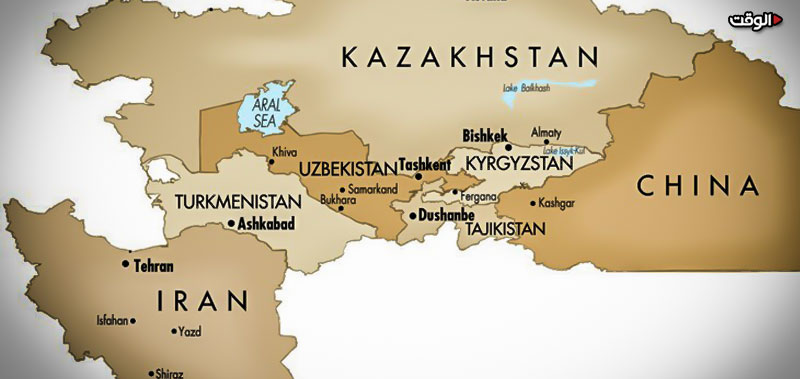


Alwaght- In a move to boost "look East" policy of Iran and to strengthen Tehran's regional cooperation, Iranian President Masoud Pezeshkian has started a visit that takes him to Kazakhstan and then Turkmenistan. The visit is described as a continuation of the Iranian government's push to bolster economic and political ties with neighboring states, especially the republics in Central Asia, a region that occupies an important position in the Iranian foreign policy due to its strategic significance and its economic, energy and transportation capacities.
With the previous Iranian government, led by the late Sayyed Ibrahim Raisi, laying the groundwork for deepening the ties with these countries, the government of Pezeshkian is seriously following this path, seeking to enhance Tehran's position in the region and structure of Central Asian interactions by drawing on mutual cooperation opportunities.
Economy top on Tehran-Ashgabat agenda
Given that the economy now drives international relations, strengthening economic cooperation sits at the top of the agenda for Iran’s high-level diplomatic missions to Kazakhstan and Turkmenistan.
In this regard, Mehdi Sanaei, the political deputy of the Iranian president’s office, detailed the regional visit. “The trip to Kazakhstan is at the invitation of that country’s president and is an official bilateral visit,” Sanaei stated. “Alongside official meetings, more than ten cooperation documents will be signed between the two nations. Furthermore, a major Iran-Kazakhstan trade conference, an exhibition of documents, and the unveiling of several books on the shared history of the two countries will be held.”
Regarding Pezeshkian’s trip to Turkmenistan, Sanaei added: “The president will travel to Turkmenistan to participate in the Peace and Trust Conference, where he will deliver a speech. During this visit, he will also meet with the leadership and president of Turkmenistan to discuss various aspects of bilateral relations, including energy, trade, and transit. The president will additionally hold meetings with other heads of state attending the conference on the sidelines.”
Relations between Iran and Turkmenistan have long been rooted in neighborliness, cultural-historical interaction, and geographical proximity. This closeness has created a natural advantage for the exchange of goods, services, and investment. Iran can competitively export industrial goods, construction materials, petrochemical products, agricultural and food products, and consumer goods to Turkmenistan.
Conversely, despite its considerable natural and energy resources, Turkmenistan remains dependent on foreign sources to meet its diverse domestic needs for goods and services, thus presenting a potential market for Iranian products. Accordingly, the Turkmen market has been identified as a key destination for Iran’s non-oil exports, and Iran’s private sector has actively pursued these opportunities in recent years.
Over the past three years, efforts to enhance trade relations and reduce export barriers to Turkmenistan have boosted exports of foodstuffs and consumer goods, increasing Iran’s market share there. According to a report by Caspian Post, Iran’s non-oil exports to Turkmenistan saw renewed growth in 2025. In the first quarter alone, the value of these exports reached approximately $125 million.
Furthermore, Iran's provinces bordering Turkmenistan, including Northern Khorasan, Razavi Khorasan, and Golestan, have a high capacity to expand trade ties with Turkmenistan given the border markets and customs. Establishing border markets and local authorities' interactions can facilitate the trade and create job opportunities in the region. Given the two sides' resolve to shore up partnership, these provinces are expected to become the center of economic growth and sustainable growth of the Iran-Turkmenistan relations.
Turkmenistan is the biggest trade partner of Iran in Central Asia and is seen as the gate of Iran's entry to this region, and therefore, the broader ties between the two nations, the larger volume of Iran's bilateral trade with other regional states.
Boosting economic ties with Kazakhstan
Iran-Kazakhstan relations have also been on an upward trajectory in recent years. As two active economic and trade players in the Central Asia and Persian Gulf region, Iran and Kazakhstan possess numerous capacities and opportunities for mutual cooperation that can elevate bilateral relations beyond previous levels of engagement. This cooperation extends not only to the import and export of goods but also to investment, value chain development, industrial technologies, and logistics.
From an economic aspect, Kazakhstan, with its rich mineral resources, agricultural products, and raw materials, represents an attractive market for Iran. Iran can meet diverse Kazakh market demands by exporting industrial goods, petrochemicals, construction materials, production equipment, and consumer goods. Beyond fulfilling domestic needs in Kazakhstan, these goods can also be utilized in joint development projects and investments.
Conversely, Kazakhstan holds specific potential in meeting Iran’s needs. Mineral resources, agricultural products such as wheat and barley, and industrial raw materials can constitute a significant part of Iran’s imports, while also laying the groundwork for joint production and industrial investments.
Meanwhile, important agreements have been signed between Iran and Kazakhstan, smoothing the path for economic collaboration. Among these agreements are a roadmap for trade and investment cooperation, MoUs to enhance the exchange of goods and services, and joint programs to develop logistics and transportation infrastructure.
The two countries have actively cooperated and held consultations within regional organizations such as the Economic Cooperation Organization (ECO) and multilateral frameworks in Central Asia like the Eurasian Union. Consequently, Iran's membership in the Eurasian Economic Union has created opportunities for increasing preferential trade and expanding joint investments with Kazakhstan and other union members.
Official Kazakhstan reports suggest that trade volume between the two countries has increased significantly over the past year, with some statistics indicating an almost doubling of exchanges compared to previous years.
According to official statistics, the trade volume between the two countries reached $340 million in 2024, and based on set targets, it is projected to rise to the $3 billion mark in the future. This growth has been driven primarily by expanded cooperation in agriculture, processed food products, and certain industrial goods.
At the beginning of 2025, economic delegations from both countries signed a series of trade agreements valued at approximately $92.8 million. These agreements include enhancing trade association cooperation, strengthening the role of the private sector, and facilitating the entry of Kazakh goods into the Iranian market.
Experts maintain that Kazakhstan holds significant importance for Iran due to having the longest Caspian Sea coastline in the region, an area with promising potential in logistics, economic relations, and even environmental protection.
Capacity of Iran's corridors for Central Asia
Central Asia has no access to sea and this geostrategical and geoeconomic restriction adds to Iran's comparative advantage to this region. Meanwhile, the geopolitical developments in recent years have doubled this significance. West's sanctions on Russia that led to blocking of direct Central Asian countries' trade with Europe have made finding alternative routes ghe top priority of the foreign policy of the Central Asian countries.
In this context, Iran, with its distinct geopolitical position, access to land and maritime routes, and developed transit infrastructure, has become one of the most reliable and cost-effective corridors for transporting export goods from Turkmenistan and Kazakhstan, both in the energy sector and in other fields.
In recent years, Iran has undertaken extensive projects to enhance its transit infrastructure. These include the development of the North-South Corridor, the launch and upgrading of rail lines connecting Kazakhstan and Turkmenistan to Iran, the improvement and expansion of southern ports, particularly Chabahar Port, and the modernization of the transportation network in the northern part of the country. These measures have not only made the Iranian route fast and secure but have also created conditions for landlocked Central Asian countries to move their goods to the Persian Gulf and the Indian Ocean in the shortest possible time and at the lowest cost.
Gas swap
The gas swap between Iran and Turkmenistan over the past years has become one of the most important pillars of energy cooperation between Tehran and Ashgsbat. This cooperation not only has a strategic role in meeting Iranian energy needs, but also allows gas economic advantages from gas transit capacities for Iran.
Under Raisi, the two countries inked a key deal according to which Iran will annually transfer 2 billion cubic meters of Turkmenistan gas to Azerbaijan and from there to Turkey and take part of this supply to meet consumption needs for its five northern border provinces.
This mechanism significantly alleviates gas shortages in Iran's northern and eastern provinces while enabling Iran to generate economic revenue from gas transit. Turkmenistan, ranked among the world's largest holders of natural gas reserves, can export a substantial portion of its resources to foreign markets via Iranian routes. Therefore, the gas swap arrangement between Iran and Turkmenistan is not merely a bilateral energy cooperation but also serves as an important instrument for enhancing energy security, increasing transit revenues, and fostering regional economic ties.
Iran has the capacity to transit Turkmen gas to Persian Gulf countries. Should this potential be realized in the future, appropriate agreements would strengthen the energy corridor from Central Asia to the Persian Gulf, establishing a regional energy linkage. This would not only ensure stable energy supply but also create significant economic and geopolitical opportunities for Iran and neighboring countries.
Furthermore, the electricity sector is another area that could substantially bolster energy cooperation between Iran and Turkmenistan. For years, Iran has met part of its consumption needs by purchasing electricity from Turkmenistan. According to official reports, the volume of electricity imported from Turkmenistan stands at around 140 megawatts, primarily used in Iran's northern and eastern provinces. Given rising demand and electricity shortages during the summer, Turkmenistan's extensive power generation reserves play a crucial role in compensating for this deficit.
According to Iran's electricity industry authorities, launching the second power grid from Turkmenistan to Iran's north in 2023 decreased daily burning of about 1 million liters of fuel in Iran to generate power. This not only helps sustainable power supply internally, but also bring about considerable economic and environmental advantages to Iran.
Furthermore, Turkmenistan energy ministry has announced that it plans to increase its power generation by 2030 to 35.5 billion kw/h, a growth providing Iran with a proper opportunity to, beside meeting its internal needs, play a transit bridge role in regional markets. It can transfer Turkmenistan's power to such countries as Iraq, Afghanistan, Turkey, Azerbaijan, and Armenia and so both meet its own needs and secure a strategic place in the regional electricity market.










