








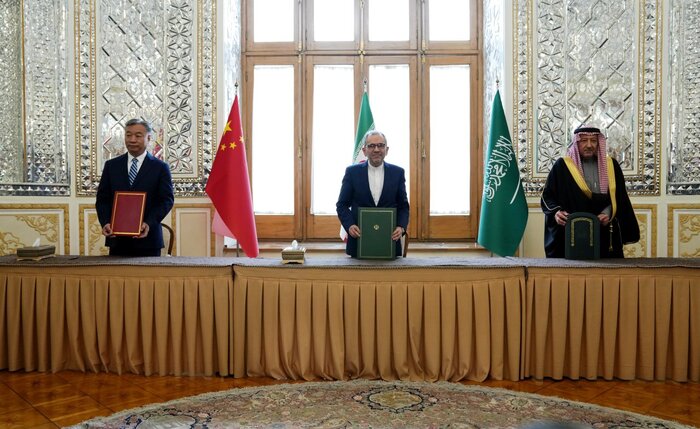


Alwaght- As the security and political developments gain pace in West Asia, Iran and Saudi Arabia more than before move towards strengthening bilateral relations and strategic convergence. In this connection, the third joint meeting of the deputy foreign ministers of Iran and Saudi Arabia, accompanied by China, was held on Tuesday in Tehran. The meeting, initiated with the aim of de-escalating tensions and mending ties after China-brokered March 2023 rapprochement deal between Tehran and Riyadh, demonstrated the two countries’ resolve to boost dialogue between the two West Asian powers.
Tehran meeting was chaired by Deputy Foreign Minister Majid Takht-Ravanchi and was attended by his Saudi counterpart Walid al-Khariji and Chinese counterpart Miao Deyu.
The Iranian and Saudi sides have underscored their commitment on implementation of all of the terms of the Beijing deal and continuous efforts to bolster neighborly relations through commitment to the UN charter, the Organization of Islamic Cooperation Charter, and international principles like respect to bilateral sovereignty, territorial integrity, independence, and security. The three countries have also voiced their welcome of the constant Iranian-Saudi ties and seizing the existing opportunities for direct contacts at all levels.
Expanding economic-political cooperation
For nearly three years following the signing of their peace agreement, Iran and Saudi Arabia have actively worked to restore their bilateral relationship to its pre-2016 diplomatic level, significantly reducing the atmosphere of distrust that dominated previous years. A series of official meetings and summits at various levels demonstrates that strengthening political ties has become a major priority for both Tehran and Riyadh. This trend reflects a shared understanding between the two nations of the necessity for cooperation and dialogue within a complex regional and international landscape.
Developing political relations based on mutual respect and common interests can help build greater trust and stabilize ties. Continued political consultations will not only foster more durable relations and broader cooperation but also contribute to enhancing regional stability and managing disputes.
Given that the expansion of bilateral relations across various fields is fundamentally channeled through diplomacy, this issue was a central focus during the recent talks in Tehran. Consequently, consular affairs formed a key part of the agenda, with both sides discussing measures to facilitate travel for citizens, increase regular flights, improve services for pilgrims, and resolve consular obstacles. Considering the expected presence of over 85,000 Hajj pilgrims and more than 210,000 Umrah visitors from Iran in 2025, enhancing consular cooperation is not only an operational necessity but also an opportunity to gauge the depth of collaboration between the two countries.
On another front, as political cooperation increases, bilateral trade is also poised to grow reciprocally. In the economic sphere, both sides emphasized revitalizing joint committees and launching specific projects in energy, transportation, investment, and trade.
Iran and Saudi Arabia enjoy considerable mutual economic capacities that can pave the way for their cooperation broadening. The two countries are among the top energy producers and play a determining role in the oil and gas market. Their further coordination in energy sector, common investment in oil and gas and petrochemicals, and also cooperation within the framework of such blocs as OPEC can bring about substantial economic interests to the two nations.
Iran, with its industrial infrastructure and strategic transit position, could be a suitable partner for Saudi Arabia’s economic and trade projects. Conversely, Saudi Arabia, with its strong financial capacity and extensive investment plans under Vision 2030, has significant potential for joint investment in various sectors of Iran’s economy, including renewable energy, industries, tourism, and services. Increasing bilateral trade volume and facilitating banking and trade relations can help strengthen economic ties and reduce barriers to cooperation.
Although the volume of trade between Tehran and Riyadh is not substantial, official statistics show significant growth in trade between the two countries following the peace agreement. According to Foroud Asgari, head of the Iranian Customs Administration, non-oil trade between Iran and Saudi Arabia in 2024 reached approximately 61,000 tons of exports and imports, valued at $25 million, a 6,483 percent increase compared to the previous year. Major export items from Iran to Saudi Arabia included steel and iron products, pistachios, raisins, carpets, glass, and apples. Based on these statistics, the trade volume between the two countries in the first five months of the current year reached about $410,000, accounting for less than 0.03 percent of Iran’s total trade with Arab countries. During this period, Iran’s share of exports was $345,000, while Saudi Arabia’s was $64,000.
This is while, in 2006, the trade volume between the two countries touched $1 billion annually, the highest figure in their trade history. However, with the goals set and the growing trend of cooperation in the past two years, trade between the two neighbors is expected to develop further.
To accelerate the implementation of trade programs, regular and continuous meetings between officials of the two countries continue. In this context, Mohammadreza Farzin, the Governor of the Central Bank of Iran, traveled to Saudi Arabia in April 2024 with the aim of developing monetary and banking relations and held discussions with Saudi economic and banking officials regarding facilitating financial exchanges between the two countries. At the same time, Hassan Zarnegar, Iran’s consul general in Jeddah, also met with Saleh Abdullah Kamel, the head of the Mecca Chamber of Commerce, and both sides emphasized enhancing trade and economic cooperation. Furthermore, in December 2024, Gholamreza Nouri Qezeljeh, Iran’s minister of agriculture, announced the formation of a joint working group between Iran and Saudi Arabia to strengthen cooperation in natural resources, environmental issues, and agriculture.
Therefore, the holding of economic meetings indicates that the current administration places special emphasis on developing cooperation with Persian Gulf neighbors, particularly Saudi Arabia. By strengthening economic and trade relations with its neighbors, Iran can activate a significant portion of its domestic and regional market potential and mitigate the impact of sanctions.
China, beyond a mediator
Though Saudi Arabia and Iran have themselves worked towards a détente, China’s role in their deal was key. Beijing peace deal now makes the backbone of the relations of the two countries and China in the place of a neutral political mediator plays the role of a political guarantor. Tehran meeting showed that this role is not only now established, but also is expanding. Voicing his support to closer Iranian-Saudi relationship, Beijing has opened new horizons of Eastern diplomacy, selling itself as a replacement for the Western-reliant traditional diplomatic frameworks.
China views the long-term trajectory of the West Asia region with clear-eyed understanding: without stability and cooperation among the region’s major players, its own economic and geopolitical ambitions will face serious headwinds. Therefore, for Beijing, fostering closer ties between Iran and Saudi Arabia is not merely a temporary diplomatic win—it is a core pillar of a grand strategy.
The Belt and Road Initiative, China’s flagship global project, demands secure, stable, and reliable corridors. Nations like Iran and Saudi Arabia play indispensable roles in this project. Iran’s pivotal geography, linking East to West and North to South, combined with Saudi Arabia’s command over vital energy and maritime trade arteries makes these two countries essential links in realizing Beijing’s envisioned corridors. Greater coordination and unity between Tehran and Riyadh would accelerate the development of these corridors while reducing their costs.
In the energy sector, China’s role is particularly prominent. As the largest importer of oil from both Iran and Saudi Arabia, Beijing sees stable relations between the two as a direct boost to its own energy security. Leveraging its extensive trade and economic ties, China aims to use energy cooperation as a tool to align Tehran’s and Riyadh’s perspectives and interests, transforming economic collaboration into more durable political bonds.
Looking further, China seeks to fashion Iran-Saudi reconciliation into a regional platform, inviting other nations to join and engage in strategic partnerships with Beijing. This approach gains urgency amid China’s intensifying rivalry with the US, which has heightened Beijing’s need for support, both from large and small nations, especially those rich in energy resources. From this vantage point, China’s active role in bringing Iran and Saudi Arabia closer is more than a diplomatic maneuver, it is part of a broader recalibration of global power dynamics in Beijing’s favor.
Settling regional cases
Enjoying a major weight and position in the region’s political and security equations, Iran and Saudi Arabia have the capacity to elevate their cooperation beyond mutual levels to involve complex and contentious regional ones. So, in security terms, Tehran meeting concentrated on managing regional crises, preventing further disputes, and developing a common vision of the threats.
The past years’ experience has shown that competition and tension between Tehran and Riyadh have not only failed to resolve regional crises, but have in some cases exacerbated instability. Therefore, a shift toward dialogue and cooperation could mark a turning point in addressing the region’s chronic crises.
One of the most significant issues casting a heavy shadow over Iran-Saudi relations in the past decade is the Yemen conflict. Yemen has now become an arena for regional and even international rivalries, inflicting extensive human, political, and security costs on all parties involved. Accordingly, during the trilateral meeting, Tehran, Riyadh, and Beijing reached a consensus on pursuing a comprehensive political solution to the Yemen issue under UN supervision, a stance explicitly outlined in the joint trilateral statement.
Thus, Iran and Saudi Arabia can begin collaborating to reduce tensions, cease hostilities, and create a platform for Yemeni-Yemeni dialogue by recognizing their shared interests in regional stability. The trilateral meeting in Tehran, convened just as a new wave of military activity by Saudi Arabia and the UAE began in occupied Yemeni territories, sends a clear message, suggesting that Iran is prepared to offer political and diplomatic solutions to regional crises. Should the Saudi side demonstrate the necessary political will, numerous common grounds for cooperation exist, which could pave the way for lasting peace and stability in Yemen.
Iran and China have consistently sought to promote stability in Yemen. If Saudi Arabia aligns with the US policies, it risks further escalation of tensions in the Red Sea. Therefore, Iran and China can help raise Saudi awareness about the consequences of Washington’s role in perpetuating the Yemen crisis and lay the groundwork for a trilateral coalition to end this decade-long conflict.
At a broader level, intensifying Israeli threats in the region raise the necessity of cooperation of the Muslim world’s big powers. The three countries called for Israel to immediately stop its hostilities in Palestine, Lebanon, and Syria and condemned the Israeli aggression on Iran in July.
As two influential regional powers, Iran and Saudi Arabia can set up a bulwark in the face of the Israeli adventures in the region if they can bolster their political and even security bonds. Alarmed by destabilizing Israeli actions and their consequences in West Asia and on Beijing’s economic interests, China works to use diplomatic capacities to contain this major threat. Tehran and Riyadh are well aware that convergence against Tel Aviv doubles their power to ward off the Israeli plots.