
















Alwaght-Unlike the other Arab People Movements, the Bahraini Movement had all the components of a revolution. Before the beginning of the Bahraini revolution, many have warned about it. Hassan Mshaymie, Secretary General of Al-Haq Movement warned, “The revolution is near,” and he stated that the Bahraini people are under huge pressure, and there will be consequences on the future of the regime if the people’s demands are left ignored.
This was based on cumulative facts, since at least 2004, when People’s Committees committed to with the strategy of calling for their rights in the street, and putting direct pressure against the government to regain their rights; they refused the strategy that the political associations cried for.
The birth of these committees surfaced due to reluctance of the officials in answering the demands of the people, on one hand; and on the other hand, the movement toward establishing projects by King Hamad Al-Khalife that pose risky consequences, especially the project of political nationalization.
The perseverance of the People Committees led to the general popular movement, which put the ground for the building of the Objective Party, which was the fruit of the revolution done by the Popular Committee. It was normal that the Bahraini regime to get upset with the expansion of the Objective Party. This was prevailed by the ascending diathesis of the roots of the revolution by the Security Forces. The diathesis included the detaining of a number of the Revolution’s symbols and cadres, in an intermittent but successive, especially during August 2010, where they witnessed an unprecedented security suppression since the first decade of Hamad Al-Khalifa in 1999.
The analysts of this cumulative construction known as “the revolution’s sociology” confirm that “August 2010” was the basis for the creation of “February 14 Revolution”; especially after the brutal torture of “August Network” detainees, among whom were religious symbols and prominent activists. The birth of the revolution was also due to the biased courtrooms where the protesting defense lawyers decided to retreat.
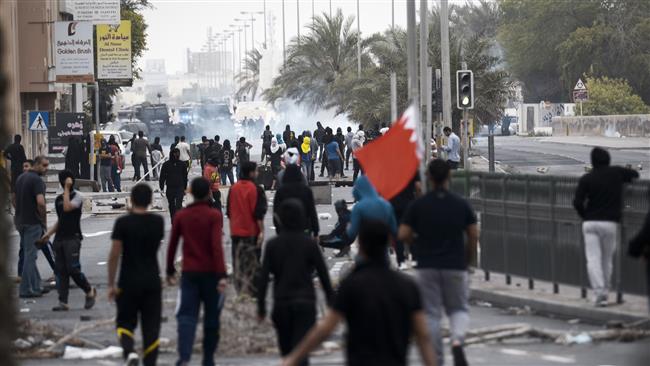
The fourth anniversary of the Bahraini revolution was marked by protestors staunching in the streets of Bahrain, despite the continuous brutal assaults by the security forces.
In 2011, with the uprisings going in the surroundings, Bahrainis, Sunni and Shia, marched to the Pearl roundabout, protesting against Hamad’s ruling. The authorities responded violently; many were killed, others injured. Mass arrests, detentions, trials, and ongoing torture became a norm.
In 2015, little has changed. The authorities banned demonstrations; however, the protests continued. The authorities have created an apartheid system, with the Shia being the targets of the ongoing repression and human rights violations.
On the fourth anniversary, the police fired tear gases and sound bombs, and used rubber bullets against the demonstrators who were holding Bahrain’s red and white flags calling for equality and the release of the main opposition leader Sheikh Ali Salman, who was arrested in December. The Secretary General of Al-Wefaq Movement, Sheikh Salman, urged the Bahraini people to continue their revolution. He told the Bahraini people through a message from Al-Khalifa prison that: “I feel tranquility and peacefulness flooding my heart thanks to Allah Al-Mighty… I felt humbled by your noble stance on my arrest. You made more than what is expected of you, and I am grateful for your perseverance.” He added that: “Don’t forget the rest of the detainees. Don’t forget our main demand of electing our government in a democratic and sound way, as well as electing the parliament that legislates decrees without the tutelage of a particular council, in periodic elections based on equality.”
The arrest of Sheikh Salman has re-ignited near-daily protests in the Shia areas. The protestors continue to claim their rights peacefully, using only demonstrations as their democratic weapon. On the other hand, the monarchy of Hamad Ibn Issa Al-Khalifa continues with its brutal torture against the Bahraini people, who are demanding democracy and social reform.
The Bahraini people are asking for a “real constitutional monarchy with an elected prime minister who is independent of the ruling royal family.” However, the royal family has refuted the demands. The Saudi royal family backs the Bahrain’s dynasty. The latter is using all of its power to aid the Bahrain’s royalty in attacking the opposition and thereby defending its existence. It is noteworthy that Saudi Arabia has been the defender and supporter of the “Arabs’ uprising” in the Middle East and North Africa, all except Bahrain and Yemen.
Major issues raised by the protestors included questioning the legitimacy of the political regime. They have been requesting the regime to give the Bahraini Shia the position they deserve as the major group in the country – so far, they are being treated like a minority. The previous uprisings in Egypt, Tunisia, and other Arab countries encouraged the Bahrainis to pour into the streets hoping that they would achieve their political and social rights. However, their legitimate demands are tied to a set of regional considerations, which rendered the present complications.
The Government has tried to continuously to silence the protestors using brute force. However, the perseverance of the Bahraini people rendered the government’s efforts fruitless. Recently, it has been trying to “draw a wedge among moderate Shia groups.” Since then, it was aiming for the following goals. First, it aimed to “create rifts” among the revolutionary groups and divide them. Second, it needed to but more time to prepare human rights reports that would “point an incriminating finger at the masterminds.” The final goal included showing the Bahraini movement if terrorist-affiliated. This was done by promoting Shiaphobia, Islamophobia, and Iranophobia. This policy was also followed in other Persian Gulf states supporting Al-Khalifa regime.
The Bahraini revolutionaries see that their goals cannot be achieved through official and legal channels. They have not sense any seriousness in the regime to interact with the Shia Muslims.
The Bahraini regime is very much mistaken if it believes that it can quench the wrath of the people by detaining protestors. The problems in Bahrain are far more deep-rooted to be solved through detaining a single person.










