













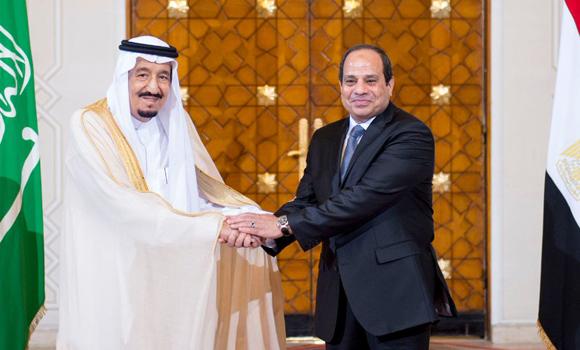


Alwaght- Saudi and Egyptian leaders are taking their countries’ ties to new heights. In a rare such incident, Saudi King Salman bin Abdulaziz paid Egypt a 3-day visit.
The red carpet was rolled out for King Salman as Egyptian President Abdul-fattah Sisi announced "Welcome to the historic visit of your second home" to the royal visitor.
The Saudis signed 17 cooperation agreements with the Egyptians, and pledged three to four million dollars for projects in the Sinai region. The agreements include a 16 $billion investment fund. However, the climax of the visit was marked by Cairo’s handing over the ownership of disputed Red Sea islands of Tiran and Sanafir to Saudi Arabia amid strong objections.
The Saudi King further announced revisiting an initiative to build a bridge between Egypt and Saudi Arabia, the first ever man-made connection between Asia and Africa.
Egypt’s Importance
But why has Riyadh suddenly taken an interest in reviving relations with Cairo, having taken a down turn following Hosni Mubarak’s ouster in 2011?
Egypt is the Arab world’s most populous nation. With a population of around 90 million, having the Egyptian authorities by one’s side counts for something and gaining public support further improves one’s image. By going after Egypt, the Saudi regime is trying to secure an Arab support base at a time when it is increasingly losing its status in the region.
In addition, Al-Azhar, has an effective role in the Islamic world, particularly among Sunnis. Exploiting the influence of the Islamic institution would allow the Saudis to export their own ideology and messages through the port of Al-Azhar. In fact, King Salman laid the foundation stone of Beouth Islamic City at the Al-Azhar University on Saturday. Observers see that funding the restoration of the university is part of a plan to exert powers on its leaders who in turn are expected to preach to the religious portion of society.
Geographically, Egypt’s Suez Canal connects the Mediterranean Sea to the Red Sea and separates the African continent from Asia. The bridge would connect the two continents through Saudi Arabia on the Asian side. This means that both countries will largely benefit economically from the route. Egypt, especially, is in dire of financial support need to boost its economy.
Last but not least, King Salman’s visit along with a large entourage spells the obvious. It is well know that the Saudi-led aggression on Yemen is failing to attain the set goals. Furthermore, Riyadh needs further military support in order to be able to continue the war. Earlier this year, Egypt’s national defense council extended its military's in Yemen for up to one year. But that does not mean that the Egyptian public is supportive of the war on Yemen or the Saudi funding of extremists to fuel the conflict in Syria. Even authorities are warily committed to their involvement in Yemen, meaning that they may retract sometime soon.
Yet, in light of these plots and decisive decisions it is the Saudis who seem most desperate for Egypt’s support rather than the other way around. This does not mean that Egypt is not in need of Saudi financial aid. Consequently, the Egyptian government has in numerous occasions accepted Al Saud’s aid but at the same time did not comply with all of its policies.