













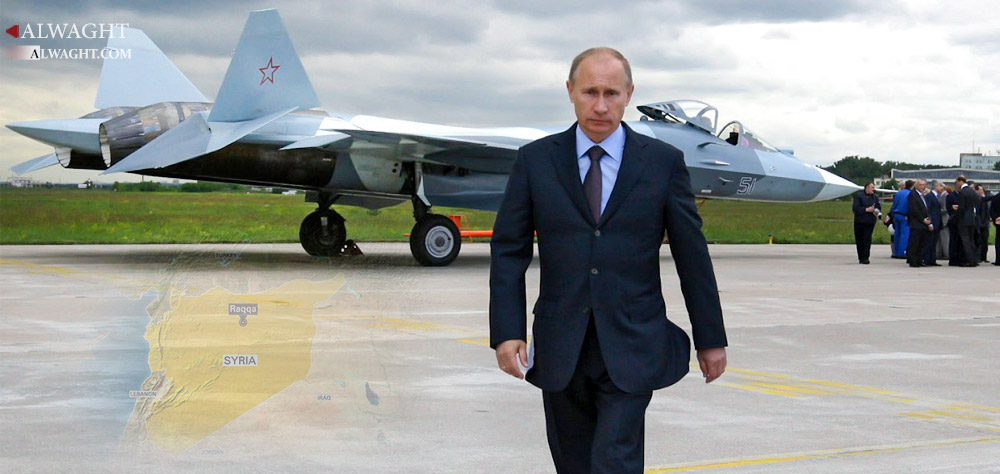


Alwaght- Russian airstrikes in Syria are the country's first post-Cold War military actions far from its borders. Russian involvement in Syria has had some benefits for Moscow. Russia has managed to direct the world attention from the issue of Ukraine to crisis in Syria. To publicize advanced military capabilities of Russia, to make use of the Russian leverage to exercise pressure on Damascus where it has to do with Iran, and to strengthen Russia's claim for having a major role in forming the future government in Syria, are among the positive consequences of Moscow’s involvement in crisis in Syria.
These results are not trivial ones, as the European powers and Washington have been negotiating with Moscow to end the Syrian crisis; however, neither side has changed its position towards Ukraine. We should note the fact that Russia can remove the world attention from Ukraine as long as it is successful in Syria. In fact, global and regional assessment of the reliability of Russian troops and weapons depends on the output of Moscow’s intervention in Syrian crisis.
As Russia proclaims, the most important goals of Moscow in its involvement in Syria are: to consolidate the central government in Syria, to restructure the Syrian troops, to disrupt the supply path of the terrorists from Turkey, Saudi Arabia and Qatar, to unite the allies and enemies of Assad against the ISIS terrorist group, to convince the European powers that their intervention in the West Asia would improve their security, and to convince the United States to negotiate with Bashar al-Assad. These goals are a combination of long-term and short-term plans some of which are being fulfilled.
However, the abilities of Moscow in shaping the future government of Syria might be uncertain, because the influence of Moscow on Damascus largely depends on what the Syrian leaders expect from Russia. On the other hand, Russia spends about 2.5 to 4 million dollars every day in its military operations in Syria. However, there is little evidence to suggest that these operations would politically continue to end the crisis, anyway the policies could be changed quickly. The Syrian army, backed by Russian air force has managed to expel the terrorists from Damascus and drive them to northern regions which are strategically of less importance. Nevertheless, it should be noted that Russia currently does not have enough facilities to size back Aleppo and al-Raqqa. Besides, several thousand troops are required for these operations, while Persian Gulf countries and Turkey help terrorists for anti-aircraft operations.
One of the worst incidents that happened for Moscow was the downing of the Russian fighter jet by Turkey. Apart from the fact that which party should be hold responsible, after years of determined efforts to develop ties with Turkey, Russia has almost cut off its relations with Turkey. Even much worse is the fact that Turkey is allied with the United States and has been developing its ties with Riyadh and NATO. This issue would complicate the Russian policy in Ukraine, the same as the West Asia in a way that Russian newspaper wrote that Riyadh and Ankara are developing their ties to affect the future of Syria, and get united against their common enemy, i.e., Syria.
Many politicians in Russia voiced their concern about the unity and convergence between Turkey and Saudi Arabia, but to mitigate these concerns, Putin gave up his previous policies to the extent that in a summit at the end of last year, he stressed that Turkey is the country which seeks hostility, but Russia does not consider Turkey as its enemy. Putin also noted the increased dialogue with Saudi Arabia. On the other hand, at the domestic level, 82 percent of the Russians are strongly or almost concerned about terrorism in Russia, and 3 percent believe that Moscow should stop military operations in Syria. From a broader perspective, Russia's involvement in Syrian crisis would call in to question the country's long-term attempts to pursue a policy based on partnership with all, and avoiding difficult decisions. Meanwhile, tensions between Iran and Saudi Arabia have made it difficult for Moscow to take stance without inclining towards one of the disputing parties.
Currently, the operations advance slowly, and those who were waiting for remarkable success, have probably been disappointed. In many aspects, the Russians have struck some blows to ISIS, for example, they have targeted many headquarters, lots of the equipment and ammunition and training bases of the ISIS terrorist group. The Russians launch airstrikes in support of the Syrian army which have led to small victories for both Russia and Syria.
Nevertheless, Russia and Syria have yet failed to find a way to stop the most important advantage of ISIS, i.e., the ability to recruit new troops in to Syria through Turkey or other countries. In the meantime, it is not clear whether the Russians can kill more terrorists than they come in to Syria! However, the Russians have provided the Syrian army with weapons to fight against terrorists with help of stronger artillery fire.
Over the last two weeks, no special events have happened. Meanwhile, the US-led coalition has not also achieved any remarkable results. At the same time, tensions between Saudi Arabia and Iran have made it difficult to achieve any tangible results. With regard to its domestic issues about the Kurds, Turkey has been facing growing tensions and does not provide a clear plan for Syria. Therefore, no news means good news for Russia, because Russia would be known as the major actor of this scene.
Although some analysts believe that Russia is likely to deploy ground troops in Syria, it cannot be counted on, as neither Russian officials have made mention of it nor the Russian army is organized for such long-term operations. In theory, it might be possible that Moscow would send troops in to Syria and back them by its Navy, but this is in contrast with the Russian military doctrine, and it would involve many risks. Therefore, constructive engagement of Moscow to reach a political agreement on the future of Syria can be life-saving for the country, as the attempts made by Moscow for the dialogue between the Syrian opposition and the central government suggest that Moscow is moving in this way.










