





The new king has set the succession line, but the kingdom's path remains uncertain.
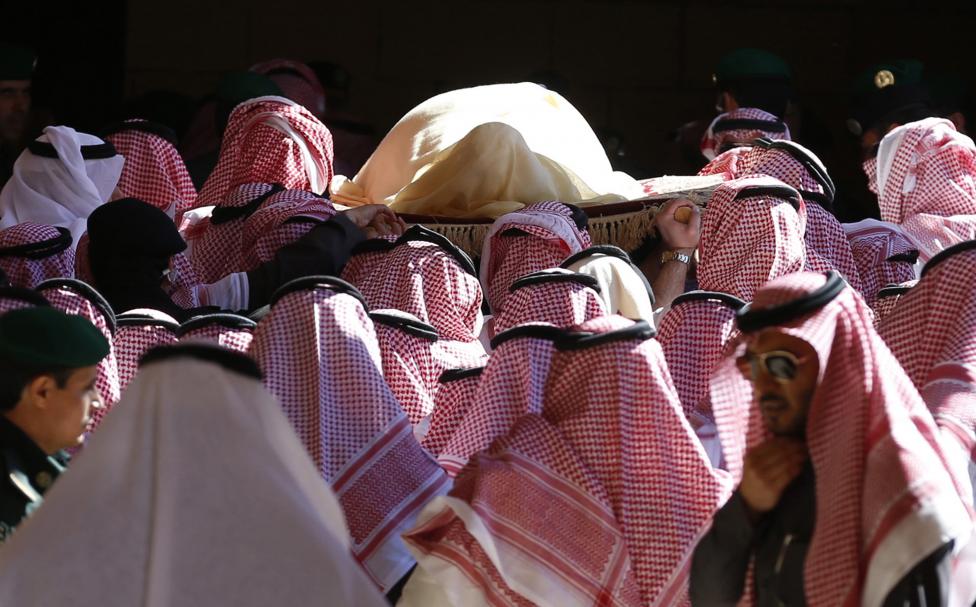
Saudi King Abdullah bin Abdulaziz has died at the age of 90 and his crown prince Salman has been declared the new monarch.
Abdullah became Saudi Arabia’s sixth king in August 2005 and was de facto ruler for almost a decade before that, after King Fahd was incapacitated by a stroke in 1996. His death is the third among senior members of the ruling family since 2011.
In a statement carried by the Saudi TV in the early hours of Friday, the Saudi Royal Court announced the death of King Abdullah.
It declared crown prince Salman bin Abdul Aziz as new king of the Persian Gulf country and prince Muqrin bin Abdulaziz as new crown prince.
Saudi Arabia's new King Salman on Friday named one of his sons as defense minister and his nephew as deputy crown prince, cementing power for his branch of the royal family.
The appointments of Prince Mohammed bin Salman as defense chief and Interior Minister Prince Mohammed bin Nayef as second in line to the throne coincided with Salman's first public remarks as king.
Prince Mohammed bin Nayef appointment as the new deputy crown prince helps to solidify control by the new king's Sudayri branch of the royal family, named after Hissa bint Ahmad al-Sudayri, the mother of Salman and his late brother Nayef.
Their influence had waned under King Abdullah (from the Shuvaim branch), who died early Friday at the age of about 90.
The 55-year-old son of Nayef, the grandson of the founder of Saudi Arabia, Abdulaziz ibn Saud, is the first of his generation to be placed in line for the throne.
No change in Saudi policies
Despite the new appointments, Salman pledged no change in the kingdom's direction.
Meanwhile, King Abdullah's successor and half-brother Salman has promised to follow in the footsteps of the late Saudi monarch.
"We will continue adhering to the correct policies which Saudi Arabia has followed since its establishment," Salman said in a televised speech on Friday.
Salman had been serving as defense minister since 2011 and was increasingly moving towards taking over from his predecessor, whose health was deteriorating.
No change in Saudi oil policy, but oil prices spike up 2%
The death of Abdullah has led to a spike in the oil price despite a swift indication that there would be no change in policy from the new Saudi leadership.
The announcement of King Abdullah's death created enough uncertainty about the future direction of Saudi policy to push up the oil price after several months of steady decline.
Brent crude futures rose to a high of $49.80 a barrel shortly after trading started today, before falling back to $49.20 by 3.15pm UK time. The $49.20 per barrel price is still a rise of 76 cents on yesterday. In the US, WTI crude futures rose as high as $47.76, before easing back down to $47.
Experts believe that the death of King Abdullah will not force any significant change in Saudi Arabia’s oil policy in short term. The Saudis have been pumping oil at high levels even as prices are dropping, a strategy that has further accelerated declines in crude prices.
"Things go downhill from here for us with King Abdullah's death. The next generation and others—while they talk a good game and a lot of happy talk toward the US and what they want—what they really want is a very sustainable oil price, a higher one than I think we would like and can benefit from, and will work to do that," said John Kilduff, founding partner of Again Capital.
Saudi Arabia is pursuing this high-production, low-price policy in order to "break the backs" of American oil producers, and possibly those in Iran and Russia, Kilduff said.
Challenges
The king's death is expected to fuel a power struggle within the ruling family.
The new monarch, who has suffered at least one stroke that has left him with limited movement on his left arm and is believed to be suffering from Alzheimer’s, is taking over at a time when King Abdullah’s demise is expected to fuel a power struggle within the ruling family.
His succeeding to the throne also coincides with the kingdom’s grappling with dissent in the east and the region’s attempting to deal with the repercussions of the terrorism funded and the extremism exported by Riyadh.
Riyadh is receiving great criticism for sending shockwaves throughout the international economy by allegedly fixing oil prices.
Riyadh, staunch supporter of Takfirism
The western leaders’ appreciation of the late Saudi King as a proponent of peace comes despite the fact that the oil-rich kingdom has played a major role in supporting extremism and terrorism in various countries, particularly Syria.
Under King Abdullah’s rule, Saudi Arabia gradually became an incubator for groups promoting extremism and Takfirism. Off-shoots of al-Qaeda also managed to expand their domain of influence in the Middle East and North Africa, with terrorist groups like ISIS committing heinous crimes against followers of other religious communities in Syria and Iraq.
Such support for sectarian violence has also been visible in countries like Pakistan, where thousands of Shiites have been killed in attacks and bombings that seem to be approved by elements inside the monarchy.
The Al Saud regime has also helped the Bahraini regime in its deadly crackdown on peaceful protesters and political activists since 2011.
The death of Saudi Arabia's King Abdullah has left US officials worried about an era of new uncertainty in already tense relations with a key partner in the Middle East.
US officials are concerned that the death of the king might affect issues that Washington and Riyadh have been trying to address together including policy towards Iran, Iraq and Syria, according to The Wall Street Journal .
‘More cautious decision-making’ on Iran and Syria
Dennis Ross, a long-time Middle East diplomat with close ties to the Saudi royal family, told The Journal that the transition period might reduce the kingdom’s ability to move decisively on difficult issues.
Ross said the death of King Abdullah, coupled with this week’s collapse of the US-backed government in Yemen, presented a "worst-case scenario" because it would further strengthen Iran’s position as a major player in the region.
“I think you get more cautious decision-making” on Iran and Syria, Ross said.
The US-Saudi alliance was already strained during Abdullah’s reign over an array of issues, chief among them a failure by Obama to strike Syria in 2013, as well as negotiations with Iran over its nuclear energy program.
Saudi officials have viewed the nuclear talks with Tehran as a sign that the White House was willing to work behind King Abdullah’s back.
US officials are worried that King Salman, who is not considered by many as a strong or healthy leader, might not be able to quickly consolidate power.
Salman, 79 years old, takes over as the ultimate authority in a country that faces long-term domestic challenges compounded by the plunging price of oil in recent months and the rise of the ISIS terrorist group in Iraq and Syria, which vows to topple the Al Saud ruling family.
Muqrin bin Abdulaziz, current crown prince, is not viewed as a potential king in future due to not having any external or internal support.
He is not a real prince; his mother was a slave and there are other brothers who are more competent,” said a former Saudi official last year. “Nobody believes Muqrin can become king.”
All Saudi kings since Abdulaziz's death in 1953 have been his sons and the need to move to the next generation had earlier raised the prospect of a palace power struggle, where hundreds of princes are jostling for power.
The rapidity of the decisions startled Saudis, used to a delay of up to several months before top appointments following the deaths of their monarchs.
"Times are dangerous," said Joseph Kechichian, a scholar of Persian Gulf Arab ruling families. "Mohammed bin Nayef's appointment shows Salman feels it's important to speak quickly with a single determined voice in the face of all these threats."
A current Saudi monarch may find foreign policy the easy part of the job. At home problems are pressing and less attended to. Liberals rail against the slow pace of reform in a country where the constitution is Wahhabist and women are still banned from driving. The Shiite population in the country’s east, who make up at least 15% of Saudis, are still persecuted.
In the long term Saudi rulers have to manage the needs of a rapidly growing population of 30 million plagued by structural unemployment, and an economy that remains overly dependent on oil revenue and undermined by lavish subsidies.