








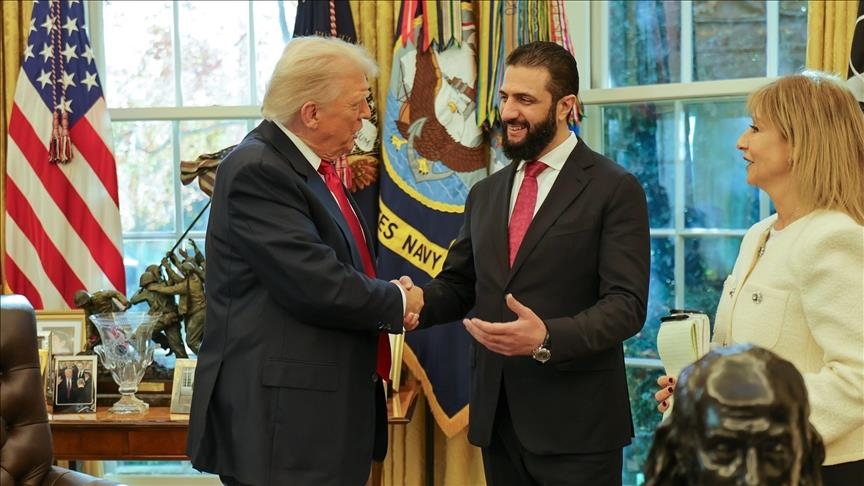


Alwaght- The death of three American forces in Syria’s Palmyra attack has once again drawn the attention to the relations of the Trump administration and the new Syrian government. Since fall of Bashar al-Assad in last December, this is the first American military toll in the Arab country.
Trump has attributed the attack to ISIS terrorist group and vowed revenge. But this claim very soon was contradicted as the spokesperson to the Syrian government told the Syrian television that the armed man who opened fire at the American forces and a civilian interpreter was a member of the new Syrian security forces.
According to the Syrian interior ministry, the armed man infiltrated into a meeting of Syrians and an American delegation. It is yet unclear how this man made his way to the meeting in the military headquarters as some sources claim the shooting took place outside the building and the armed man could not infiltrate the building.
Furthermore, the Americans have not commented on the nature of the meeting with the Syrians. Arab and Western countries, including the US, have supported the government of Interim Syrian President Ahmad al-Sharaa, but recurrent tensions in Syria raise questions about al-Sharaa’s capability to control the security situation in the country.
Americans doubtful of al-Sharaa
Even well before the recent shooting that killed three US troops, Western analysts held no positive or hopeful view of the West’s and Washington’s relationship with al-Sharaa, a former al-Qaeda member better known by his nom de guerre Abu Mohammad al-Jolani
In an interview with CNBC News, Sajjan Gohel, Director of International Security at the Asia Pacific Foundation, stated: “We live in a very unusual world, where suddenly individuals who until very recently made no secret of their hatred for the West, particularly America, are now being embraced as potential allies and partners.”
Some experts note that although al-Shara has tried to present his regime as supportive of women’s rights and to project an image palatable to the West, a closer look at the people Jolani has appointed to key strategic positions in Syria, and their ideologies, has cast doubt on any real transformation by al-Sharaa and Syria’s new ruling body.
Possible formation of Salafi government in Syria
Even the prospect of a secular government in Syria faces skepticism among American analysts. Michael Shankir, an expert at the Foundation for Defense of Democracies, warns that the stakes for the US in Syria are dangerously high. Should al-Sharaa succeed in stabilizing Syria, the outcome could be favorable. Failure, however, could see Syria re-emerge as a major security threat. If events turn sour, he cautions, the path could be cleared for an extreme Sunni government to take root in the heart of the Levant.
Complicating the picture are Syria’s still-overcrowded prisons, holding tens of thousands of former ISIS fighters. While the US and Europe prefer the new Syrian regime to detain these individuals within its borders, a significant risk remains. Hardline elements among the prisoners could morph into a major internal security threat, further destabilizing Damascus and even attempting to reignite an ISIS-style insurgency from within the prison walls.
Furthermore, after a year in power, the new Syrian government still does not fully control all territories. This persistent instability raises the alarming likelihood of terror enclaves and cantons re-forming across the country. From this perspective, a US and Western alignment with the current Damascus regime may ultimately generate more threats than it mitigates.
Echoing these concerns, David Schenker, a senior fellow at The Washington Institute and former US Assistant Secretary of State for Near Eastern Affairs under the Trump administration, points to the regime’s ideology as the most troubling long-term consequence. A Salafist government at the heart of the Levant, he argues, would undoubtedly embolden its ideological sympathizers across the region. Significant fears already exist about the potential spillover of this extremist ideology into Jordan, Iraq, and Egypt. Worse still, he warns, Syria risks becoming a renewed hub for Salafist hardliners, especially as there remains no discernible effort by the regime to hold its own extremist elements to account.
Incomplete control of Syria
It should be taken into consideration that the true capability of the Syrian government to take full control of the country after a year remains limited. The new regime controls roughly 50-60 percent of the country, including the Damascus-Homs-Hama-Aleppo urban corridor and a majority of the big cities.
In major cities under its control, al-Sharaa’s government administers a relatively comprehensive network of state institutions, security apparatuses, tax collection, educational systems, and medical services. However, in Syria’s peripheral regions, from the eastern desert and northeast to the southern areas, the central government’s control is minimal. Here, local militias, tribal groups, and rival Salafist factions have successfully expanded their power and recruited new members over the past year, sounding a stark warning for Syria’s future.
A report by the US Institute for National Strategic Studies indicates that ISIS operates in Syria through terrorist and guerrilla tactics, relying on small, dispersed cells. The group’s activities are primarily concentrated in the Syrian desert, around Raqqa and Deir ez-Zor, and have recently expanded into Damascus and Idlib. While the terrorist group currently controls no territory, the vast ungoverned or weakly governed spaces within Syria preserve its potential to resurge. Meanwhile, recent data points to increased ISIS activity in the Hama, Homs, Aleppo, and Idlib regions. Though its activity rates are lower than the past, they indicate a consistent capacity of the terrorist group to upset the stability and undermine the new regime in Syria. This situation gives the West reason not to fully trust the government of al-Sharaa.