







Alwaght- In exploring the most important issues of the international relations, matching the developments with dominant international order and cultivating an understanding of the influence of the interests and competition of the world powers in the course of developments is significant. Without this understanding, in fact, developing a correct historical analysis is impossible. For example, the decades-long US hostilities to Cuba should be analyzed with regard to world's bipolar atmosphere and the Cold War.
This significant aspect with great influence on the international developments is even more tangible as the post-Cold War unipolar world order is declining and the big powers are competing for bigger political and economic sway on the global stage. So, as another example, if we accept that US hostilities to Iran mostly stems from a conflict of policies in the region, anti-Iranian lobbying by the pro-Israeli circles, Saudi-led anti-Tehran propaganda against Iran, the US-China confrontation's role in increased pressure on Iran cannot be ignored.
Over the years of the Cold War, the US offered to China special economic privileges to lure it away from Soviet Russia, and even more, to sow division and competition between them for the final aim of undermining the leader of the rival Eastern Bloc. But two decades after the fall of the Soviet Union, Washington was appalled at the fact the Chinese economy is thriving and posing a direct threat to the US global hegemony. Local advantages helped Beijing leaders attract the Western investors, something put China among the world economic powers. The Chinese rise has obsessed American leaders. Former US President Barack Obama prioritized countering China as a top White House policy. He called the 21st century the century of Asia, signaling the significance of the continent in the eyes of the American strategists and policymakers.
The former US president resorted to a set of tricks to check China, like signing the Asia-Pacific trade agreement and helping India to rise in the face of China. Not only they did not work for the American administration but also Beijing became one of the giant investors in the Indian economy. 33.7 percent of the foreign investment in the Indian economy belongs to the Chinese.
When Trump assumed the power in early 2017, he continued what his predecessor started. The Trump administration even went beyond the set lines, and waged a trade war against China in a bid to obstruct the economic thrive of the Asian heavyweight. The successful Chinese economic performance and policies have yielded increased national wealth and thus increase in political and military strength. As of now, the Trump’s anti-China war, which is at the same time directed against other powers like Europe and even neighboring Canada, does not look effective in slowing the Chinese growth. But a change has happened over the past few years. While the US began to produce shale oil and turned into the world’s biggest oil producer not relied on the West Asian oil, China became the world’s biggest oil consumer which needs to secure the oil flow from the region, mainly from Iran as a current and prospective key supplier, to guarantee sustainable economic growth. Aware of this Chinese strategic reliance, the US president is seeking to cut the Iranian oil exports to China to deal a blow to the Asian giant’s economy. To restrict the Chinese access to the energy resources, the US even intensified its naval presence in the East China Sea, where Beijing is at odds with other coastal countries over the oil and gas reserves in the disputed sea.
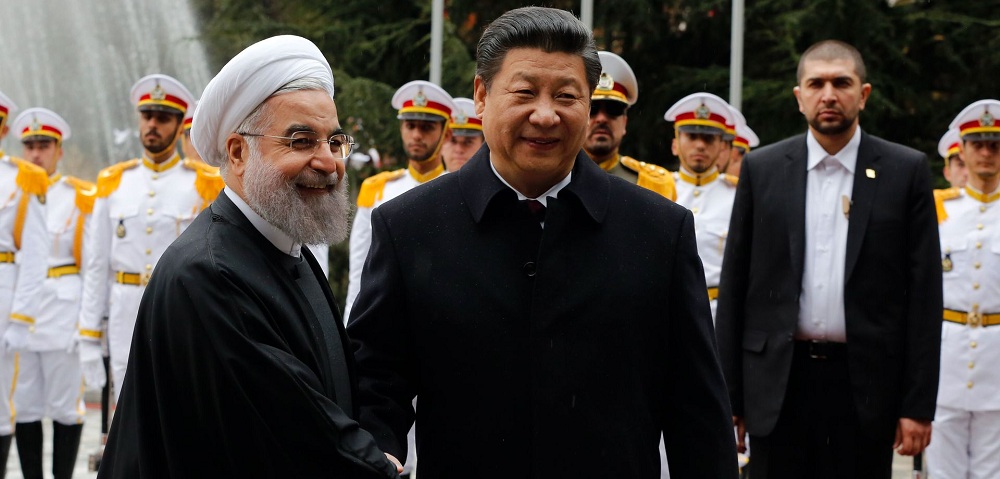
China has responded not only by reciprocal measures in trade including imposing tariffs on the American products but also by offering to the Islamic Republic surefire guarantees for continued trade ties with Tehran.
Here there is a question, however. Why does China risk being sanctioned by the US but does not replace Iran’s oil with that of Russia as an ally?
To answer the question, it must be said that Trump’s attempts to cozy up with the Russian President Vladimir Putin despite the home opposition echoes Washington’s economic privileges to Beijing to move away from Moscow during the Cold War. This becomes even more serious if we take into consideration the potentials for a rivalry between the Eastern powers. On the other side, Beijing has its own reasons to take such a risk: It opposes the Trump US unilateralism to exhibit itself as a responsible actor attempting to protect the global economy’s stability. Moreover, it tends to save Iran as a regional power and a reliable ally in the strategic West Asia despite Washington’s struggle to eject Tehran at any expense from the circle threats against American hegemony.
In accordance with this policy, the Chinese foreign ministry has announced that Beijing will not be committed to the anti-Iranian embargo. Earlier this month, the US asked China to cut Iran oil imports. China in response said that cooperation with Iran was “transparent, logical, fair, and legal” and did not violate any of the United Nations Security Council’s resolutions.
While the Western insurance companies have said they will cut cooperation with Tehran once the US sanctions are re-imposed, two Chinese oil giants, Hangzhou Genrong and Sinopec, have recently added a new article to their contract with the National Iranian Oil Company that will allow them to use the Iranian ships to carry oil to China.
The ongoing threats to impose sanctions on any party doing business with Iran, like those made by Iran Action Group’s head in response to the Chinese reaction to bow to the American pressures in relation to Iran, all are expressive of Washington’s transregional view of anti-Iranian sanctions and pressures.