












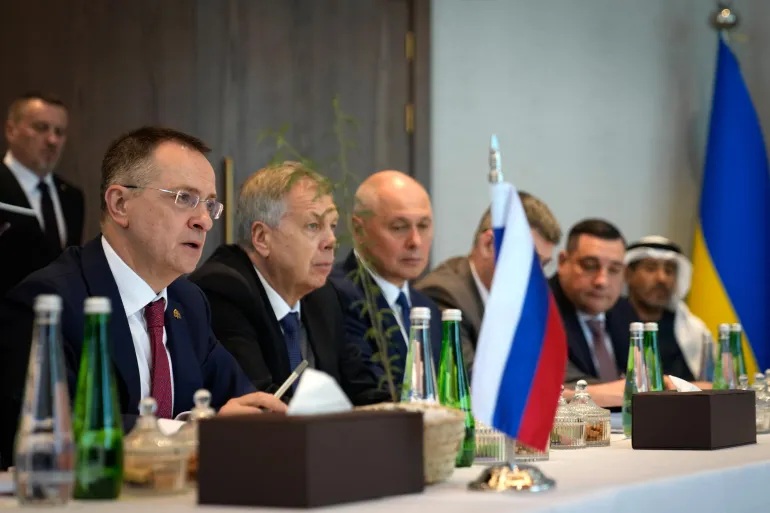


Alwaght- After months of failure by international mediators, top of them the US, to push Russia and Ukraine toward de-escalation and a return to the negotiating table, a new round of trilateral talks finally convened in Abu Dhabi.
The talks opened against a backdrop of months in which the flames of war surged across the front lines, with both sides placing economic infrastructure, energy in particular, at the top of their military target lists and the prospect of agreeing to negotiations badly dimmed. Yet White House pressure on Ukraine, Witkoff's repeated trips to Moscow and Trump's direct consultations with Putin ultimately brought both sides to soften and return to the table.
The two-day gathering marks the first round of direct trilateral negotiations since February, and it opened with fundamental disputes between Moscow and Kiev still unresolved, core disagreements over Russian-controlled territories, the future of Ukraine's NATO membership and the Western military presence in the country.
On the first day, Ukraine's President Volodymer Zelensky offered a positive assessment of the talks, calling them "constructive and thoroughly substantive." The Ukrainian president said the first half of the negotiations covered humanitarian issues and security guarantees. He also described the meeting as "a special moment", though no sign of a concrete agreement or decisive progress on the main files of contention between the two countries has yet emerged.
Jared Kushner, Trump's son-in-law and a central figure on the US diplomatic team, stressed in his opening remarks the need to establish a new framework for achieving peace. Pointing to the failures of past efforts, he said the American side was seeking to examine the factors that led to the current situation and, drawing on past lessons, to design a fresh framework for a durable peace.
Medinsky, head of the Russian delegation, likewise expressed hope that the talks could advance toward a peace benefiting the people of Russia and Ukraine.
Territorial dispute, the main obstacle to peace
Despite the relatively positive atmosphere Zelensky described from the first day of talks, the two sides' fundamental disputes remain entrenched, with the territorial question sitting at the very top.
Russia has seized 20 percent of what was formerly Ukrainian territory in the war. Moscow now demands that Ukrainian forces withdraw from parts of the Donetsk, Luhansk, Zaporizhzhia and Kherson regions still under Kiev's control. Moscow regards these areas as its own territory on the basis of 2022 referendums, while Ukraine refuses to recognize the annexations and insists on preserving its territorial integrity.
Amid this, one option Ukraine has floated is a halt to hostilities along the current lines of contact, a proposal that could lay the groundwork for political negotiations on more complex issues without amounting to formal acceptance of changed borders or a renunciation of Kiev's territorial claims.
Yet, even on the principle and mechanics of a ceasefire, there is no agreement. Ukraine argues that military hostilities must stop first to make room for negotiations on political and security matters. Russia, by contrast, is skeptical of a ceasefire without a comprehensive agreement, believing a temporary halt to the war could give Ukraine the opportunity to rebuild and strengthen its military capacity. The question of how a ceasefire would be monitored and how the parties' compliance would be guaranteed has thus become yet another point of contention.
Security guarantees and future of NATO: Another sticking point to negotiations
Another key issue is the future security arrangements for Ukraine and the kind of guarantees to be provided should a peace deal be reached.
Kiev is demanding binding commitments from Western countries so that an effective, deterrent response is possible if Russia resumes military operations. Ukrainian officials have repeatedly called for guarantees akin to Article 5 of the NATO treaty, the clause that treats an armed attack on one member as an attack on all.
Moscow, for its part, argues that any security arrangements must not focus solely on Ukraine's security but must also take into account Russia's security concerns and the broader European security architecture. In this framework, the question of Ukraine's potential NATO membership remains one of the central points of contention. Russia demands that Kiev abandon this prospect, but Ukraine regards it as part of its sovereign right to choose its foreign and security policy path.
The question of Western military forces deploying to Ukrainian soil after the war has added further complexity to the negotiations. Some European countries have raised this option as part of a security-guarantee mechanism and a means of preventing a recurrence of conflict, but Russia is fiercely opposed and has warned that it will treat Western military forces stationed in Ukraine as legitimate military targets. Kiev, in turn, sees such a presence, absent NATO membership, as an additional layer of protection.
Europe-Washinton dispute over playing role in peace process
Another notable dimension of the Abu Dhabi talks is the disagreement over Europe's place in the push for a deal.
The European Union and the Council of Europe dispatched a joint delegation of senior officials to Abu Dhabi, accompanied by representatives from France, Germany and Britain. Before the main negotiations began, Ukrainian representatives met separately with European, NATO and EU officials, but the Europeans wanted a direct role in the talks, not merely observer status. European countries stress that they must be party to any agreement that determines the continent's security future. To that end, France had emphasized before the summit that a durable peace in Ukraine is impossible without addressing European security, and that European countries must be part of the process.
Yet, the Abu Dhabi meeting went ahead with the European demand conspicuously absent, confined to three parties: Russia, Ukraine and the United States. The outcome once again laid bare the widening divergence between European and American perspectives in the Trump era on international affairs, particularly the Ukraine conflict.
Russia had earlier declared its opposition to European participation in direct talks with the Russian and Ukrainian delegations. The Kremlin insists the Abu Dhabi meeting is trilateral in nature.
Energy, Black Sea, and Humanitarian matters on agenda
Alongside the political and military disputes, economic and humanitarian issues are another major axis of the negotiations. Prisoner-of-war exchanges, the return of civilians and the protection of Ukraine's critical infrastructure are among the items Kiev insists on pursuing.
With winter approaching, protecting energy facilities and preventing attacks on power infrastructure and other vital centers has taken on greater urgency. Ukraine is also calling for the restoration of safe navigation in the Black Sea and guaranteed, uninterrupted access to maritime trade routes, especially for its agricultural exports. That issue matters not only to the two sides' economic interests but also to African and Asian countries dependent on Russian and Ukrainian grain exports.
The future of Western sanctions on Russia is another potential economic dimension of the talks. Moscow wants the economic restrictions imposed by the US and its allies lifted or eased, while Washington and European capitals still see sanctions as a tool for pressuring Russia. So far, however, no concrete agreement on lifting sanctions has been announced as part of the Abu Dhabi talks' results.
Dim outlook of peace deal
In general, the resumption of direct Russia-Ukraine talks mediated by the United States can be read as a sign of renewed movement on the diplomatic track toward ending the war, but the gap between the two sides on fundamental issues remains considerable. Disagreement over Russian-controlled territories, the future of Ukraine's NATO membership, security guarantees, the presence of foreign forces and even the mechanics of a ceasefire together form a wall of obstacles to a comprehensive deal.
Analysts, mindful of the record of previous rounds and the persistence of the disputes, are doubtful that tangible progress will come quickly in Abu Dhabi. While Donald Trump has recently spoken of Russia and Ukraine being close to an agreement, the positions the two sides have staked out make clear that any such deal would require difficult political and security compromises.
From this view point, the Abu Dhabi meeting is better assessed not as an immediate step toward a final peace agreement but as part of Washington's effort to manage tensions in energy markets by limiting Ukrainian strikes on Russian oil and refining infrastructure.
The energy crisis and fuel and commodity inflation in the US market brought on by the war with Iran cost the Republicans and Trump a heavy defeat in the congressional midterm elections, despite every expedient, including buying diesel from Moscow. That defeat has sharpened the prospect of crisis and infighting within Trump's cabinet, as well as confrontation between the new Congress and White House policies, particularly on the Iran war and the Ukraine war. Trump, it seems, needed this photo-op of diplomats' staged smiles more than Zelensky, Putin or the Europeans did.