














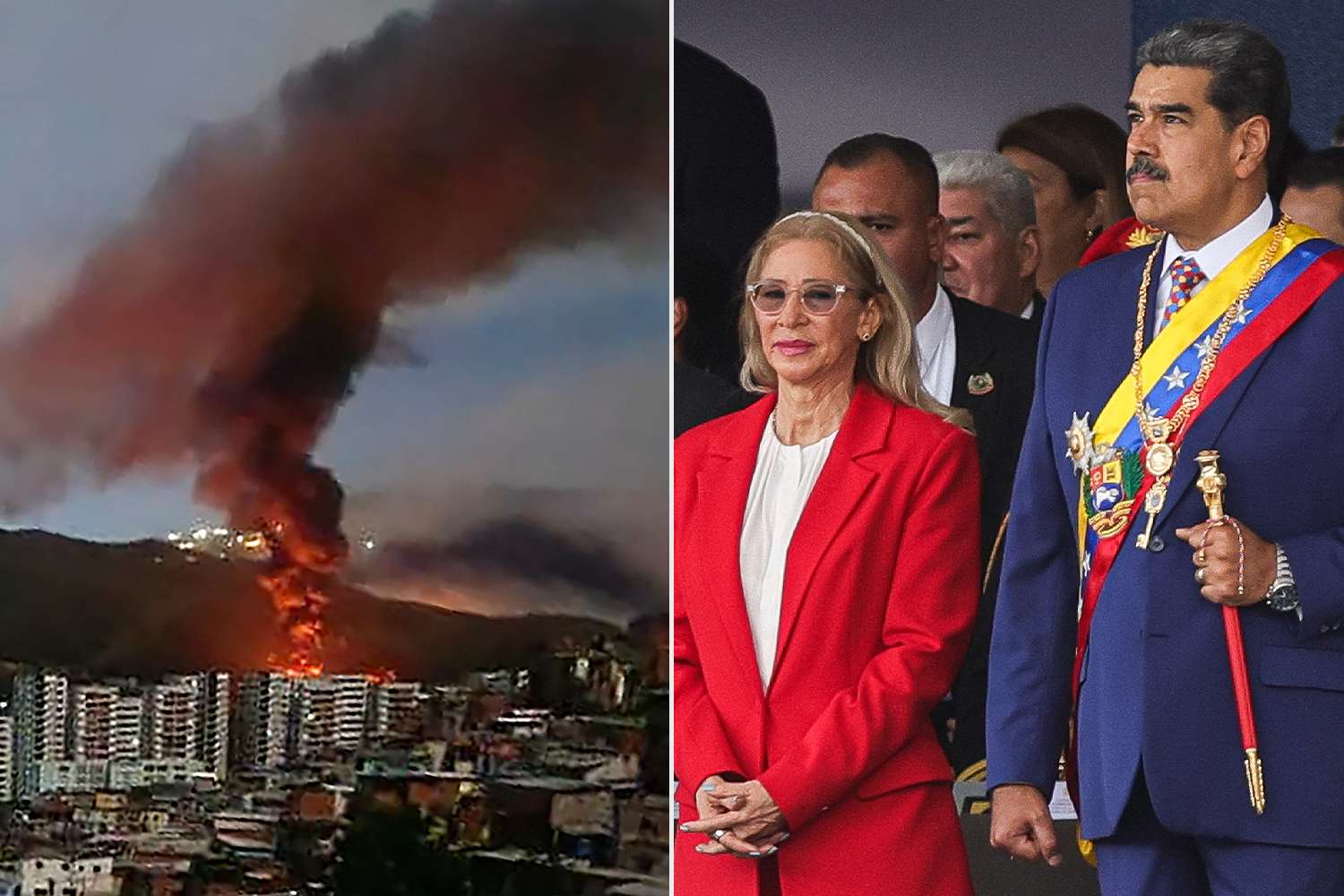


Alwaght- Finally, the predictions that the US naval blockade of Venezuela, purportedly for counternarcotics operations, could escalate into direct military action have now materialized. The US military launched strikes against targets inside the country.
On Saturday, residents of Caracas reported multiple explosions and sightings of low-flying aircraft over the capital.
Video footage showed attacks targeting an airport and an airbase. Explosions and smoke have been reported across the capital, with power outages affecting parts of the city.
The Financial Times reports that at least five large Chinook helicopters took part in the operation. There have been no confirmed reports of surface-to-air missile fire or engagements with US aircraft so far.
Since explosions were heard in Caracas, police have been patrolling the streets, but there were no reports of critical security conditions or things slipping going out of control of the government.
The government, accusing the US of attacking civilian and military facilities, issued a call for people to take to the streets.
"The Bolivarin government calls on a political and social forces to activate mobilization plans and condemn this imperialist attack," the statement read.
The statement said Maduro ordered the full implementation of all national defense plans" and declared a "foreign emergency."
On the other hand, The New York Times, citing its own sources, reported that government forces remain in control of the airbase attacked by the US It wrote that since dawn, several armed men in civilian clothing have been seen guarding the Generalissimo Francisco de Miranda Airbase on the outskirts of Caracas.
Meanwhile, Chevron, the US oil giant operating in Venezuela, stated on Saturday morning that it continues its activities, adding: " Chevron remains focused on the safety and wellbeing of our employees, as well as the integrity of our assets."
Trump's statement about abduction of Maduro
In a post on his Truth Social platform, US President Donald Trump announced that Venezuelan President Nicolás Maduro and his wife have been "captured and flown out of the country."
The Trump administration had earlier accused Maduro of drug trafficking, with the State Department labeling him the head of a "narco-terrorist" government, a move analysts saw as laying the groundwork for potential military intervention. These accusations first surfaced in 2020 during Trump's first term, when the White House unsealed an indictment charging Maduro with leading a narcoterrorist conspiracy.
The US military has been conducting interdiction operations against vessels in the Caribbean and Eastern Pacific since early September. According to statistics released by the Trump administration, as of Friday, these operations have included 35 vessel interceptions resulting in at least 115 fatalities.
To date, no international bodies, including the UN, have published reports confirming Caracas or Maduro's government as playing an organized role in drug trafficking.
Maduro was last seen publicly on television this Friday during a meeting with a delegation of Chinese officials in Caracas.
Maduro's capture by the US forces comes just two days after he expressed a willingness to negotiate with Washington in an interview with a Spanish media outlet, stating Venezuela desires peace.
"The American people should know they have a friendly, peace-loving people and a friendly government here," Maduro said, delivering part of his message in English. "They should know our message is very clear: 'No to war. Yes to peace.'"
Interior Minister of Venezuela Diosdado Cabello Rondón appeared on television urging calm and asking Venezuelans to trust their leadership. "Do not let anyone be disheartened. Do not let anyone make things easier for the invading enemy," he stated.
Footage from Caracas shows public anxiety, but no signs yet of a collapse in public order or a rupture within the power structure, factors that could complicate Washington's calculations for escalating operations.
Venezuelan arny: We will resist
After the US attacks over past hours, all eyes are now on the reaction of the Venezuelan armed forces. The defense ministry published a statement saying: "All units of the army, Bolivarin Guard, and public defense forces are on high alert. Defense Minister Vladimir Padrino López said that Venezuela "will prevail … not negotiate … not give up."
Initial evidence suggests that the US attacks were predominantly limited, targeted, and focused to causing psychological shock, and the US military has not yet engaged in full-scale ground clashes.
Other Latin American countries next? Cuba can be next in line
Beyond Venezuela, many regional observers say that attack on Caracas is not the end. Rather, it is part of a broader strategy Washington intends to pursue to redefine security order in Latin America. Since its return to power, Trump administration has several times highlighted the need for clearing Western Hemisphereof anti-American governments, calling Venezuela the "main ring of destabilization chain."
Within this framework, Cuba, as Caracas's longstanding ally and an icon of resistance to Washington in Latin America, has once again come into focus as a potential target. The US media outlets aligned with Republican circles have recently published reports alleging Havana's role in providing intelligence and security support to the Maduro government, claims that could pave the way for new pressures, broader sanctions, or even direct security measures against Cuba.
Beyond Cuba, countries like Nicaragua and even Bolivia are watching developments in Venezuela with concern. Many Latin American governments, including those with close ties to Washington, have expressed alarm at the overt return of the US military option to the region. Such a trend risks reviving memories of 20th-century direct interventions and could trigger a wave of political and social instability across the region.
Internationally, reactions have been meaningful. Top on the list was Russia that has strongly condemned the US attack and called for an urgent UN Security Council meeting.
In general, regardless of Maduro's fate, the US aggression can usher in a new period of geopolitical tensions in the Western Hemisphere; a period in which Latin America once again will take a center stage in the competition of great powers. So, risk of Caracas experience spreading to other capitals in the region now looks more serious than ever.










