







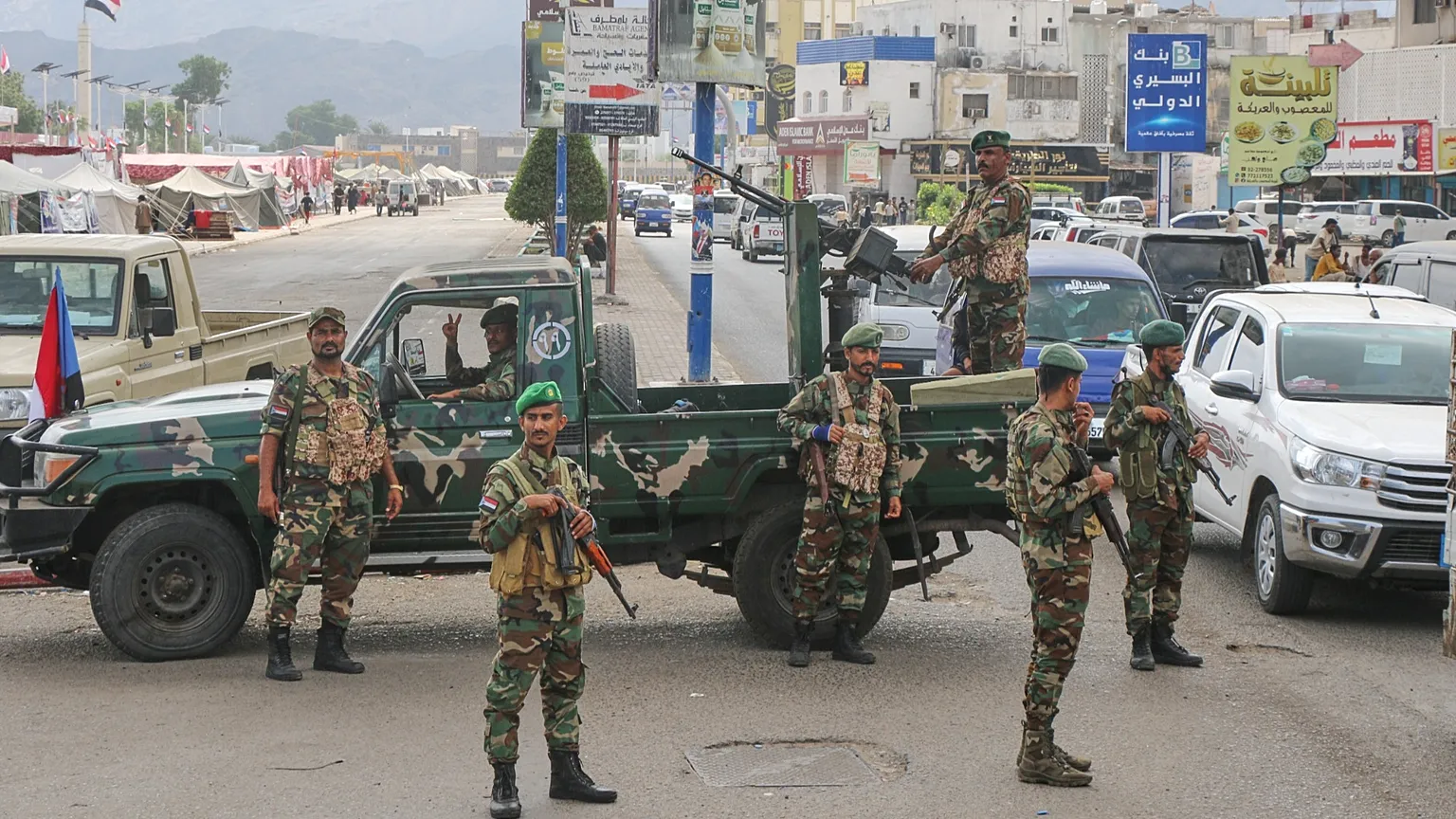


Alwaght- Southern Yemen has been on the brink of major upheaval in recent weeks, as the intricate dynamics of power in the region continue to shift. At the outset of the latest developments, the UAE-backed Southern Transitional Council (STC) forces appeared to be gaining the upper hand. They advanced through the southern province of Hadhramaut and Al-Mahrah in eastern Yemen, pushing out forces loyal to the Saudi-backed Presidential Leadership Council (PLC) and positioning themselves to dominate the unfolding situation in the south. But the balance of power has flipped once again. Saudi Arabia has intervened militarily, deploying forces to back the National Shield militias loyal to Riyadh and the PLC. This decisive move has reshuffled the equations, casting the already volatile region into a new state of uncertainty and ambiguity.
In this connection, Rashad al-Alimi, the PLC president, on Sunday announced that the National Shield Forces have secured an "exceptional success" restoring their military and security positions in Hadhramaut. This included retaking of the city's international airport.
"Arrangements are underway [for the STC] to hand over the bases and state institutions in Al-Mahrah province to the National Shield Forces," he further stated.
This comes while General Barjash, the commander of Al-Mahrah's Second Military Region, who in support of the STC has recently said that he will not cede al-Mahrah positions to the National Shield, seems to have failed to resist waves of attacks by Saudi Arabia and its loyalists on the ground and finally withdrew his positions.
Al-Alimi has called on the secessionist STC to "remain committed to the dialogue track and retract its unilateral actions."
This demand comes as forces loyal to the Saudi-backed council scored a significant military victory. On Friday, the National Shield forces seized the strategic city of Seiyun, the administrative capital of Hadhramaut province, which had been under the control of the UAE-backed STC. The capture forced STC fighters to retreat toward the coastal areas.
The fall of Seiyun, a key political and military hub in eastern Yemen, marks a major shift in the balance of power and is likely to impact the broader political and security landscape of southern Yemen.
The Saudi-aligned advance was enabled by intensive airstrikes from the Saudi air force, which targeted STC positions and paved the way for the ground offensive.
The advance follows last week's announcement by the Abu Dhabi that it had withdrawn its military officers from southern Yemen. The move effectively created a power vacuum, allowing its regional rival, Riyadh, to reassert its influence in areas where it had lost ground. Saudi Arabia is concerned about the UAE gaining the upper hand in these Yemeni parts and due to their competitions, it tries to block Abu Dhabi’s ambitions.
In 2019, the UAE announced it ended its military presence in Yemen, but the field evidence suggests that this withdraw was more of a show than a reality. In the following years, Emirates maintained its influence in Yemen through far-reaching support to the aligned groups, especially STC separatists. The backing included training, arming, providing intelligence, abd even directly running some bases and ports.
The military moves by the STC in Hadhramaut and Al-Mahrah that led to their capture showed that the Emirati influence project is still active and has even grown more aggressive, something raising serious concerns at regional levels, especially for Saudi Arabia.
Holding Riyadh conference
Given the deteriorating conditions in the south and to steer clear of further escalations that could complicate the situation, the two warring sides have agreed to hold a conference for a political solution.
Al-Alimi has called on Saudi Arabia to host a comprehensive meeting gathering together all southern groups and figures, including the STC. Welcoming the proposal, the Saudi foreign ministry said that all southern groups should actively engage in this conference in search of a fair and legitimate solution in order to realize demands of the southerners.
The Saudi authorities are acutely aware that the Riyadh conference will yield no tangible results without the participation of the STC. Nevertheless, the STC's response to the proposal for this conference has been decidedly ambivalent. On one hand, the separatist group has expressed readiness to engage in this diplomatic initiative, stating: "We welcome Saudi Arabia's invitation to support and host a dialogue concerning southern Yemen." On the other hand, the rhetoric of the group’s key leaders radiates profound distrust and a clear reluctance to share power.
In this context, STC’s Vice President Ahmed Saeed bin Brik called on the people of Hadhramaut to mobilize against a "potential invasion by northern forces."
Simultaneously, Aidarous al-Zubaidi, President of the STC, announced the commencement of a two-year transitional period that will culminate in a referendum for southern independence. He called upon the international community to guarantee this process through comprehensive political oversight and participation. He emphasized that this action, as a legal declaration, would be implemented immediately, provided the stipulated conditions are met.
The separatist body went further by officially publishing the constitutional declaration for the so-called "State of Southern Arabia" on January 2. According to the provisions of this declaration, the so-called State of Southern Arabia is introduced as an independent country with full sovereignty, with the city of Aden designated as its capital. The STC emphasized in this document that this state would possess all the authorities and attributes of an independent nation.
The STC's pursuit of independence for southern Yemen comes as Saudi Arabia strongly opposes such a move. From Riyadh's perspective, the UAE and its southern allies are attempting to strengthen their own position by fragmenting splitting Yemen and gaining control over the south's oil and gas resources. This strategy is even seen as paving the way for consolidating the presence of the Israeli regime in these areas, a development considered a serious threat to Saudi interests in the Red Sea.
Riyadh is concerned that Israeli presence in southern Yemen and the Red Sea would escalate tensions in the region. The Ansarullah movement in Sana'a, which has been holding the north since 2014 following a popular revolution against dictator Ali Abdullah Saleh, is wholly intolerant of any encroachment by any occupation forces and this issue could lead to widespread conflict, severely endangering the security of Saudi Arabia's borders.
Furthermore, the proposal for Riyadh conference comes as earlier meetings for a solution and deescalation of tensions between the Saudi Arabia and UAE, and their proxies, have yielded no tangible results. The Emiratis refused to respect their promises they made in previous meetings and this makes a final solution to secure peace in southern Yemen a tough path.
Abu Dhabi uninterested in am escalation
A decade after leading the Arab coalition's military intervention in Yemen with the aim of removing the Ansarullah movement from power and taking control of the country, Saudi Arabia and the UAE are now at each other's throats, clashing over conflicting interests.
Although the rift between Riyadh and Abu Dhabi emerged during the middle of the Yemen war and have repeatedly led to clashes between their proxies over the years, the competition has recently intensified and taken on new dimensions following recent regional developments.
In an interview with Alwaght, West Asian affairs analyst Jafar Ghanadbashi commented on whether the competition between Saudi Arabia and the UAE would lead to direct confrontation between the two countries: "The Emiratis are trying to advance their influence project in Yemen without conflict and have no desire to engage with Saudi Arabia under these circumstances. Behind these confrontations are not only the Emiratis, but also a series of companies that have vested interests in this matter. This competition is not only in the Yemen arena, but also exists simultaneously in other regions including Sudan and Libya. Therefore, if tensions between Abu Dhabi and Riyadh ease in Al Mahrah and Hadhramaut, it does not mean that competition in Libya and Sudan will decrease, and the UAE can continue to compete with the Saudis in other regions. In light of Saudi Arabia's strong reaction, I saw that the Emiratis retreated sooner, which indicates that the rulers of Abu Dhabi are uninterested in an escalation with the Saudis."
Abu Dhabi’s influence indelible
Mr Ghanadbashi was asked whether Saudi Arabia with its recent push can elevate the PLC to the same levels of the STC. He responded:" Despite their vast territory, Hadhramaut and Al-Mahrah have small population and so Saudi Arabia can boost its and the PLC's influence in these region. However, in populous southern provinces, there is no positive view of Saudi Arabia."
According to this regional expert, due to the economic and political activities conducted in recent years with the help of the STC, the Emiratis have gained a better position than the Saudis. However, there is no positive sentiment towards Saudi Arabia, so the Saudis lack leverage to attract these groups to their side. They can only achieve relative success in sparsely populated areas where the UAE has little influence. The recent clashes are not over the whole of southern Yemen, but over new areas that the Emiratis intended to bring under their control.
Concerning the outlook for the conflict in Yemen, Mr Ghanadbashi held that because Saudi Arabia has a lesser role in the developments in Sudan and Libya, it is trying to improve its position in Yemen in competition with the UAE and prevent Abu Dhabi from taking control of Hadhramaut and Al Mahrah provinces. On the other hand, the UAE does not want to test its chances for renewed confrontation with Saudi Arabia. Given that Abu Dhabi and Riyadh share a common goal in Yemen, which is confronting the power of Ansarallah, a direct clash between the two countries could seriously harm the path to this objective.
So, the only thing keeping Abu Dhabi and Emirates from large-scale military clashes is to avoid Ansarullah capitalizing on their fight.
"I think that even in case of halt to clashes, the two sides are unexpected to move to peace and the situation will remain in the form of current competition," added Mr Ghanadbashi.