







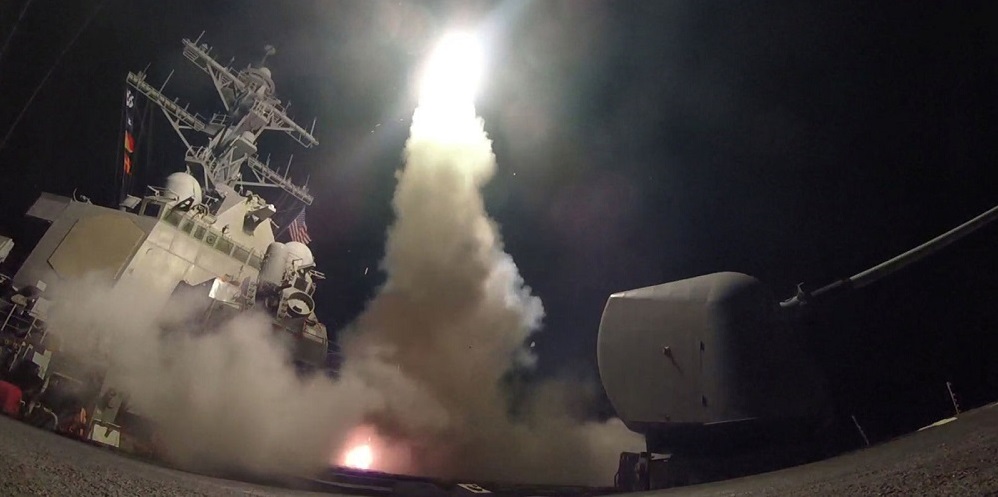


Alwaght- The US navy’s missile strikes against the Syrian military base on last Friday have unleashed an array of media and expert speculations on what will Trump’s future strategies be in relation to the Syrian crisis, ranging from heading to the direct military action against Damascus to continuing the previously-followed pathway of supporting the armed opponents of the Syrian President Bashar al-Assad.
Some sides called the strikes as "planned long before" the chemical attack on Khan Shaikhun, which was blamed by Damascus on the terrorists who did so in a bid to draw American support while they were losing ground to the Syrian forces. Others called the missile attack a personal and rash decision made by President Trump, adding that it was not unlikely that the move could get Russia and the US come to blows over Syria.
Still, a set of main theories can be suggested about the Friday morning missile attack against the Shayrat military base in Homs province in western Syria and whether or not the strikes will continue in the future against the Syrian military infrastructures while they are significantly contributing to fighting terrorism at home.
1. Through a comparison of the past and present US policies in relation to the Syria conflict, it can be concluded that Washington has developed no serious plan to directly attack the Syrian government’s positions, and that this situation does not appear to have changed with Trump’s assumption of office at the White House. This is clear from the recent missile strikes that were limited and cautiously conducted. The analysts' suggestion is that the attack was simply a demonstration of power and a warning to the others, rather than being a serious and aimed one.
2. Knowing it well that any military intervention in Syria will bring about for the US resounding political and economic costs, Washington is far from taking steps alone and without assistance from an international coalition once it wants to wage a full-scale war against Damascus. Even if the new American leader has in mind plans for direct military engagement in Syria against the government of President Assad, he first will think about steering clear of shouldering the costs alone, and sure will try to put the burden on others like Turkey and Saudi Arabia which are eager to see direct US military campaign against Damascus.
3. On the heels of US missile strikes on the Syrian air base which is leading in launching air raids against the terrorists, Trump has reportedly talked to an array of global leaders and debated with them establishing a no-fly zone over Syria. But this scheme does not look viable, as before Syrian fighter jets faced no-fly zone over Al-Hasakah city in northeastern Syria but this failed soon later. So the same plan to preclude Russian and Syrian airstrikes against terrorist positions will likely meet with failure. The main hurdle for safe zones in Syria is the US worries about possible collision with Russia in the crisis-hit country.
4. In 2013, following a Russian-American deal, the Syrian government agreed to destroy and transfer abroad all of its chemical stockpiles under supervision of the United Nations and global powers, including the US. Therefore, any anti-Damascus American military campaign with the justification of the Syrian chemical weapons will be devoid of international legitimacy. Not to mention that Washington has so far failed to present evidences to substantiate its claims of Syrian government’s use of chemical weapons against its people.
5. Russia since the beginning has been party to the Syrian crisis and it alliance has cost it hugely politically and militarily. The White House officials are well aware that the Russians will never back down from their pro-Assad stances and have no intention to leave the Syrian president alone, even if it costs them military encounter with the US. Additionally, Trump is never interested to get involved in a crisis with Russia in the initial months of his administration as he knows that this will stir domestic protests that will challenge his presidency's legitimacy.
6. Multiple experts agree that the main Trump’s goal behind the direct missile strikes is shutting the mouths of his warlike critics in the Republican party on the one hand and appeasing the regional US allies such as Riyadh that saw its ties with Obama administration frayed after the Saudis disparaged the president's inaction in relation to Damascus on the other hand. The analysts predict that the limited missile raids will make the Senate Republicans rally behind Trump, as at the same time the US will see a jump in its arms sales to Saudi Arabia and other Persian Gulf Arab monarchies.
7. The navy’s missile attacks against the key Syrian air base under chemical weapons excuse took place while the public opinion in the region and beyond hold unanswered questions about the US decline to react to use of chemical weapons against the civilians by ISIS and al-Nusra Front terrorists in Iraq’s Mosul and Syria’s Raqqa and Ghouta neighborhood. If the American president eyes continued strikes against Syria under this pretext, he needs to first give convincing answers to these questions.