














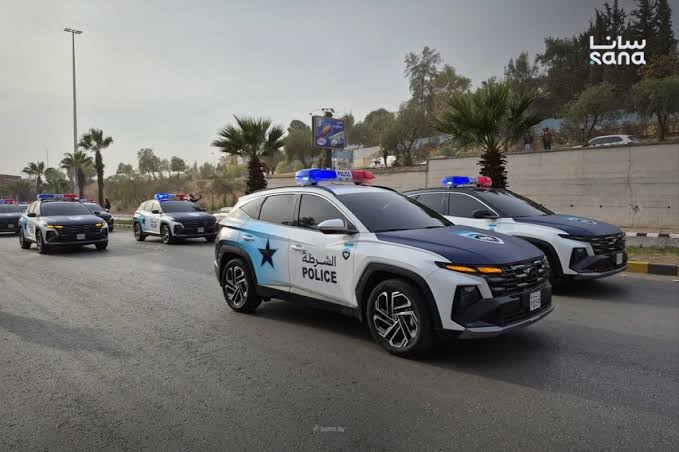


Alwaght- In recent days, the Syrian interim government led by Ahmad al-Sharaa, better known for his nom de guerre Abu Mohammad al-Jolani, in a massive street parade unveiled new visual identity and design for the police and security forces vehicles.
Unveiling luxury cars for police forces comes while the country is grappling with grave security, economic, and political crises. Meanwhile, the presence of senior Turkish military and security officials in the parade and the striking similarity of the new visual identity of Syria police to that of Turkey motivates speculations that Erdogan’s government has very likely funded these vehicles as a gift to Damascus allies it helped topple Bashar al-Assad during 13-year civil war.
The images of the parade left Syria social media ablaze, with various interpretations leading to the notion that this event sent a symbolic messages with various dimensions by the government to the people.
Intimidating the the opponents
A critical point for interpreting this military parade and show of force is its deliberate timing alongside recent public protests in the Damascus suburb of Beit Jin. What began as demonstrations against the crimes of the Israeli regime rapidly swelled into a broad social movement, alarming the interim government.
The stark reality is that after a year under the al-Jolani government, security remains a distant mirage for Syrians. Conditions have deteriorated further with the ascent of armed factions. Throughout this period, arbitrary arrests and the suppression and killing of minorities, from Druze to Alawites, have been a constant feature in reports on the conduct of militias under al-Jolani and Hayat Tahrir Al-Sham (HTS).
Compounding this, the ongoing Israeli occupation, expanding daily without effective counteraction from Jolani, has cast serious public doubt on the new ruling body’s ability to safeguard national territorial integrity. Consequently, the recent Beit Jin protests against Israeli forces effectively sounded a warning alarm for Jolani’s nascent and precarious administration.
This, this street-level power display, centered on police forces, serves as a public flex against dissent, with its core objective is to intimidate the people, ensuring no one dares challenge the central authority.
A message of good service to Tel Aviv
The massive police parade in Syria sends a message to the Israeli regime. Through this move, al-Jolani tries to show that his government is in control at home and no popular protests, even if directed against the Israeli aggression, cannot threaten the lives of the Israeli forces or security of the Israeli regime.
The significance of this move gets bolder when we shed light at in the framework of the recent Israeli Prime Minister Benjamin Netanyahu’s claims. He asserted that from Damascus to Jabal El Sheikh (Mount Hermon) should be de-militerized, adding that this stands as Tel Aviv’s precondition for any possible security deal with the government of al-Jolani government. Furthermore, the Israeli regime is under world community pressures for its recurrent incursion into Syria, to an extent that the UN General Assembly on Tuesday adopted a resolution calling for end of Israeli occupation of Syria’s Golan Heights. These conditions have left Tel Aviv unable to directly advance its plans and agenda inside Syria.
Hence, Netanyahu’s government is seeking to offload part of its security responsibilities onto the al-Jolani government. This move represents a calculated strategy, allowing Tel Aviv to exert indirect influence over Syria’s internal dynamics while alleviating international pressure.
In response, al-Jolani’s government has initiated a series of operational measures to meet Israeli demands. Recent field reports indicate that groups under al-Jolani’s command have begun erecting walls and restricting movement in certain Damascus neighborhoods, particularly in Alawite-majority areas, with the apparent aim of monitoring social activity and preventing any protests against the central authority.
Within this context, the parade of luxury, heavily-equipped police vehicles serves as part of the new government’s strategy to consolidate domestic control and serve Israeli interests, something signaling al-Jolani’s willingness to act as a reliable enforcer for the Israeli project.
Giving sham hope to people
Despite the glitzy display of police vehicles, what al-Jolani presented was less a reflection of real capability and more a form of symbolic imagery. Over the past year, despite repeated economic promises from the al-Jolani government, no tangible achievements have materialized. Western sanctions remain firmly in place, and efforts to attract foreign investment for infrastructure reconstruction have failed. The result of these failures has been declining revenues, deepening poverty, disrupted trade routes, and deteriorating public services, all of which have fueled widespread public discontent.
In such atmosphere, the parade of luxury police vehicles serves as an instrument to supply optimism and feeling of modernization to the people’s thought. The main purpose of this show is not only to cover up the government’s economic failures, but also to assuage public pressure and manage public sentiments. The government aspires to insinuate the picture of under-control situation and create a sense of closeness to settlement of challenges. Actually, through this performative policy, which is a form of collective psychological engineering, citizens are briefly lulled into an illusion of progress and prosperity. This allows the government to buy time and continue its domestic governance and crackdowns without facing significant, organized resistance.
Easing human rights criticism
By deploying its forces in modern police vehicles, al-Jolani government is openly trying to tamp down international criticism over Hayat Tahrir al-Sham’s security practices. Over the past year, these armed groups, still widely viewed as former terrorist factions, mostly relied on military trucks and heavy equipment to crush internal dissent, actions that drew global condemnation as human-rights abuses and terrorist-style behavior. Now, by swapping those assets for official police cruisers, al-Jolani is attempting to rebrand his forces from militias into a legitimate police force.
This cosmetic shift gives them room to justify any future security operations or crackdowns as lawful, wrapped in legal cover, while easing the intensity of international blowback. Putting police units on display signals that the interim government is trying to build institutions that resemble recognized legal bodies and international standards, and that it can manage the internal situation in a way that appears more acceptable to its regional partners.
Finally, showoff of luxury police vehicles may give a picture of order and modernization and deploy a sense of management capabilities, but without true economic, social, and political reforms, the effects will get temporary and largely symbolic. Long-term success of such moves depends on the government’s ability to meet the real needs of people and bring relative welfare, and as long as economic problems are not settled, even most equipped cars cannot ensure sustainable stability or legitimacy for the government of al-Jolani. Perhaps the attempt to legitimize crackdown on the minorities through police under the ruse of protecting security can draw negative reactions and inflame protests instead of solidifying the position of the interim government.










