














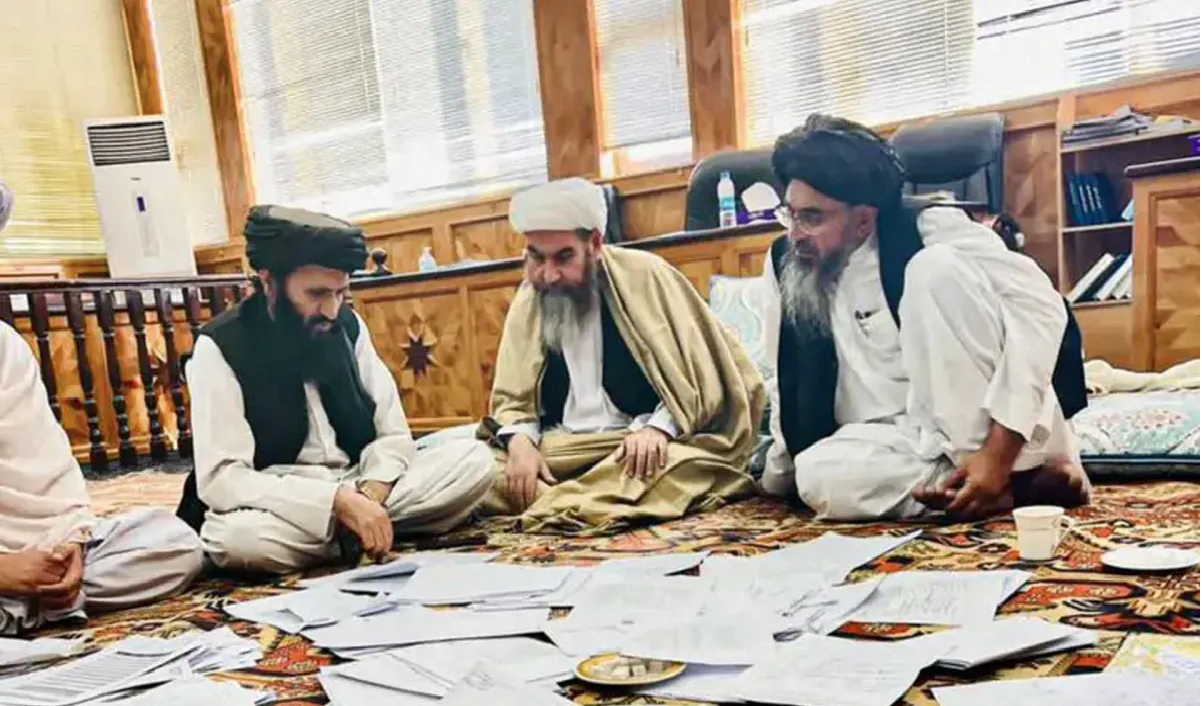


Alwaght- On the fifth anniversary of the Taliban’s comeback to power in Afghanistan, the group has unveiled its new legal code or charter of rule, causing controversy nationwide. The document is expected to replace the previous constitution and is set to determine the legal, executive, and political framework of governing.
The Supreme Court unveiled the penal code of the country's courts on January 7. Signed by the group’s leader Hebatullah Akhondza, the document is comprised of 10 chapters and 119 articles in 60 pages in Pashtun language. In effect since its issuing, the document have covered a wide range of items and said to have been compiled by a Taliban's religious scholars from jurisprudence books of Hanafi faith.
Despite repeated calls by the international community for the Taliban to form an inclusive government and recognize the rights of minorities and women, the group’s newly released charter makes clear that its governing approach remains at odds with global demands, a stance likely to intensify external pressure on Afghanistan’s interim authorities.
A review of the document shows that most of its provisions have been crafted to favor the Pashtun minority and factions aligned with the Taliban. Far from supporting the group’s claims of a sound interpretation of Islamic teachings, the text instead reflects an exclusionary and narrow vision of power and governance.
Hanafi Sunnism, the official faith of Afghanistan
The new charter initially refers to the faith of Afghanistan, and the eighth term of the second article calls the followers of the Hanafi faith as the true Muslims and the followers of other faiths in Afghanistan as "heretics."
In Islamic fiqh( jurisprudence), the term mubtadi, or innovator, refers to individuals who introduce new doctrines or practices into religion without grounding them in the Qur’an, the Sunnah, scholarly consensus, or other authoritative religious sources. Such an approach can, in practice, expose followers of other schools of thought to discrimination and may lead to negative consequences or legal and social restrictions against them.
Under this code, anyone accused of insulting or mocking the Taliban’s leader or Islamic beliefs faces punishments ranging from 40 lashes to up to two years in prison. The document, however, fails to define what constitutes insult or mockery. The provisions reflect the Taliban’s hardline interpretation of Islam and, for the first time, formalize that interpretation in a legal framework signed by the group’s leader and handed to courts as a basis for adjudicating legal cases.
Five years on, a Taliban government that still lacks legitimacy among much of the population and fears for the stability of its interim rule has turned repression and intimidation into tools of governance. Seeking to consolidate power and entrench its authority, the group labels armed opponents as baghi (rebels) and agents of “corruption on earth,” declaring that their harm is “public” and that they “cannot be reformed except through killing.”
Taliban’s class-based society
The Taliban's legal code claims it is based on credible Islamic resources and Hanafi jurisprudence while it gives the religious scholars and elites special position. The document categorizes the people into clerics, elites, middle-class, and the lower class and the intensity of punishment of people is decided by their social class.
Therefore, if individuals from these groups commit a similar crime, the punishments will be as follows: clerics will receive only a warning; the elite will be summoned to court along with a reprimand; while those from the middle and lower classes will face physical punishments, including imprisonment.
This stands in stark contrast to the principles of Islam, which the Taliban claim to be reviving, where no human being is inherently superior to another. In Islam, a person's status depends solely on their faith and piety. Those with stronger faith hold higher respect and standing before God; human worth is not determined by proximity or connections to the ruling power. Thus, the true measure of human dignity and respect lies in one's relationship with God and personal ethics, not in political status or power.
Although slavery was abolished in the Islamic world 1,400 years ago and in Western societies in recent centuries, the Taliban’s rulebook continues to categorize people as “free” or “slaves.” This system shows that the Taliban not only recognize social classification and discrimination but have codified it into criminal and legal statutes—a move that is virtually unprecedented and unacceptable in the modern world.
The rulebook also prominently features a degrading view of women, making clear they hold no real rights in Taliban-run society. For example, Article 34 prohibits women from repeatedly visiting their father’s home or other relatives without their husband’s permission and states that anyone preventing a woman’s return to her husband’s home will be considered a criminal. This approach exemplifies how the Taliban’s laws systematically restrict women’s fundamental freedoms.
Since the Taliban returned to power, the United Nations and numerous countries have repeatedly condemned the group’s discriminatory treatment of women and warned of the broad social and human rights consequences of these policies. Such discriminatory measures not only violate women’s rights but also undermine the Taliban’s legitimacy on the international stage.
Although slavery was abolished by Islam 1,400 years ago and in Western societies in recent centuries, the Taliban’s rulebook continues to categorize people as “free” or “slaves.” This system shows that the Taliban not only recognize social classification and discrimination but have codified it into criminal and legal statutes, a move that is virtually unprecedented and unacceptable in the modern world.
The charter also prominently features a degrading view of women, making clear they hold no real rights in Taliban-run society. For example, article 34 prohibits women from repeatedly visiting their father’s home or other relatives without their husband’s permission and states that anyone preventing a woman’s return to her husband’s home will be considered a criminal. This approach exemplifies how the Taliban’s laws systematically restrict women’s fundamental freedoms.
Since the Taliban returned to power, the United Nations and numerous countries have repeatedly condemned the group’s discriminatory treatment of women and warned of the broad social and human rights consequences of these policies. Such discriminatory measures not only violate women’s rights but also undermine the Taliban’s legitimacy on the international stage.
Reactions of Taliban’s new code
Publication of this document has drawn waves of reactions from rights organizations. Rawadari organization, a body monitoring rights in Afghanistan, called the penal code extremely worrisome and openly running counter to the international rights laws and fundamental principles of fair trial.
The organization argued that this code is a discrimination against people from various sects and religions, suppression of basic liberties. It adds the document violates human dignity, freedom of expression and thought, and legalizes extra-judicial and indiscriminate arrests and punishment.
Rawadari has condemned the discriminatory approach toward women as a clear violation of the right to human dignity and the prohibition of gender discrimination. It has emphasized that such measures will seriously exacerbate human rights violations, lead to widespread suppression of fundamental freedoms, and fuel abuse and lawlessness.
The rights organization has called for the immediate halt of the implementation of the Taliban’s rulebook and urged the international community, the UN, and other relevant global bodies to utilize all legal means to prevent its enforcement. The organization also reaffirmed its commitment to continuously monitor the Taliban’s conduct and the consequences of implementing these regulations, pledging to share its findings through regular reports to the media, human rights organizations, and the public.
Taliban’s legal code illegitimate
Ismail Bagheri, an Iranian expert of Afghanistan affairs, talked to Alwaght about the details of the document and the degree of its compliance with the modern world legal realities, saying: "Since Taliban's rise to power in August 2021, the group claimed commitment to constitution that was adopted under last King of Afghanistan Mohammad Zahir Shah. But this was just the surface and by such stances the Taliban tried to placate the home protests that erupted when they retook the rule 20 years. In practice, what was implemented were the decrees and fatwas issued by the Taliban’s leader Mullah Hibatullah Akhundzada , which were enforced inconsistently across different regions under Taliban control. Now, with relative stability established in Afghanistan after more than four years, the judicial courts have drafted their own specific penal code."
Emphasizing that this code lacks legal legitimacy, Bagheri stated: "The current Afghan government is not the product of a national consensus but the result of the Taliban’s takeover of all state structures. They rule Afghanistan based on the principle of domination. According to the Doha Agreements, intra-Afghan negotiations were supposed to be held with all political factions to form an inclusive government. However, the Taliban claim that since they represent the majority of society and have seized power by force, they see no need for the participation of other groups and minorities in the political structure."
According to the political expert, under the current Taliban-dominated conditions, no minority has any role or influence in governmental processes, and all affairs are controlled by the Pashtun ethnicity under Taliban leadership. Therefore, the most significant challenge facing this code is the inequality and privileges it institutionalizes in favor of Pashtuns and to the detriment of other ethnic groups.
Bagheri further held that by clinging to this new penal code, the Taliban try to silence any opposite voice and therefore prevent rise of any social movement against their rule. This approach gradually builds the ground for an authoritarian government, or even a dictatorship. The severe punishments prescribed for offenders resemble a primitive, pre-modern era more than a contemporary legal system, a reality fueling despair and disillusionment among the Afghan people.
Asked whether there is consensus on this code between the two main factions within the interim government, namely the Kabul-Haqqani network and the Kandahar factions, Bagheri said: "In Afghanistan, there exists a council of Kabul and Kandahar. They coordinate with each other whenever conditions and interests require, and there is no doubt they have consulted on this code as well. However, the Haqqani Network seeks to project a pragmatic image, attempting to show cooperation and engagement with other minorities. This policy is also largely driven by their rivalry with Mullah Hibatullah Akhundzada, which is part of the internal Pashtun and Taliban competition. Nevertheless, where their interests are not served, they formulate their own independent directives. Pashtuns in each region have their own specific rules, which they follow accordingly."
Impacts on minorities
Asked about the consequences of this penal code and charter on the minorities, Bagheri held that if this code is fully enforced, the non-Pashtuns will suffer the restrictions and the minorities will gradually lose their position and power and even their population may decrease. The Taliban have taken measures to register the minorities as Pashtun in their identification documentats.
Based on this code, which has been drafted according to the Hanafi Sunnism, the beliefs and rights of other Islamic sects have been disregarded. As a result, the implementation of these laws will disproportionately impact Shia Muslims, particularly the Hazara community in the north, and could eventually lead to restrictions or even bans on religious ceremonies such as Muharram and Arba'een observances in Afghanistan.
These restrictions will gradually undermine non-Pashtun communities, diminishing their intellectual and social capacity and reducing the potential for organized civil protest and resistance against the regime. "The continuation of this approach could ultimately steer Afghanistan toward a fully Taliban-centric structure," Bagheri added.
The expert further stated that Pashtuns hold greater privileges not only in the political sphere but also in the economic domain. Through such policies, the Taliban are seeking to create conditions that would assimilate other ethnicities into the Pashtun identity. The Taliban’s primary objective is to alter Afghanistan’s demographic composition in favor of Pashtuns, a process that has been pursued to varying degrees by local governments for decades.
"By considerable birth rates, the Pashtuns try to increase their population compared to other sectarian groups and through this solidify the pillars of their rule. In schools under Taliban management, it is emphasized that only Pashtuns should be allowed to teach and study, and the Pashto language is replacing Persian and Dari and other languages commonly spoken in the country. Laws pertaining to Shia Muslims have been removed from the legal framework, and the new code makes no mention of the rights or status of minorities. Should this approach continue and the country's demographic fabric shift in favor of Pashtuns, at the end of the road Talibanism or a Taliban-dominated order will be established in Afghanistan," Bagheri concluded.










