



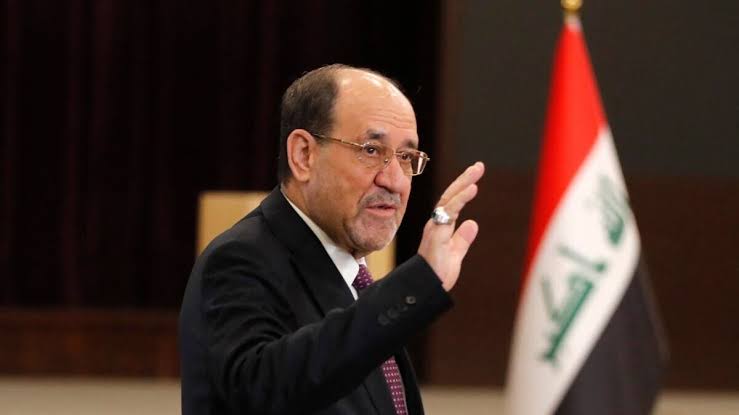


Alwaght- The race for Iraqi prime minister's post is witnessing a dramatic comeback; one that already appears to be making Western and American officials uneasy. This follows the official announcement by Iraqi state media that Nouri al-Maliki has been selected as the final candidate for the premiership.
In a decisive political maneuver, current Prime Minister Mohammed Shia al-Sudani has stepped aside, clearing the path for former Prime Minister Nouri al-Maliki to reclaim the role.
The breakthrough was formalized in a statement from the Shiite Coordination Framework (SCF) an alliance of Iraq's major Shiite parties, following intensive internal negotiations. The announcement confirms the nomination of al-Maliki, who previously held the post from 2006 to 2014.
Over the past three months when Iraq held its parliamentary elections, Shiite political factions have been working towards a consensus over the PM post as the party of al-Sudani failed to secure majority and he had to coalesce with other Shiite parties, the outcome of which was naming al-Maliki for the post.
From religious school to Dawa Party
Al-Maliki, in addition to leading the Dawa Party and the State of Law Coalition, previously served as PM of Iraq for eight years. Born on June 20, 1950, al-Maliki has deep historical roots, as his grandfather, Muhammad Hassan Abu al-Muhasnees, was a leader in the May 20 Revolution against British colonialism.
Al-Maliki completed his secondary education in Al-Hindiya and pursued higher studies at the College of Islamic Law in Baghdad, founded by Ayatollah Murtadha al-Askari, one of the key figures behind the Dawa Party. This university boasted prominent professors, including Ayatollah Muhammad Baqir al-Hakim. He earned his bachelor's and master's degrees in Arabic language from Salahaddin University in Erbil, and joined the Dawa Islamic Party in 1968, closely associated with Abdul-Sahib Dakhil al-Najafi, one of the party's founders, who was executed in 1969 after being thrown into a vat of acid.
Al-Maliki began his political career as a Shiite opposition figure during Saddam Hussein's regime in the early 1970s. After fleeing to Syria due from a death sentence, he moved to Iran in 1982, driven by ideological differences within the Syrian ruling part party, and subsequently returned to Syria. He also frequently traveled to Kurdistan to participate in opposition meetings.
He served as the head of the Dawa Party's jihadist wing and took part in the intifada of Shaban (March 1991) from Iraq.
As a politician
Al-Maliki returned to Iraq in 2004, a year after the US invaded Iraq and toppled Saddam Hussein. He intensively participated in foundation of administrative council following Saddam's collapse and also served as a deputy head of a committee responsible for cleansing the country's state offices of Baathist party. He was an official spokesman to the committee and later served in other posts including head of the Security and Defense Committee. He was among those who pushed hard for legislation of the fight against terrorism in National Assembly. As a distinguished member of the Constitution Committee, he opposed federalism and insisted on Iraq's Arab identity.
After then PM and Dawa Party head Ibrahim Jaafari rejected to name him next PM due to opposition from the Sunni and Kurdish factions in the parliament, he was named as PM in May 2006 following a consensus.
In 2010, the State of Law Coalition led by him secured 89 seats while the rival Al-Iraqia coalition secured 91 seats. After 8 months and after settling major challenges, including foundation of the National Council for Strategic Policies to be ruby by Ayad Alawi of Al-Iraqia coalition, he managed to retain the post.
In 2014, al-Maliki pushed for a third term. Despite the fact that the National Coalition of him secured the largest number of seats, al-Maliki's efforts for a third term went nowhere due to opposition to him within the coalition. He finally gave place to deputy PM Haider al-Abadi.
In 2019, at the height of disputes within Dawa Party and its division into two factions, one led by al-Maliki and the other by al-Abadi, he secured the post of secretary-general of the coalition for the second time.
Why does al-Maliki's comeback matter?
His tenure as PM from 2006 to 2014 is regarded as one of the most turbulent periods in Iraq's history, coinciding with the US occupation, the withdrawal of American troops in 2011, and the rise of ISIS in 2014.
Today, Iraq finds itself in a critical position, and al-Maliki's return to the PM post would not bode well for the Americans. According to Iraqi sources, Washington has been exerting pressure on the current Iraqi government over the past two months to prevent pro-Public Mobilization Forces (PMF) forces from obtaining the ministership in the upcoming government. To the US frustration, al-Maliki is seen as a figure closely aligned with the resistance groups in Iraq. Reuters has reported, citing American sources, that the US has issued a stern warning to senior Iraqi political figures regarding the composition of the country's future government. Washington has threatened that if resistance groups participate in the next Iraqi government, it will impose sanctions on the entire Iraqi administration.
The scope of these sanctions could be extensive, potentially targeting Iraq’s oil revenues that flow to the Baghdad government via the Federal Reserve Bank of New York, a move that would directly impact the main arteries of Iraq's economy, the sources suggest.
These warnings are made amid ongoing regional tensions as Washington seeks to prevent resistance groups from gaining a formal and effective role in the political decision-making process in Baghdad.
Another pressing issue is the re-rise of ISIS, the fighters of which have made their way back to Iraq after recently being released from Syrian prisons run by the US allies. He will inevitably have to address the security threats posed by the return of these terrorist elements.