













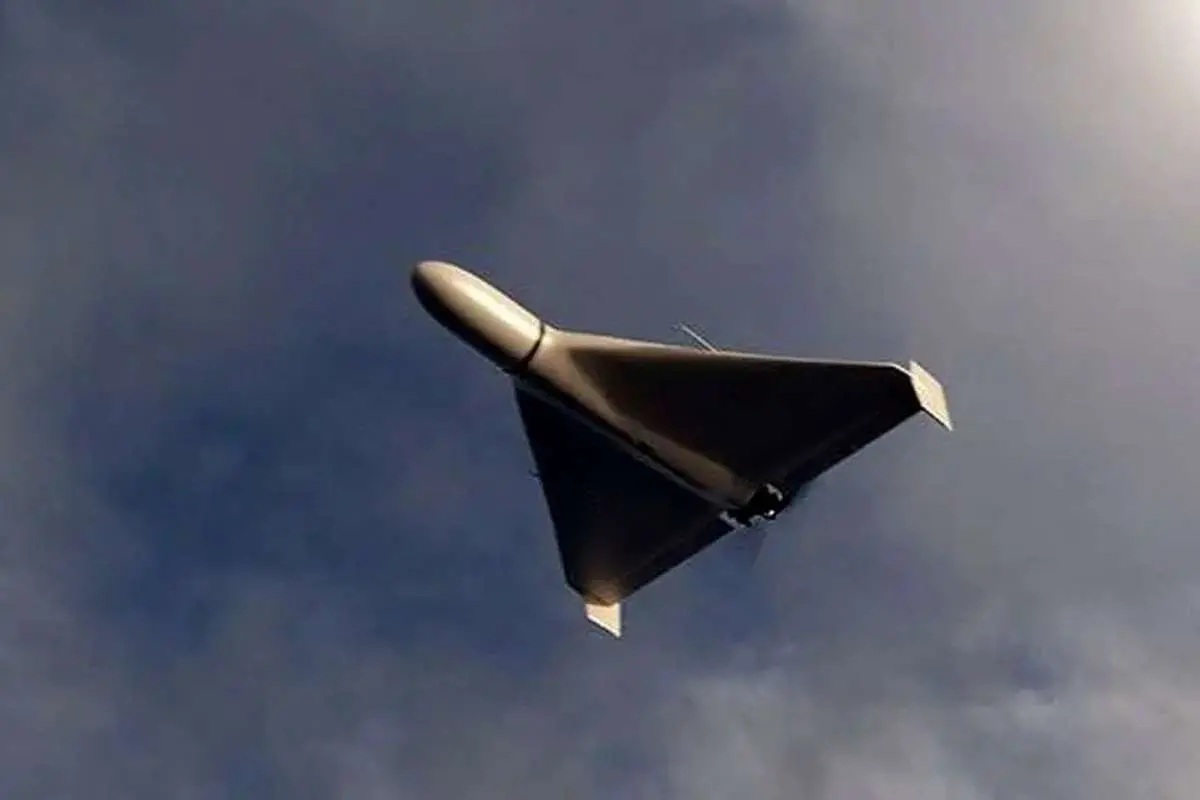


Alwaght- In modem wars, suicide drones, or what are known as loitering munitions, present themselves as the most determining tools in the battles. These weapon systems combine the capabilities of surveillance and loitering of the drones with the power of destruction of the missiles. Just unlike the common drones that return to bases after carrying out missions, the suicide drones are designed to directly hit and destroy their targets.
In recent decade, actors like Iran, Israel, the US, and Russia have presented themselves as the leading parties in this area. However, among all these systems, one is harvesting the prominence more than others; one that due to its lower price and mass production and strategic impact has symbolized the new generation of warfare: Iran's Shahed-136.
Why have suicide drones grown significant?
Modern militaries have turned to loitering munitions, especially drones, for several key reasons:
1. Far lower production costs compared to cruise missiles.
2. The ability to overwhelm air defense systems through swarm attacks.
3. Precision strike capability at long ranges.
4. Reducing pilot casualties.
5. Constant psychological pressure on the enemy. The distinct engine sound of the Shahed-136 has become a terrifying symbol in the Ukraine war and regional conflicts. These drones’ persistent presence in the sky inflicts severe psychological strain on both civilians and defense crews.
6. Ease of production, maintenance, and transport. Their simplicity allows for mass industrial-scale output.
Among these factors, cost outweighs all other advantages. The Ukraine war and West Asia conflicts have shown that mass-producing relatively cheap drones can force an enemy to spend millions of dollars intercepting each target.
Shahed-136 as a game-changer
Shahed-136 should be regarded as the most effective suicide drone of our day.
Designed by Iran Aerospace Industries, this drone was first officially delivered in 2021 for service in the combat forces, but it had been used on the battlegrounds in some cases before, including the attack on Saudi Aramco oil facilities by Yemen’s Ansarullah movement in 2019. But what drew attention of the world to this new Iranian technology is its massive use in Ukraine and regional wars.
The Shahed-136 falls into the category of "suicide drones" or "small cruise bomber munitions." Designed for high-precision ground attacks, it’s built to pierce complex defensive lines. Its key features include a striking operational range of over 2,000 kilometers, precision targeting via final-stage optical and GPS guidance, a lightweight and simple design that keeps production costs low, and the ability to launch from mother drones or ground platforms.
Why has the Shahed-136 become so much important?
Unlike Western loitering munitions, mostly built for highly precise, limited strikes, the Shahed-136's design philosophy rests on a different idea:
"Cheap production plus attrition and saturation warfare." Iran did not try to match the West’s most sophisticated cruise missiles. Instead, it built a system meant to be deployed in massive numbers at low cost.
Estimated at just $20,000 to $50,000 per unit, the Shahed-136 often forces its interceptors to fire missiles worth hundreds of thousands, or even millions, of dollars. That creates what analysts now call "economic asymmetry on the battlefield."
On top of that, the Shahed-136 can launch simultaneously in large salvos from truck-mounted launchers. Iran’s operational doctrine hinges on volleying scores of drones at once to overwhelm radars and interception systems. This tactic pressures even the most advanced air defenses.
As a result, many military experts label the Shahed-136 an "attrition weapon", one designed not just to destroy targets, but to gradually drain the enemy’s air defense stockpiles.
And with a reported range of up to 2,500 kilometers, the Shahed-136 can strike strategic infrastructure deep inside enemy territory. That allows launch crews to stay well away from the front lines.
Top world drones the class of Shahed-136
Compared to the similar systems, the American Switchblade 300 and Switchblade 600 are majorly built for tactical support of the ground forces.
The Switchblades are technologically more advanced, but Shahed-136 is strategically of deeper impact on the battleground, since it is produced on the basis of mass numbers and low cost.
To fix this shortcoming, the Americans turned to reverse-engineering the Shahed-136. The result was a drone with the commercial designation: LUCAS FLM 136, built by US company SpektreWorks. But this copycat carries an 18-kilogram warhead, has an operational range of roughly 700 kilometers, and a six-hour flight endurance.
Harop drone, produced by Israel Aerospace Industries, is one of the first successful suicide drones. The system is mainly designed to destroy radars and air defenses.
The Harop’s cost is far higher than the Shahed-136’s. Many analysts believe Iran took a different path in designing the Shahed: quantitative superiority over technological complexity.
Russia was also one of the first countries to take an interest in the Shahed-136 and move toward producing a localized version. The Geran-2 and Lancet drones were the result of that effort, both of which gained notoriety in the Ukraine war for striking artillery, armored vehicles, and radar systems.
The Geran-2 is essentially Russia’s version of the Shahed, produced with modifications to its navigation system, including the ability to install a SIM card, along with a composite fuselage, a new warhead, and upgraded electro-optical sensors (optical and thermal imaging). Lancet, meanwhile, has a shorter range than Shahed and also carries a smaller warhead. It is designed mostly for front-line battlefield strikes, whereas the Shahed-136 goes after strategic missions and long-range attrition attacks.
Why is Shahed-136 seen a strategic shift?
Many analysts believe that Shahed-136 has induced change to the military thought more than the complicated Western systems. Rise of these drones showed that future wars will rest on the drones since these cheap systems can threaten advanced armies, their quantity can outweight the technological complexities, and most importantly the war economy is as important as the technology, and it is exactly this logic that has turned the Shahed-136 drone to one of the most important and influential drones of our time.
That is why some countries are now eyeing development of low-cost, mass-produced drones taking inspiration by the very model.