














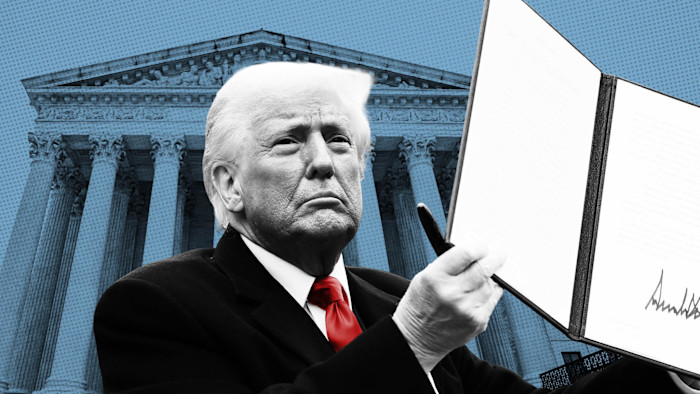


Alwaght- A day after the US Supreme Court ruled to revoke Trump's tariff orders, the president announced that the 10-percent temporary tariffs he had imposed on imports from all countries will increase to 15 percent. According to American sources, this is the highest authorized level according to the law. On Friday, immediately after the ruling, Trump announced the 10- percent tariffs on the world countries.
Why has Supreme Court ruled against Trump’s tariffs?
The US Supreme Court ruled that Trump exceeded his legal authority when imposing his previous tariff program under the International Emergency Economic Powers Act.
While the law permits the president to take emergency action against immediate external threats such as security or economic crises, the court found that using it to impose sweeping trade tariffs fell outside the statute's intended purpose and scope.
The justices emphasized that trade policy and general tariff decisions lie fundamentally within Congress's jurisdiction, and the president cannot take such actions simply by declaring an economic emergency.
Trump's defiance, however, shows no end. Just one day after the Supreme Court struck down his heavy tariffs on other nations, Trump announced he would impose a 15 percent tariff on all goods imported from every country into the United States. This 15 percent rate represents the maximum legal limit the Trump administration can impose independently; any higher rates would require congressional approval.
Billions in compensation on the US government
Following the landmark Supreme Court ruling against Trump's tariff order, the US government is now forced to return billions of dollars in revenue collected over the past year as compensation to the companies that paid these tariffs. Hundreds of lawsuits have already been filed against the Trump administration in the US trade courts. If the courts review these claims and rule in favor of the plaintiffs, the Trump administration may be compelled to refund billions of dollars in collected tariffs to these companies.
Among the lawsuits filed against the Trump administration seeking compensation for the imposition of heavy tariffs, the toy manufacturer Learning Resources has emerged as one of the most significant legal challengers. The company, which imports 90 percent of its educational products from China, paid more than $10 million in tariffs under the IEEPA in 2025 and was forced to downsize its operations.
In effect, by preventing Trump from continuing his tariff war, the Supreme Court's ruling not only paves the way for the refund of previous tariffs but also has a sweeping impact on the US government's budget. According to analyses, up to $1.5 trillion of the projected revenue from Trump's tariffs is now at risk of being refunded.
Putting the brakes on Trump
The Supreme Court's ruling has curbed the Trump administration's power to use its emergency powers in the trade sector, and this will, indeed, reflect directly on the prices of the consumer goods in the US. In other words, although the Trump administration defended these tariffs as a leverage to "protect national interests", this ruling has undermined one of the core pillars of his trade war strategy.
Actually, the ruling in not just about tariffs ; it is about the limits of the president's powers against those of the Congress. The Supreme Court's message was clear: In fundamental economic matters, the final say lies with the Congress lawmakers not the White House.
To put it differently, the ruling restricts Trump's power to threaten others or punish them using tariffs in areas off the trade sector. Now, Trump needs to find another way to vent his anger at other countries.
Where will Trump's tariffs head?
A new Council on Foreign Relations poll shows a majority of Americans believe tariffs have driven up prices and that there should be limits on a president's authority to impose them. The timing of this decision in an election year could turn it into a politically risky issue.
To implement the ruling, the administration is expected to order Customs and Border Protection to halt tariff collections. Uncertainty also looms over how to refund the tariffs importers have paid in recent months, but based on previous legal precedent, refunds are mandatory.
The Council on Foreign Relations reports that the Trump administration will likely launch or complete investigations under other authorities in an attempt to reinstate tariffs before the 10 percent Section 122 tariffs expire in five months. Some companies have already cut deals with the Trump administration in response to the threat of new tariffs. A significant portion of the pharmaceutical industry, for instance, committed to investing hundreds of billions of dollars in the US. While they may review those plans, the uncertainty over the tariffs' fate means they will likely proceed with their announced plans for now.










