









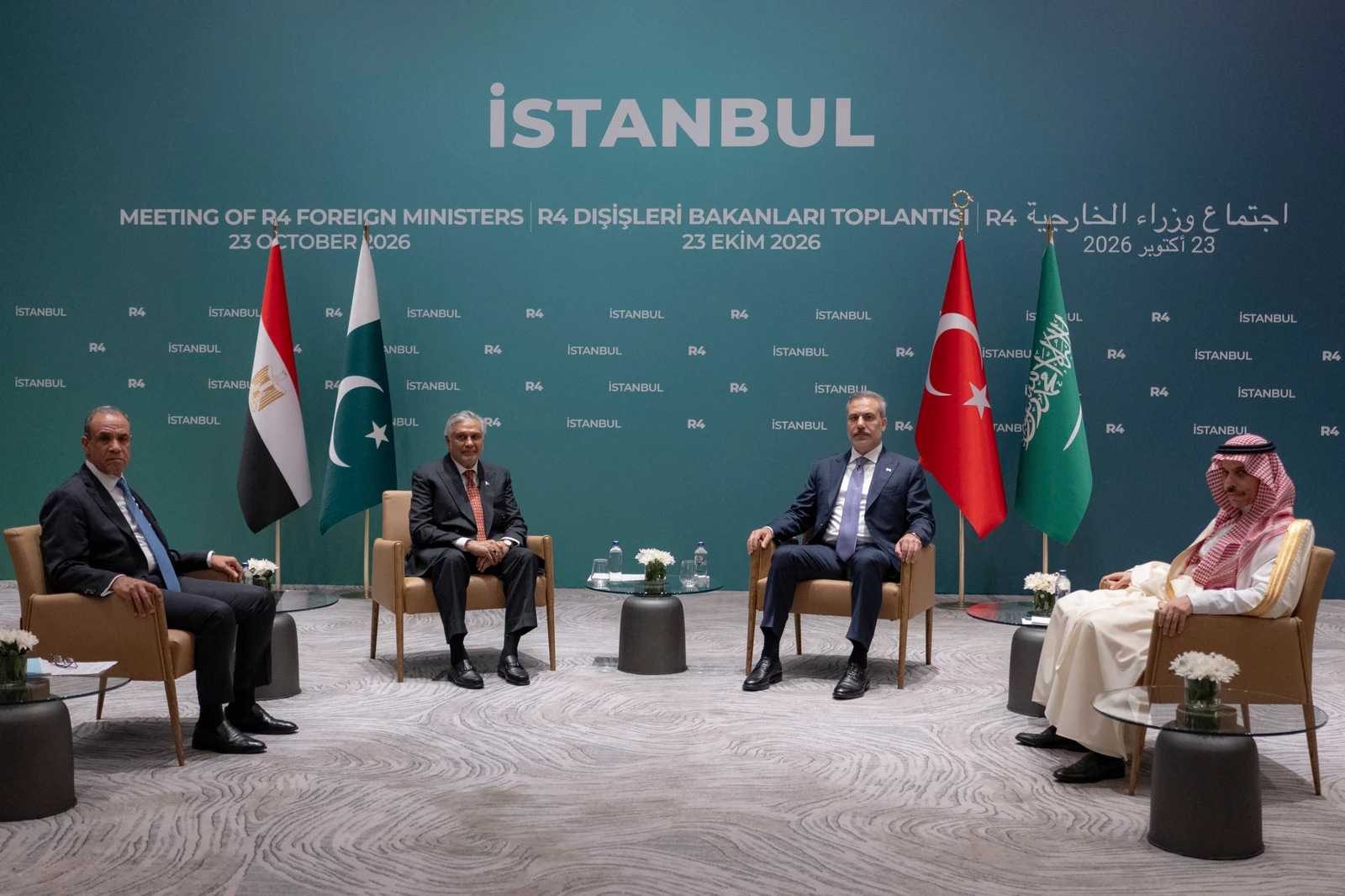


Alwaght- At a time the White House officials in recent weeks have been upping their threats against Iran along with the Israelis and the analysts have not ruled out a fresh round of war, the meeting of foreign ministers of Turkey, Pakistan, Saudi Arabia, and Egypt in Istanbul beyond an ordinary gathering carried an important message about limits of the US and Israeli regime's strategy to continue the destabilizing policy.
Emphasizing on diplomatic solution to the crisis, supporting Islamabad agreement between Tehran and Washington, and openly condemning the Israeli regime as the root cause of instability in the region showed that key regional actors are not aligned with hawkish American policies and are deeply concerned about the consequences of this escalatory approach by Washington.
Failure to forge regional concensus against Tehran
One of US and the Israeli regime's central objectives in confronting Iran has been to cast Tehran as the principal source of insecurity in West Asia and to forge a regional consensus against it.
Washington and Israel have sought to manufacture false threats, citing Iran's peaceful nuclear program and regional influence, to pave the way for coalition-building against Tehran and to lend legitimacy to their own aggressive, warmongering actions. But at the Istanbul summit, regional powers torpedoed that strategy, making clear that they hold the occupying regime's expansionist policies and Trump's war-mongering in service of Israeli interests chiefly responsible for the region's troubles and instability.
These countries, which are among West Asia's most consequential powers, have absorbed the lessons of the past two rounds of war, which, exactly as Iran warned, spilled beyond borders, deepened instability, imposed costs on every regional state and even triggered a global economic crisis. Now, as Trump, leaning on a Netanyahu who sees himself going down and is bent on dragging America into another war to escape his domestic crisis, faces their declaration, they have signaled not only that they will not back a new U.S. war against Iran but that they oppose one and are deeply worried about its fallout. Washington would do well to heed that concern.
The FMs of Turkey, Saudi Arabia, Egypt and Pakistan, while stressing the need to secure shipping lanes and reopen the Strait of Hormuz, insisted that the crisis between the US and the Israeli regime on one side and Iran on the other can be resolved only through dialogue and diplomacy. They also endorsed the Islamabad MoU and underscored the need for a durable, negotiated solution.
Their stance matters because all four countries, given their geography, security calculations and economic interests, stand to lose from a wider war and regional instability. The experience of the past two rounds of conflict has shown that, contrary to what its architects assumed, a crisis pitting Iran against the US and Israel does not stay confined to Iran's borders; it can disrupt Persian Gulf security, energy transit routes, international trade and global supply chains.
In such conditions, the region's anxiety about another war is not merely a political posture, it is bound up with these states' security and economic calculus.
From this viewpoint, the Istanbul statement can be read as a sign of the limits of Washington's strategy of converting military pressure on Iran into a regional coalition.
This message is passed to Washington at a time any move towards a rejuvenated war risks broadened conflict range and subsequent heavier costs on the region. If Trump thinks that he can, through military pressure and threat, press the regional countries into joining ranks against Iran, the recent position of the US allies made it clear to the American president that such calculation is well disconnected from West Asia's complicated realities.
Palestine, another gap in the American-Israeli narrative
The significance of the joint statement by the four FMs goes well beyond their position on Iran and the Strait of Hormuz. Its section on Palestine is politically telling, suggesting that the top diplomats identified Israeli occupation as a root cause of instability in the region and beyond, and stressed the need to implement the two-state solution grounded in UN resolutions.
The statement affirmed the Palestinian people's right to self-determination and to an independent, sovereign, viable and contiguous state along the June 4, 1967 borders. The ministers also condemned settler violence, settlement activity in the West Bank and Al-Quds (Jerusalem), and efforts to alter the city's legal and historical status, calling for continued humanitarian aid and reconstruction in Gaza.
These positions collide with a narrative that seeks to detach regional security from the question of occupation and the unresolved Palestinian crisis, promoting normalization instead of addressing the conflict at its roots. By foregrounding Israeli occupation, the four countries, at least at the level of diplomatic posture, challenge that narrative.
Riyadh's different message: Normalization still pending Palestinian cause
Among the four signatories of the Istanbul statement, the Saudi posture is of special importance. In their official statements, Turkey, Pakistan, and Egypt officially underscore the Palestinian rights and opposed normalization until an independent Palestinian state is formed. But the Saudi place in the calculations related to normalization with Israeli regime gives this posture a different weight.
For years, Riyadh has been one of Washington's most prized targets in its drive to expand Arab normalization with Tel Aviv and broaden the framework, dubbed the "Abraham Accords." Any hint of Saudi-Israeli thaw or security and intelligence cooperation between the two sides therefore fuels speculation about Riyadh possibly joining that track.
In recent weeks, reports and regional developments, including accounts of Saudi-Israeli intelligence cooperation in Yemen and the fallout from the emergency landing in Saudi Arabia of a damaged Emirati passenger plane carrying Israeli travelers, have revived debate over Riyadh's ties to the Israel-aligned camp. Such reports alone, however, fall short of proving a secret agreement or a firm Saudi decision to normalize.
What matters in the Istanbul statement is Saudi Arabia's explicit emphasis on Israeli occupation as a driver of regional instability and Riyadh's support for an independent Palestinian state. That stance shows the Palestinian question remains a weighty consideration in Riyadh's regional policy, and that Saudi Arabia cannot be assumed to slide easily into a Tel Aviv-led security framework while ignoring it, a position that could narrow Washington's room to tether normalization to an anti-Iran coalition.
Finally, the Istanbul statement should be seen within a regional push to manage war fallout and prevent a new round of conflict. For Washington the message is unmistakable: Regional states are far from ready to accept the costs of a massive war simply for aligning with the American-Israeli strategy. For them, lasting security does not come from threat and war; especially that the Palestinian cause and ongoing Israeli occupation remain the main causes of crisis in the region.