










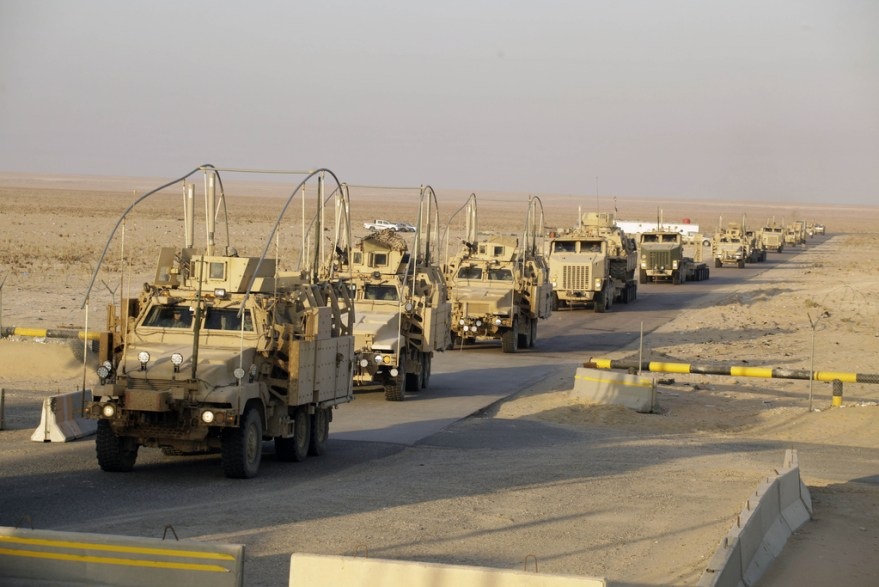


Alwaght- With the announcement that the last American troops have left Iraqi soil on September 30, the case closes on more than two decades of military occupation. But the question of what this war truly achieved still echoes through US political and military establishment. Launched on claims of destroying weapons of mass destruction, countering security threats and rebuilding Iraq, the war ultimately ended with a staggering human, financial and strategic bill for Washington. Official figures put American losses at 4,474 killed and roughly 33,000 wounded, while Trump pegged the cost at nearly $7 trillion.
A fresh Pew Research Center poll found about 75 percent of Americans backed ending it. Iraq, for its part, was left with years of insecurity, civil strife and vast casualties.
Now, with the American withdrawal complete, a number of US experts and analysts are trying to grade this war not merely by battlefield victories but through the lens of Washington's strategic objectives. Their verdict, in many cases, reveals a striking gap between Washington's tactical gains on the ground and its strategic aims.
Anthony Cordesman, a military expert at the Center for Strategic and International Studies, argues in his assessment: "US forces entered this war in 2004, even though their reasons for going in were wrong. The evidence conclusively showed that Iraq possessed neither long-range missiles nor weapons of mass destruction, and that the Iraqi regime had no connection whatsoever to al-Qaeda or to the attacks carried out against America and its allies."
He adds that the only achievement of the American invasion was destroying the Iraqi military's ability to deter Iran, without the US having any clear plan to restore security and order through a democratic system; one that would not lead to the isolation and marginalization of Sunnis.
Tactical win, strategic loss
This American military expert, despite his criticism of the war's results, believed that the Iraq War, and ultimately the US withdrawal, delivered at least one tactical victory. In his view, American forces managed to build effective capacity to suppress the insurgency and, in 2007 and 2008, scored major gains in cooperation with Iraqi security forces. Those efforts also went some way toward offsetting the consequences of five years of civil war in Iraq and produced a fragile framework of a dysfunctional democracy, one that could, of course, push Iraq once again toward a system built on the rule of a single strongman.
"The tactical victories of US forces merely reduced the number of security incidents and, as a result, lowered the level of conflict, a conflict that was itself the product of US's failures in the early years of the occupation. Strategically, however, the US lost this war," he continues.
To explain that assessment, he laid out four main factors. Here they are:
First: The US failed to reach an effective strategic framework agreement with Iraq that would serve Washington's strategic objectives in the region.
Second: American military forces withdrew without a clear and durable structure having been established for Iraq's political system. According to Cordesman, the American rush to draft a constitution and hold elections, without laying the necessary groundwork for Iraqi society, was one of the drivers of this failure.
Third: the US failed to rebuild Iraq's armed forces and bring them to a level capable of achieving deterrence against Iran, something Cordesman considers a major strategic mistake.
Fourth: Washington lacked a strategic plan for cooperating with the Arab states of the Persian Gulf; a plan that could have created an alternative deterrence mechanism against Iran through an advanced American military force working alongside the forces of allied Arab countries.
In his conclusion, the American expert stresses that the withdrawal of the Americans from Iraq "is not a declaration of America's victory in the war it launched against Iraq in 2003, but the end of a strategically costly war, one that ended with US forces leaving Iraq in a condition where it could not even guarantee its own internal security and stability, and left behind a strategic region without any new strategic structure having been created for the era after the last American soldier's departure."
Was Iraq war worth it?
Michael O'Hanlon, a senior fellow in foreign policy studies at the Brookings Institution, likewise argues that the costs of this war were extraordinarily heavy, and part of that price stemmed from poor preparation for war, especially in its earliest stages.
Stressing that the enormous costs of America's war in Iraq cannot be justified by the results achieved, O'Hanlon adds: "At this stage, calculating costs and gains precisely is difficult, though I am inclined to doubt that what America spent in the Iraq War was proportionate to what it managed to achieve there."
Along the same lines, Professor Andrew Bacevich, a professor of international relations and history at Boston University, borrowing Winston Churchill's famous line, argues: "Rarely in human history has such a vast volume of costly sacrifice been made to achieve such meager results."
To explain his view, Bacevich pointed to several examples:
First: US won neither a military victory nor succeeded in achieving its strategic objectives in a war that left thousands of Americans killed and wounded and hundreds of thousands of Iraqis dead and injured.
Second: The catastrophic legacy of this war in Iraq is not limited to financial losses and human casualties. This war showed that the US political leadership faces limits in restraining itself and exercising self-control, and is inclined to use military power as a tool in international politics.
Third: Regardless of what gains were or were not possible, the US rushed to start the war, as if war had become an ordinary instrument of international relations, and the American people would accept it without objection.
Withdrawal from Iraq: End of US hegemony dream
Bacevich argues that roughly nine years after George W. Bush launched the Iraq War, promising a swift victory, Barack Obama settled for what a vastly expensive war had yielded by ending it; a war that laid bare the limits of American power before the world.
The true aim of "Operation Iraqi Freedom", a name the US government chose for the invasion of Iraq, was for Washington to show the post-9/11 world that American military power could determine the course of history. From the Bush administration's perspective, Saddam's fragile regime was an ideal target to prove that thesis, since it could set the stage for a quick victory, immediate gains and a display of the US military dominance.
To illustrate this view, Bacevich points to the developments of the war's first week's, developments that initially created the impression that the theory of American military power was being vindicated.
"At first glance, the sequence of events, the war's launch on March 20, 2003, the entry of US forces into Iraq and the fall of Baghdad on April 9, created the impression that the mission would be accomplished successfully. Bush himself hastily staged a victory celebration aboard the USS Abraham Lincoln, with a large banner behind him reading 'Mission Accomplished.' He told those who had carried out the 9/11 attacks that they had imagined they could force Washington to retreat from its leadership role in the world, but they had failed, and the US was going from victory to victory," he added.
But according to Bacevich, who himself served in the Vietnam War with the rank of colonel, events in Iraq unfolded contrary to Bush's expectations.
He says the Iraq War showed that although no military power in the world surpasses the US in military capability, that power alone cannot be relied upon to achieve victory.
Bacevich thinks that the American withdrawal from Iraq was also the end of the idea of American hegemony resting solely on the country's military power.