








Alwaght- With nearly five years gone since Prime Minister Imran Khan of Pakistan was ousted, the confrontation of his party, Pakistan Tahreek-e-Insaf, and the federal government still continues. Now it has entered a new stage that can impact the political and security stability in the country more than ever.
In a related and significant development, President Asif Ali Zardari of Pakistan signed an emergency declaration for Khyber Pakhtunkhwa province، the bastion of Tahreek-e-Insaf party, on Sunday. The order asserts that the provincial government can no longer govern in accordance with the constitution, the legal basis for imposing direct federal rule over the province through the governor.
In the wake of the emergency declaration, Shahid Khattak, parliamentary leader of Pakistan Tehreek-e-Insaf (PTI), announced that Muhammad Sohail Afridi, the chief minister of Khyber Pakhtunkhwa, along with Junaid Akbar, the party's provincial president, and several other PTI leaders have been arrested by police and security agencies.
Islamabad has cited restoring law and order, combating terrorism, and saving innocent citizens from the devastating toll of terrorist attacks as its principal justifications for the emergency. Interior Minister Mohsin Naqvi said the government possesses dozens of pieces of evidence against the provincial government, but none have been made public so far.
PTI, which has governed the province since 2013, has rejected the move, calling it political and beyond the legal authority of the elected provincial government. The party said it will challenge the decision through judicial and parliamentary channels.
Gohar Ali Khan, PTI's chairman, insisted the decision is "illegal and contrary to the spirit of federalism," warning it will have serious consequences for Pakistan's political stability.
The leader of the Jamiat Ulema-e-Islam party also condemned the decision, calling it an ambush on democracy.
The move by Islamabad came after talks collapsed between the federal government and the party over a planned protest march to the capital demanding the release of Imran Khan.
Who is governing Kheyber Pakhtunkhwa?
Under the government's decision, Governor Faisal Karim Kundi will assume the duties and powers of the provincial government.
Because Zardari declared the emergency without seeking a provincial assembly vote, the constitution requires both houses of parliament to ratify the decision within 10 days, by October 21, with sessions of the National Assembly and Senate scheduled for Tuesday.
The parliament, where the Pakistan Muslim League-Nawaz led by Shehbaz Sharif, the Pakistan Peoples Party and their allies hold a majority, will take over the powers of the Khyber Pakhtunkhwa provincial assembly.
The emergency order stipulates that the chief minister, provincial ministers, advisers, special assistants and the advocate general are immediately removed from their posts.
Hassan Abdullah Niazi, a visiting faculty member at Lahore University of Management Sciences, offered a different reading of the decision. Speaking to Al Jazeera, he said: "This decision does not mean the permanent removal of the Khyber Pakhtunkhwa assembly or its elected chief minister. It is more akin to considering them incapacitated until the emergency is lifted, after which they should return to their previous positions."
Political and demographic significance of Kheyber Pakhtunkhwa
Khyber Pakhtunkhwa sits in northwestern Pakistan and holds a vital place in the country's geography, demography and politics. The province shares a border with Afghanistan, and its crossings, including the Khyber Pass, have served for centuries as key trade and transit routes between the Indian subcontinent and Afghanistan. Its capital, Peshawar, ranks among the region's historic commercial and cultural centers.
According to the 2023 census, the province has a population of roughly 40.85 million, making it Pakistan's third most populous province. Pashtuns form the majority, alongside other ethnic and linguistic groups.
The province is also PTI's most important popular stronghold, and the party's considerable electoral support there has given it a strategic foothold in Pakistan's political calculus.
What's driving the government's decision and what are the consequences?
The emergency in Khyber Pakhtunkhwa can be read through the convergence of three forces: security challenges, political feuding between Islamabad and the provincial government, and a contest for control of Pakistan's power structures.
While Islamabad says the emergency was imposed to counter violence and terrorism, accusing provincial officials of failing to contain security threats, the timing, coinciding with Imran Khan supporter protests and their planned march on the capital, has led observers to see stopping the protests from spreading as a primary motive.
Zulfiqar Bukhari, an adviser to Khan and a PTI spokesman, likened the federal move to "a coup under the guise of an emergency." He warned it could fuel more violence and instability.
Over the past week, thousands of Khan supporters have marched toward the capital in growing numbers. The federal government fears a million-strong protest in Islamabad would strengthen Khan's political standing and complicate the corruption cases against him.
Politically, the emergency also lets the federal government exert direct control over Khyber Pakhtunkhwa and expand its reach there, weakening PTI, the federal government's biggest rival, and shrinking its room to maneuver against Islamabad.
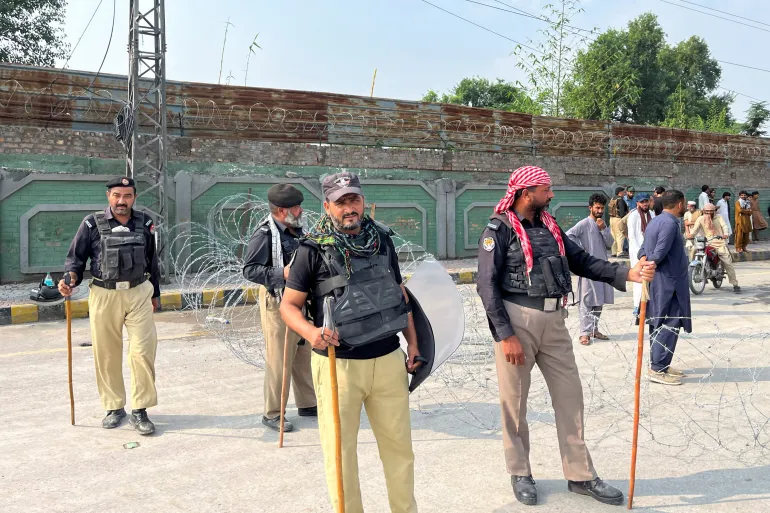
Given PTI's standing in the province, such a move could deepen the rift between the center and the party and destabilize the country. Already, Peshawar's atmosphere has been transformed: security sources say all major and secondary roads into the city have been blocked with shipping containers and traffic has ground to a halt.
Thousands of troops have also been deployed across the province to head off mass protests and contain any movement by demonstrators. Still, PTI's parliamentary leader has called on party supporters and residents of Peshawar and elsewhere in Khyber Pakhtunkhwa to take to the streets and march on the city.
In such a highly charged climate, the likeliest consequence is heightened tension between the center and PTI and a deepening political polarization in Pakistan. If arrests expand, political activity is restricted, or protesters are shown an iron fist, unrest and eroding public trust in state institutions are probable. And if the emergency measures fail to improve security and reduce armed attacks, the decision's legitimacy and effectiveness will be called into question.
Finally, the way of execution of the decision, the observance of constitutional requirements, and parliament and court oversight determine if this intervention will contribute to security stability or trigger a political and legal crisis.