
















Alwaght- Over the past seven months, massive American and Israeli strikes across Iran have laid bare a raw portrait of violence and atrocity, killing and wounding a large number of civilians. Yet from the very first hours of the 40-day war, some cities tasted the bitter cost of the enemy's crimes; cities that still bear the scars months after the attacks ended, every corner of them telling a story of the aggressors' brutality.
Lamerd, in Fars province of Iran, is one of them. On the first day of 40-day war on Iran on February 28, it was hit by banned American ammunitions, and despite Washington's claims, civilians were the sole victims of that horrific crime.
The ferocity and scale of the strike were such that its marks remain visible months later, traces that speak not only of the destruction left behind but stand as living testimony to what befell the city and its people. So significant was the attack that Iranian political officials traveled to the site in person to inspect the devastation wrought by the enemy up close.
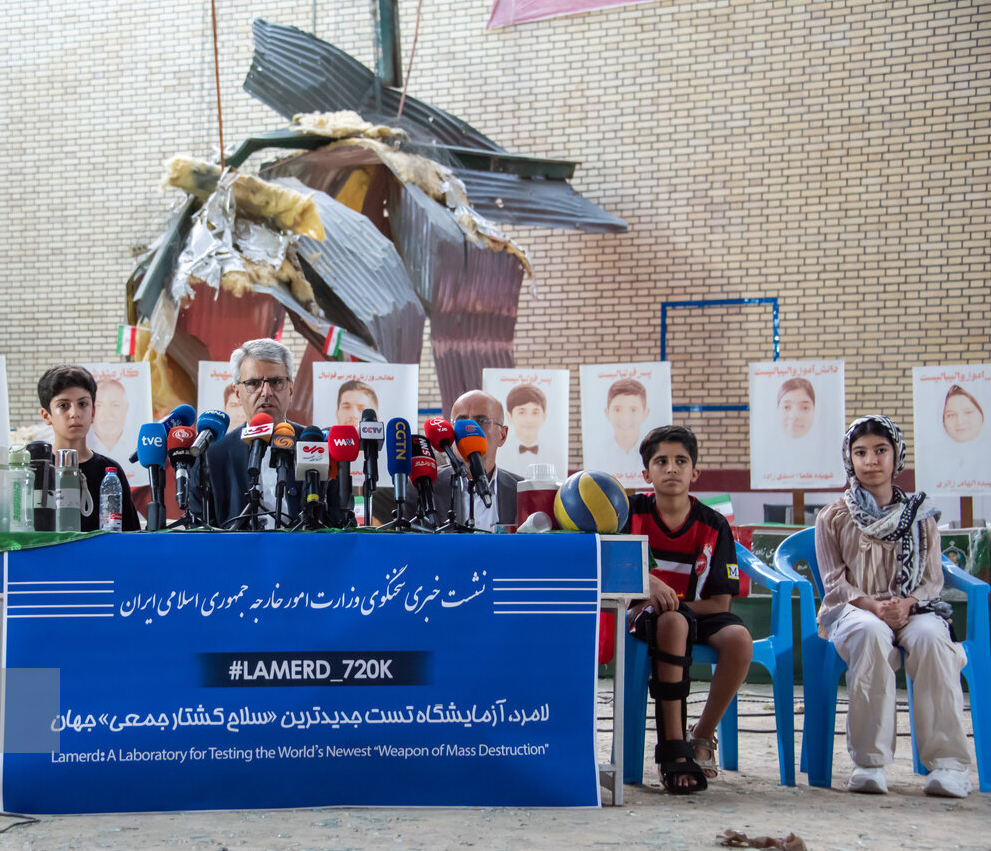
Meanwhile, on Saturday, Foreign Ministry spokesman Esmail Baghaei, visiting Lamerd and meeting its residents, pointed to the American missile strike and said: "The aim of this attack was to take civilian lives, and civilian sites, including schools and sports facilities, were targeted."
Noting that the strike hit at 5:12 p.m., February 28, the spokesperson said: "Given the timing and the method of target selection, it is likely that the aim was to inflict the maximum number of casualties among the people, and had schools been in session at that hour, the toll of martyrs and wounded from this attack could have been several times higher."
He, pointing to the close proximity of the missile impact sites to one another, said: "Within a 500-meter radius, there are four launch and impact points, yet none of the targets had a military nature. A school, a girls' sports facility, and a boys' sports facility were among the targets of this attack, and that makes the dimensions of the crime committed all the clearer."
Lamerd attack, a war crime instance
In the decades since World War II, the US has repeatedly tested each new generation of its weapons on real battlefields by attacking other countries, a pattern repeated in the recent war against Iran, where some of the most advanced American weaponry was deployed.
In that vein, the foreign ministry spokesman, citing statements by American officials about the attack, stressed: "America has openly accepted responsibility for this action and has even declared that it used this type of missile for the first time to assess the extent of destruction. In similar cases, too, efforts have been made to offer differing accounts of the attacks, and responsibility for certain actions against Iran has even been attributed to artificial intelligence, but the nature of these actions is not something that can be overlooked under humanitarian law."
It is noteworthy that on the first day of the war, several American missiles struck the Shahid Naeemi sports hall and surrounding residential areas in Lamerd. The significance of the matter grew when independent assessments of the weapon used pointed to the American PrSM missile.
The new American missile tested on the people of Lamerd was built by Lockheed Martin and, at the time of the attack, scattered 180,000 fragments each into the city's residents, leaving behind many wounded and martyred.
In that horrific crime, 21 people were killed and more than 100 others wounded by missile fragments, and more than six months on, several boys and girls from Lamerd, along with their families, are still grappling with disabilities and severe pain and suffering from those wounds. A number of tungsten pellets from the PrSM missiles remain lodged in the bodies of some children.
The missile was designed to explode at altitude and scatter a large volume of metal fragments, and an Airwars assessment found that in Lamerd the lethal effects of the blasts were observed up to roughly 50 meters from the impact point, with destruction extending some 170 meters. Post-attack imagery shows numerous fragment strikes on buildings, vehicles, and streets in the surrounding area.
Washington has confirmed the use of PrSM missiles in Iran but denied that one struck Lamerd. Yet six weapons experts who spoke with The Associated Press, based on the available evidence, deemed the use of the missile likely and said the pattern of destruction is consistent with the weapon.
Documenting Lamerd war crime
The spokesman described the purpose of his visit to the damaged areas of Lamerd as helping document the dimensions of the brutal attack , saying: "This crime must be recorded for Iranians, for future generations, and for global public opinion, so it is clear how America and the Zionist regime sought to bring the Iranian people to their knees through fear and intimidation."
"What was done in Lamerd constitutes a war crime, both for the use of a prohibited weapon and for the selection of civilians as targets and the killing of people," Baghaee continued.
Although the Geneva Conventions and international humanitarian law prohibit the use of weapons such as cluster bombs that cause "superfluous injury or unnecessary suffering," what happened in the attack on Lamerd has once again raised serious questions about the US adherence to those principles, an attack whose human toll and consequences, alongside Washington's other military actions in the region, cannot simply be set aside.
Continuing his remarks, Baghaee engaged in a symbolic gesture with the people of Lamerd, holding up three-gram pellets and volleyballs and showing them to the media, presenting the world with a document of the Iranian people's oppression and innocence.
Baghaei also spoke of the anguish, pain, and hardship endured by the people, the families of the martyrs, and the wounded, and of two-year-old Avina in particular, describing the innocent child martyr not merely as a child but as a symbol and testament to the oppression of this painful and sorrowful catastrophe.
At the gathering, families of the martyrs and those wounded in the atrocity stressed the need for a resolute pursuit of the Lamerd case and for the crime to be documented and widely publicized on a global scale. Baghaei, joining the people of Lamerd, called on domestic and foreign media to convey this bitter and painful truth to the world in all its dimensions.
Responding to a question about a proposal to designate February 28 as a "World Day Against Unconventional Weapons," Baghaei said: "The foreign ministry will support any initiative that can keep alive the memory of Lamerd's martyrs and draw global public attention to the consequences of using prohibited weapons."
These accounts and images lift Lamerd beyond a single news item amid the flood of wartime developments, turning it into a living narrative of the human cost of war, one that shows that behind every attack and every statistic of casualties lie human beings who will carry the marks of this atrocity for years to come.
Silence of world community
Even as the UN and some bodies claiming to defend human rights loudly condemn the smallest violent act against civilians in Western countries and brand its perpetrators as terrorists, they maintain a deathly silence before the crimes Western powers commit against other nations.
That double standard becomes even starker when the US and the Israeli regime are involved, commmiting crimes that in many cases meet no serious, deterrent response from the international community. The American attack on Lamerd is a case of this double standards: despite the lingering marks of the strike and the damage to civilian targets, no voice of protest was heard from the UN or human rights organizations.
Even Antonio Guterres, the UN secretary-general charged with upholding global peace and security, on the first day of the war refrained from condemning these crimes, offering only the remark that the American and Israeli attacks contravene the UN Charter and international law, and warning of their humanitarian consequences.
Yet, the global silence does not absolve the perpetrators of these crimes, but it sends the dangerous message that major powers can continue their actions without fear of legal or international consequences, a situation that ultimately casts ever more doubt on the credibility of global human rights mechanisms.
What is unfolding today in Gaza, after three years of atrocity and destruction before the eyes of the world, is the fruit of the international community's silence and failure to stop the Israeli regime's crimes, a silence repeated in various forms elsewhere in the world, paving the way for the continued genocide by major powers.
Despite the silence of political and human rights bodies before American and Israeli crimes, global public opinion today is more alert and aware than ever, closely following the crimes of powers against oppressed and wronged nations. As a result, the efforts of Washington and Tel Aviv's leaders to justify their crimes and evade responsibility no longer deceive global public opinion as easily as before.
Content published on social media in recent years has shown that public opinion has largely filled the void left by the silence of the UN and self-styled human rights bodies, transmitting directly and unfiltered to the world realities that some governments and affiliated media try to distort.
Finally, Lamerd is no longer merely the name of a damaged city but a symbol of the new crimes of the US well named as "Great Satan" by Iranian nation. The city is a place where the wounds of its people and its ruins strip away the deep gap between human rights slogans and the ruthless reality of global politics.










