













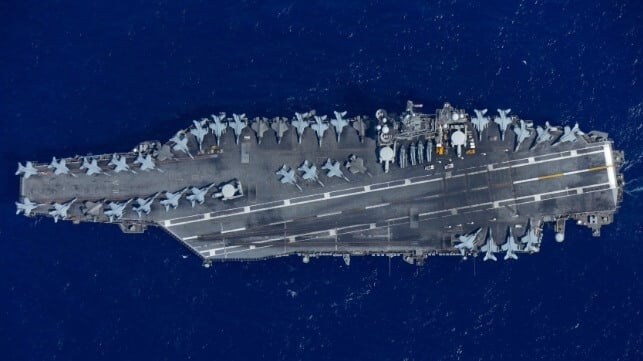


Alwaght- As tensions heighten in West Asia region and the US says it has deployed to this region its carrier strike group led by USS Abraham Lincoln aircraft carrier north of the Arabian Sea, one question repeats itself: Can Iran sink an American aircraft carrier?
On the paper, the US President Donald Trump can in the shortest time order airstrikes against Iran, but in action this is not a piece of cake. Actually, while the US's power to maneuver at sea is considerable, Iran's hands for countering the US naval force and the giant ships are not empty.
The USS Abraham Lincoln is a Nimitz-class nuclear-powered aircraft carrier carrying with some 60 F/A-18 Super Hornet jets. However, launching strikes from these floating bases against Iran would prove a complex and perilous operation. A critical and unresolved question hangs over the massive warship: in a full-scale conflict, could it, and others like it, withstand the barrage of Iran’s advanced missile arsenal?
Iran's "missile cities" vs. fighter jets
Iran's conventional air force is seen as of limited power as it is hit by decades of sanctions that barred Tehran from renewing its fleet of fighter jets. However, Tehran simultaneously compensated for its air force limits with developing its missile power. At present, Iran holds one of the most diversified missile arsenals in the world, including short-range, mid-range, and long-range missiles, as well as cruise missiles, and most importantly the hypersonic missiles with indigenous technologies unique to Iran. They fly with speeds reaching over 5 mach, giving very limited time for the foes to respond.
Recent military assessments, citing Iran's direct missile strikes against Israel during 12-day war in June, underscore a significant shift in the regional balance of power. Iran has demonstrated it possesses long-range ballistic missiles equipped with advanced hypersonic technology, such as the Fattah 2, weapons designed to evade modern air defenses.
Crucially, a portion of Iran's ballistic arsenal is engineered for a specific purpose: targeting large warships at sea. This capability is no longer theoretical. In 2024, Yemeni forces, who have publicly confirmed sourcing these weapons from Iran, successfully employed these missiles against commercial and military vessels violating a ban on Israel in the Red Sea and Gulf of Aden.
Actually, the experience of the Yemeni missiles for use of these missiles against ships in supply of Gaza war and implementation of the anti-Israeli ban in 2024 demonstrated Iran's sufficient power to strike naval ships in the sea.
How do American naval ships become vulnerable?
The aircraft carrier USS Abraham Lincoln does not operate alone at sea. It sails within a carrier strike group surrounded by destroyers. A Reuters report details that the flat-top is protected by a carrier strike group comprising cruisers and destroyers equipped with the Aegis combat system, one of the world's most advanced naval air defense networks.
This defensive shield operates in layers. The outermost layer consists of electronic warfare systems designed to jam or confuse incoming missiles. Each destroyer is armed with approximately 90 surface-to-air missiles, including the RIM-174 SM-6, a long-range interceptor with a reach exceeding 400 kilometers. Newer variants of this system also possess ballistic missile defense capabilities, enabling them to intercept certain ballistic and hypersonic threats during various phases of flight.
Despite this advanced anti-missile arsenal, a critical question remains: How would this defensive system perform against a mass missile barrage from Iran, involving the simultaneous launch of more than 100 projectiles? While American warships are outfitted with the most sophisticated missile defense systems available, even these advanced systems could be overwhelmed by a saturation attack. The simultaneous tracking and interception of over 100 incoming missiles is considered an impossible task for even the most capable anti-missile systems.
How would Iranian attack look like?
It seems that Iran's plan for attacking this aircraft carrier relies on intelligence and technical and calculated assessments.
A report by India Today suggests that Iranian forces can simultaneously fire hundreds of Shahed-136 direct attack drones beside ballistic and cruise missiles at American warships and aircraft carrier. This tactic is meant to saturate and overwhelm the air defenses of the strike group. Actually these projectiles force the American warships to fire air defense missiles in self-defense. Once they run out of ammunition, the hypersonic missiles with large destruction power can be fired at these warships.
Geopolitical location, a determining factor
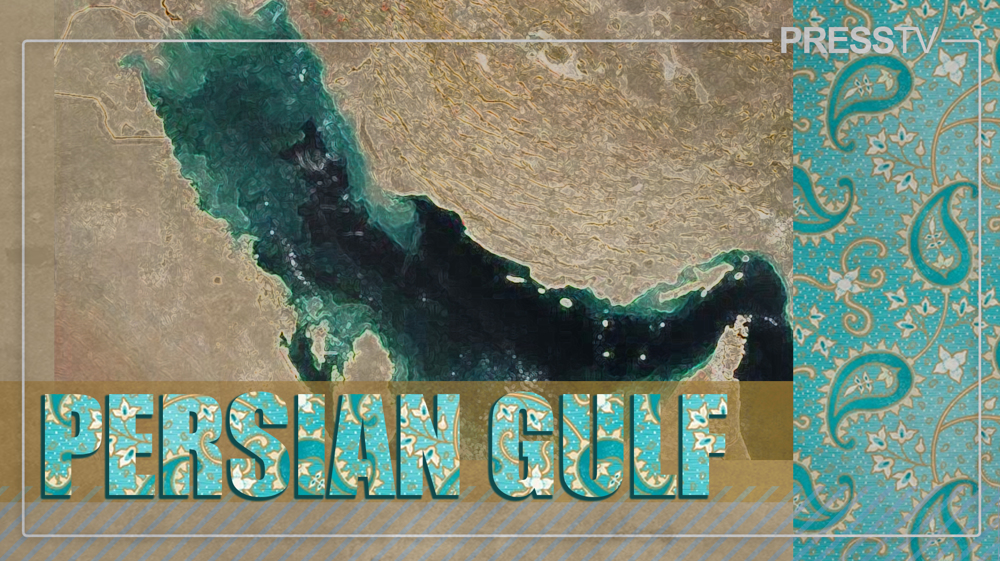
From a geographical perspective, it is unlikely that the US aircraft carriers would operate in Iranian coastal waters such as the Persian Gulf or even the Gulf of Oman. In these waters, Iran's coastal missile forces would have maximum range and capability to target American vessels. Instead, the USS Abraham Lincoln is expected to operate in the Arabian Sea, using Oman's mountainous terrain as a geographical shield to gain time in the event of a missile attack from Iran.
Military Defense website analyses also report on the role of geography in tensions between Iran and US carriers, noting that aircraft carriers are not stationary targets. A Nimitz-class aircraft carrier weighs over 100,000 tons and can travel at speeds exceeding 25 knots, covering hundreds of kilometers per day. Accordingly, carrier strike groups constantly alter their course to avoid predictable movement patterns.
For a successful strike against such a target, Iran would require a rapid and flexible missile launch chain, integrated with satellite surveillance, data fusion, command and control systems, and immediate launch capabilities. It appears Iran, aware of this operational reality, has sought to equip its missile systems with reliable satellite tracking to maintain continuous surveillance of an aircraft carrier.
Iran ready to test its naval power
At the same time, it should be taken into account that sinking an American aircraft carrier is extreme difficult. Actually, Iran can raise the costs and risks of American operations, though destroying an aircraft carrier is contingent on a set of factors and capabilities. An American military expert at the CNN believes that deterrence at sea is mainly about who can see, detect, and attack first. So, aware of these difficulties, Iran seems to be pushing to test its capability to strike the largest ships of the US Navy in a potential confrontation with reliance on satellite power unreliant on the Western technology. Vahid Yazdanian, the director of Iran's Space Research Center, had asserted that Tehran through long steps in the space industry has managed to develop domestic technology for building communication and reconnaissance satellites and use them, an important step bolstering Tehran's defense and scientific capabilities.
In the past, the US Global Positioning System (GPS) was the sole global navigation option widely used. Today, however, countries like China, Russia, Japan, and Britain have also developed their own dedicated satellite navigation constellations. Beijing employs its own navigation satellite system, dubbed Beidu, and Iran has been able to use these systems. However, Iran's ultimate goal is to develop indigenous subsystems capable of integration with domestic navigation networks. Based on this, Iranian forces are expected to leverage their missile capabilities by relying on non-Western satellite and navigation systems to track US naval vessels.