


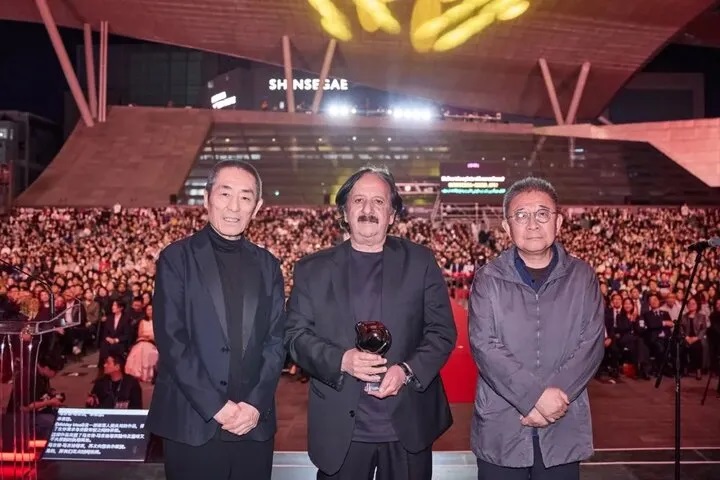


Alwaght- Some voices cannot be silenced by bombardment; voice of a mother who lost her child, voice of kids who do not come back from school, and the voice of an Iranian artist who has stood by his country in the hard days.
The new shine of Majid Majidi, the renowned Iranian director, at the Busan Film Festival in South Korea has drawn considerable attention these days, with international media widely covering the remarks of this stylistically distinctive figure of Iranian cinema, known worldwide for works such as Children of Heaven and The Song of Sparrows, as he accepted the festival's Best Film award.
In these days when the wounds of the mothers and families of the Minab schoolchildren are still fresh, and the human dimensions of the war against Iran struggle to find visibility amid the flood of military and political news, Majidi chose to go beyond an artistic statement, to become a resounding voice for the victims of the brutal aggression of the US and the Israeli regime, and a defender of the Iranian people's righteousness. It was a voice that, from a high-profile international platform, would offer global public opinion a different narrative of the war.
After winning the Best Film award at the 31st Busan International Film Festival for Midday Meal, the committed artist seized the opportunity of his presence at this prestigious event to speak about the people of Iran, the consequences of the war, and in particular the Minab school tragedy. In his remarks, he spoke of the widespread destruction of people's homes and the killing of students in the attack on the school, and dedicated his award to the people of Iran.
The further we drift from the moment a crime is committed and fresh headlines displace older ones, the greater the risk that public memory of it will fade. Raising this tragedy again on an international stage can help preserve it in the media's memory and sustain demands for accountability from those responsible.
Art, the common language of Iranians in defense of the country
Another facet of Majidi's remarks is the way they capture the link between defending Iran and national solidarity. Iranian society, for all its political, cultural, linguistic, and social differences, is a pluralistic one; but foreign aggression and the targeting of a people and their land create an issue that transcends domestic disagreements. In such a moment, protecting citizens' lives, the security of the country's territorial integrity, and national independence become common ground for the full spectrum of society.
The artist occupies a special place in this equation, because the language of art can cross political borders and speak to its audience through emotion, shared human experience, and collective destiny. By centering his remarks on children, families, and the suffering of ordinary people, Majidi honed in on a dimension of war that requires no particular political affiliation or ideological leaning to grasp: no child should be a casualty of war, and no family should be left alone to face the destruction of its home and the loss of its child.
From this dimension, defending the homeland cannot be reduced to a single form or a single arena. The soldier guarding the country's borders, the citizen whose presence on the social stage affirms national solidarity, and the artist who refuses to let the victims' narrative drown in the media din—each plays a distinct role in safeguarding the nation's capital and defending society, and artists can serve as the stage on which national unity is displayed before the eyes of the world.
Cinema vs. war of narratives
In contemporary wars, the battlefield is no longer confined to the military domain. Media image-making, the spotlighting of certain events and the sidelining of others, and the contest to determine which narrative reaches public opinion, all of this is part of the conflict. In such an environment, artists can help fill some of the gaps in the media narrative by documenting the human experience of war, refusing to let civilian victims be reduced to mere numbers and statistics.
This approach resonates meaningfully with the theme of Midday Meal. The film tells the story of a teacher in a deprived area of Chabahar who, after a benefactor cuts off financial support, faces mounting difficulties in feeding his students and keeping the school from closing. At the heart of the story lies a simple but fundamental question: children's right to food, to education, and to the chance to build a future. The choice of such a subject and then the linking of the film's international presence to the fate of the children of Minab, brings together two facets of Majidi's cinematic attention to children's lives and society's responsibility toward them.
Finally, Majidi's heroic stance demonstrated that in an era when soldiers defend the country on the battlefield and the people affirm their bond with the homeland through their presence and solidarity, the artist's voice, too, can ring out from the trenches of culture and media.