













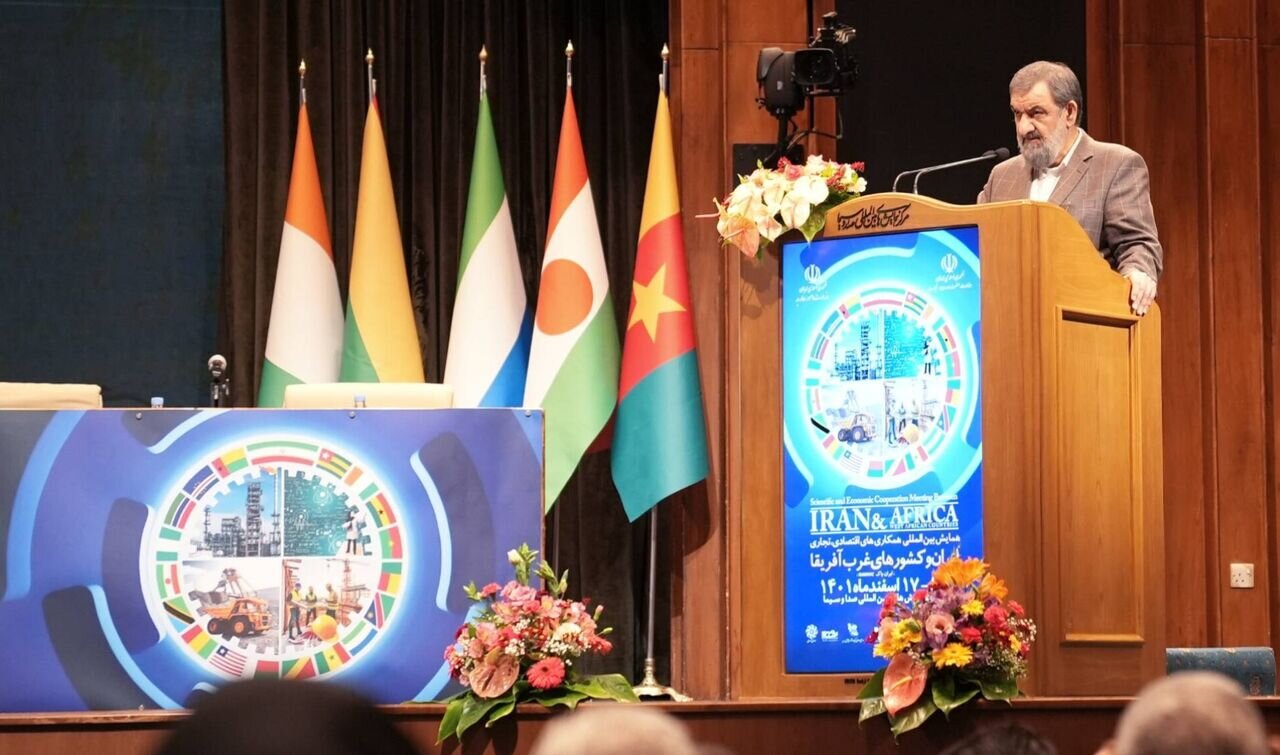


Alwaght- Africa is no longer just a continent rich with natural resources and virgin markets for the economic powers. It is becoming one of the most important theaters of geopolitical competitions of the 21st century. A continent of 54 countries and over 1 billion population with enormous mineral and energy resource and one of the youngest populations in the world, Africa is undergoing changes that can transform how it looks like in the international equations.
With this in mind, Iran's presence in Africa should not be seen just within the framework of ordinary exporting or expanding diplomatic ties. For Tehran, Africa can be part of a broader strategy whose aim is breaking economic and political isolation, offering new markets, expanding ties with countries independent of Western influence, and increasing Iran's geopolitical depth in the marine routes passing through to the Red Sea and Indian Ocean.
Africa importance
The stakes become even clearer when you consider that Africa holds a substantial share of the world's strategic mineral reserves. Gold, cobalt, platinum, chromium, uranium, and diamonds, alongside oil and gas, agriculture, and vast renewable energy potential, have turned the continent into one of the key epicenters of the global economy's future.
Beyond natural resources, Africa's expanding consumer market and young population represent an advantage whose long-term significance will likely eclipse that of many of the continent's raw materials.
Dimensions and capacities of Iran's presence in Africa
In past years, Iran has expanded its presence in some parts of Africa. This included diplomatic and political ties to defense and technology cooperation, represented by its exports of drones and other military wares.
Reports have surfaced that several African countries are using Iranian drones, including the Mohajer-6. Such cooperation, while not in itself amounting to a strategic alliance, shows that Iran's defense industry can hold appeal for African states grappling with security threats, terrorism, or weak air power.
It is worth noting that the significance of this for Iran is not purely economic. Defense equipment can serve as a starting point for broader cooperation, from training and maintenance to intelligence-sharing, border security, and technology transfer. Indeed, if Tehran can link arms sales to industrial and training cooperation, a relationship that begins as purely commercial can evolve into a long-term partnership.
Crucially, Africa's geography carries another layer of importance for Iran. Viewed through the lens of the Red Sea, the Gulf of Aden, and the Indian Ocean, this continent shifts from an economic market to a geopolitical variable.
East Africa and the Horn of Africa sit near one of the world's most vital maritime corridors, the route that runs from the Red Sea through Bab-el-Mandeb and on to the Gulf of Aden and the Indian Ocean.
For this reason, any expansion of Iran's ties with East African nations, Yemen, the Horn of Africa, and Indian Ocean coastal states must be seen on a larger map. If sustained and managed wisely, these relationships can help deepen Iran's strategic reach in its surrounding environment, though the extent of that influence should not be exaggerated, nor should every economic or political tie be equated with establishing a base or an axis.
Another key variable creating new opportunities for Iran is the shifting attitude of some African countries toward the West.
In recent years, discontent with traditional cooperation models involving France and other Western powers has grown in parts of Africa, particularly in the Sahel. Military coups in several countries in the region, the drawdown of French military presence, and a growing tilt toward Russia, China, and other non-Western partners all signal this changing environment.
Still, it would be a mistake to read this trend as a simple pivot to the East. Many African governments are not looking to replace one foreign power with another, but rather to have more options at their disposal. That very dynamic creates a significant opening for Iran.
It should be taken into account that Iran can present itself as one of the options avaliable to Africa for cooperation. It is a country that under long-term sanctions has managed to produce its own military equipment for lower prices and also to reach high degree of self-sufficiency in such areas as agriculture, medicine, energy, and some new technologies like nano. Seizing this opportunity, indeed, requires Tehran to avoid ad hoc approaches and regard Africa not as a political backyard or consumer market, but as an array of governments with various interests.
Africa, the emerging ground of competition
In recent years, competition for presence and influence in Africa has intensified among the world's major powers and regional players, a clear sign of the continent's outsize importance to the future international order.
China has entered Africa through infrastructure investment, loans, and trade, while Russia has focused more on security, military cooperation, and engagement with crisis-ridden states. The US still maintains a network of defense, training, and logistics partnerships across parts of the continent, and the Israeli regime is expanding its ties in areas such as agriculture, technology, security, and health.
Iran, then, is not stepping into a vacuum in Africa, but entering a market where virtually every major power is competing for a share.
Nigeria is a case in point. Medical cooperation and the shipment of equipment and ambulances to the country by the Israeli regime, alongside efforts to expand defense ties, show that influence in Africa does not necessarily run through weapons and security. Health, agriculture, technology, water, and even education can serve as effective instruments of soft power.
That experience carries a clear message for Iran as well: if Tehran wants to build lasting influence, it must not let military tools crowd out every other instrument of diplomacy.
The same holds true for the US. Washington's continued defense cooperation with countries like Botswana shows that, contrary to some perceptions, the US has not fully disengaged from Africa. Even where US direct footprint has shrunk, training, arms, and logistics networks can still sustain its influence.
Russia, by contrast, has sought, particularly in the Sahel region, to exploit the security needs of military and fragile governments. Reports of the so-called Africa Corps supporting Niger's government during an armed uprising illustrate how Moscow's security cooperation with some African states has shifted in nature. This trend shows that competition in Africa is no longer just about markets and security and the survival of political regimes have become part of the contest as well.
Ways to expand Iran's influence and presence in Africa
It should be added that for Iran, these conditions are both a threat and an opportunity. They are an opportunity because the multiplicity of the players allows the African nations to diversify their partners and Iran can be part of this portfolio. The threat lies in the fact that, to secure an effective foothold, Tehran must compete with powers that command far greater financial resources, investment capital, and diplomatic capacity.
So, perhaps the most important advantage of Iran in Africa is not its investments but its power to provide low-cost cooperation, and matching the needs of these countries. Drones, defense equipment, medicine, technical services, machines, agricultural technology, and the precious experience of weathering the Western sanctions are areas where Iran enjoys comparative advantage.
But it must be mentioned that this advantage only translates into lasting influence when it is accompanied by real trade. Iran's foreign relations record shows that announcing grand agreements does not necessarily mean delivering on them, and Africa is no exception. If political ties fail to produce increased trade, joint investment, new transport corridors, banking facilitation, and private-sector presence, their impact will likely be limited and short-lived.
The African Union takes on particular importance here. If Iran's Africa policy is to rise above bilateral relations, it must grasp the continent's institutional architecture. Africa is a collection of 54 countries with distinct interests, political systems, and orientations, no single template can be prescribed for all of them. Engaging with inter-African bodies and blocs, alongside developing bilateral ties, can allow Tehran to upgrade its image from a purely security-oriented actor to a political and economic partner.
Southern Africa, too, should not be dropped from Iran's calculations. Moving from North Africa toward the east, west, and south of the continent and reaching the Indian Ocean rim, if paired with a long-term plan, could project a different image of Iran's Africa policy. The goal of such a policy is not necessarily a military presence, but a network of economic, political, and technological-security relationships that can give Tehran greater depth in times of crisis.
At the same time, a strategic mistake must be warned about. Africa should not be viewed solely through the lens of Iran's confrontation with the West. African countries are independent actors, and many are unwilling to sever ties with the U.S. or Europe because of closeness with Iran. Even states dissatisfied with Western policies may simultaneously cooperate with China, Russia, the US, Europe, Turkey, India, and Iran.
The success of Iran's Africa policy, then, depends less on anti-Western slogans than on Tehran's ability to offer a compelling, actionable cooperation proposal.
Additionally, it should be noted that Africa can serve three simultaneous functions for Iran: a market, a political partner, and geopolitical depth.
A market means access to the continent's growing population and economy. A political partner means expanding the number of countries with which Tehran can maintain relations independent of Western pressure. And geopolitical depth means extending Iran's network of connections along the Red Sea, the Gulf of Aden, and the Indian Ocean.
But realizing these three goals takes a vision review. If Iran sees Africa only as a market, it will fall behind key rivals like China, Turkey, India, and others. And if looks at it as a ground for security competition with the US and Israeli regime, it will lose a great part of its economic and social capacities.
The more effective way can be a combination of the soft and power, trade, technology, official diplomacy, private sector, and bilateral and inter-continental relations. In such a model, defense cooperation is just one of the tools, not the whole strategy.
Seen this way, the core challenge for Tehran is not conquering Africa, but building a durable place in an emerging Africa. A continent that today is a stage of competition among China, Russia, the US, Europe, India, Turkey, and the Israeli regime will likely rank among the world's most important centers of economic and demographic growth in the coming decades.
It should also be added that if Iran can, before the new power configuration fully consolidates, transform its ties with African countries from ad hoc agreements into a network of mutual interests, Africa could shift from a peripheral arena of Iranian foreign policy to one of the pillars of the country's foreign relations diversification.
In that case, Africa's strategic value for Iran will lie not in the number of drones sold or agreements signed, but in the formation of a network of economic, political, military-security, and cultural ties capable of defusing part of the pressure from Iran's external isolation while simultaneously cementing its presence in one of the most important arenas of global power competition.










