












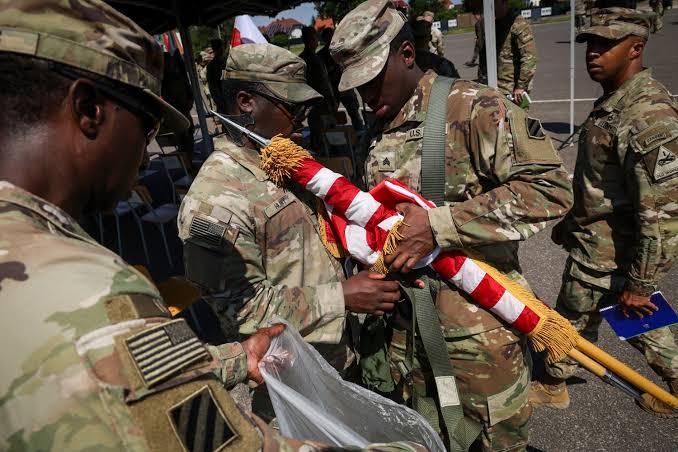


Alwaght- On Friday, NBC News reported, citing seven current and former US officials, that Pentagon was mulling plans to withdraw military wares, including aircraft, ships, and indeed tens of military personnel from Europe. The move would amount to a reduction of roughly one-third of US forces stationed on the continent, or nearly 25,000 troops, though some accounts suggest the figure could rise to as many as 40,000.
General Alexus Grynkewich, commander of US forces in Europe and NATO's top general, has delivered his preliminary assessment to War Secretary Pete Hegseth, with a final recommendation due by November 6.
The public rollout of the plan is hardly coincidental as it marks the culmination of a process launched in June with a six-month review of the US military posture in Europe.
Albridge Colby, the Pentagon's strategy chief, framed the review's goal as locking in a swift, irreversible shift toward Europe shouldering primary responsibility for conventional defense. Colby calls this vision NATO 3.0, an alliance in which Europe supplies the bulk of conventional firepower while the US retreats to a purely nuclear guarantor and strategic backstop role.
Germany, Italy and Spain are slated to absorb the deepest cuts, according to reports, with some troops likely repositioned to NATO's eastern flank, a shift underscored by Trump's announcement of progress toward establishing a permanent US military base in Poland.
Iran war, an accelerator of disputes
But one accelerant of the trans-Atlantic rupture is, in the current moment, the war with Iran.
Washington started its aggression against Iran without consulting its European allies and indeed Europe avoided involvement in response despite US calls for help. Spain said no to the US request to use its military bases for anti-Iranian operations and France denied permission to some American military flights over its airspace.
Hegseth, at the June gathering in Brussels, struck a tone rarely heard from his predecessors: when Washington asked to use European bases, he said, a striking number of allies told us no, a conduct he branded shameful. Trump, for his part, called NATO a paper tiger and accused member states of cowardice. The withdrawal of 5,000 troops from Germany was announced only after Chancellor Friedrich Merz criticized America's strategy in the war, a telling link between political friction and military punishment.
That logic of reward and punishment took institutional form last month. According to a document obtained by Bloomberg, Washington has circulated a questionnaire among NATO members measuring each country's public support for US foreign policy, the restrictions it places on American forces' use of its bases, and how much it buys from US defense contractors. Allies see the initiative as an attempt to force them to prove ideological loyalty in exchange for American military protection. Even US analysts warn that such scorekeeping conflates military contribution with political alignment, and, at the very moment when the pivot to a Europe-led model demands greater cohesion, it stokes rivalry among allies instead.
Dispute within NATO, another face of the trade war
The economic dimension of this rupture is no less consequential than the military one. In a document delivered to European lawmakers last week, Washington threatened that unless European preference clauses are stripped from the EU's long-term budget, it will review the full range of retaliatory options, including suspending "Buy American" waivers under mutual defense procurement agreements with 19 of the bloc's 27 members. So, the military realignment and a trade war over defense industries have become two sides of the same coin. Washington wants Europe to shoulder more of the defense bill while European contractors capture a smaller share of the contracts.
Europe, for its part, has hardly sat idle. July's Ankara summit produced an expanded A330 tanker fleet, joint purchases of Triton drones and Global 6000 aircraft, and a deep-precision strike initiative backed by 12 allies with a commitment approaching $50 billion. EU foreign policy chief Ursula von der Leyen, in her September 16 annual address, proposed a European security council bringing together the EU, Canada, Norway and Britain, along with an emergency mechanism modeled on NATO's Article 4. The FREYA missile defense project, involving nine European countries plus Ukraine and pitched as a cheaper alternative to Patriot, will serve as the real-world test of this pivot.
Is Europe prepared for defense independence from the US?
Meanwhile, the main issue is time. The International Institute for Strategic Studies in its recent assessment has warned that the European ground forces are not yet ready to provide the backbone NATO requires and shortage of manpower, artillery, air defense systems, and munitions can hardly be replenished before end of the current decade.
The think tank points to a mismatch between capabilities and timelines, citing shortcomings in fuel distribution capacity to the eastern flank, medical evacuation, heavy armored rail transport, and mobile bridging equipment. In the areas of integrated command and control, strategic intelligence integration, and advanced missile defense, Europe likewise lacks capabilities on par with those of the US.
At the end, NATO is not on the brink of collapse, but on route to transform to a two-way structure, where Poland gets a permanent military base and Spain is punished. The main risk for NATO is not the US exit but the time gap between the US power downturn and the Europe power uplift, a period that can prove golden to Moscow. Today, Europe's strategic independence is not a tactical choice but a strategic and emergent response to mistrust.