
















Alwaght- Though the US President Donald Trump claimed that the Iranian missile strikes on the American bases in the Persian Gulf have not inflicted meaningful damage on these facilities ovetlr past six months, as the war drags on, new reports emerge to reveal fresh details of the US damage and casualties, to the extent that the White House officials can hardly hide the true dimensions of these losses.
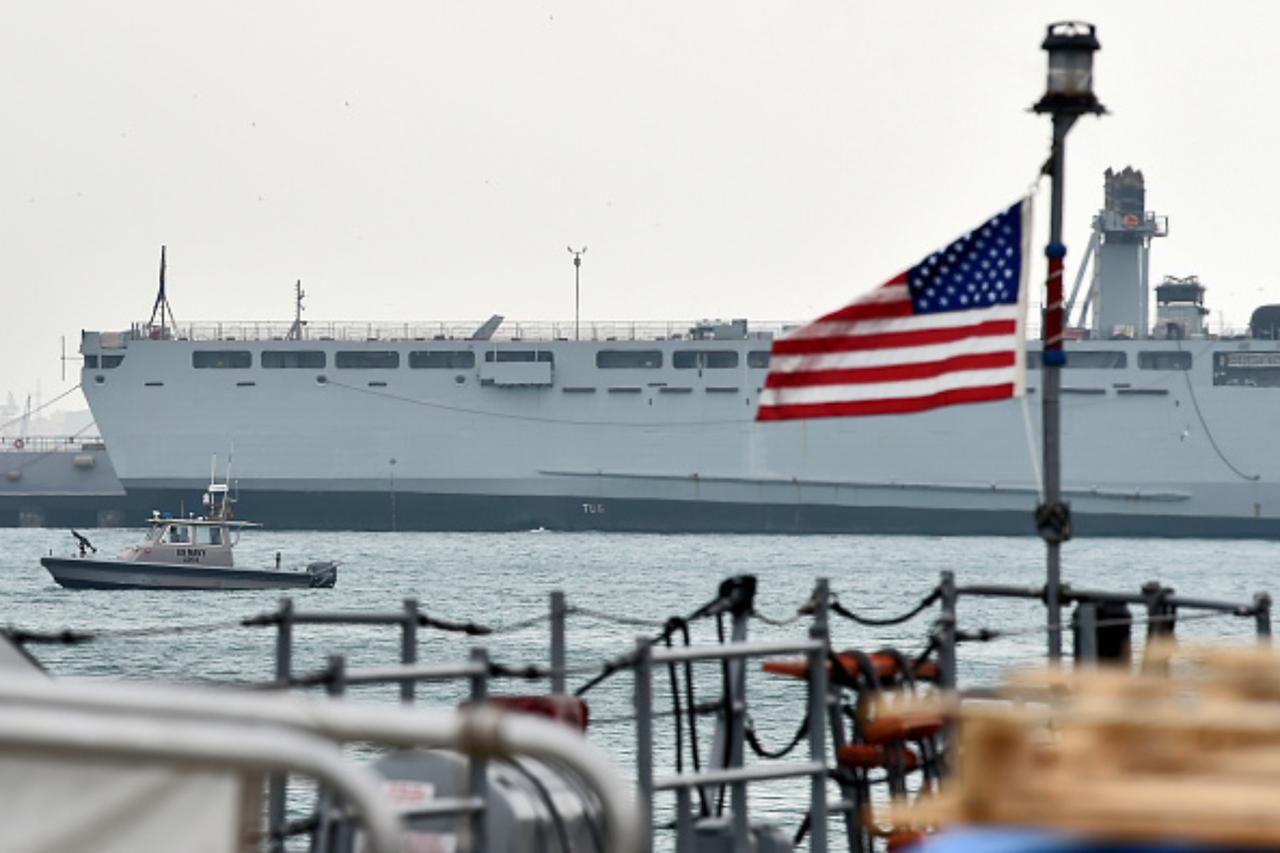
In this connection, the Acting Secretary of Navy Hung Cao admitted that the Iranian attacks have caused major damage to the US's naval facilities in Bahrain, the home to the Fifth Fleet.
The US official’s remarks amount to a rare acknowledgment at such a senior level of the damage inflicted on the headquarters of the US Navy’s Fifth Fleet in Bahrain. He stressed that “Bahrain hosts the headquarters of the U.S. Navy’s Fifth Fleet, whose area of operations encompasses the Persian Gulf, the Red Sea, parts of the Indian Ocean and other territorial waters.”
Cao said the damage to the base had also disrupted operations involving the aircraft carrier USS Abraham Lincoln, leaving the carrier’s crew without a place to berth.
The comments come after Military Times reported that several crew members aboard the Abraham Lincoln, which had been deployed as part of operations against Iran, had committed suicide. The report cited excessive workload and extreme fatigue among the factors affecting the sailors. MS NOW also reported that the carrier’s prolonged deployment had led to equipment problems, including malfunctions in its aircraft launch and recovery systems.
Earlier analyses based on media reports and satellite imagery had indicated that US facilities in Bahrain sustained significant damage during Iran’s attacks.
Admiral Daryl Caudle, the chief of naval operations, said in early September that the Navy would not resume its maritime support operations in Bahrain “anytime soon” because the facility had been damaged.
Significance of presence of US Navy in Bahrain
The deployment to Bahrain of the US Fifth Fleet and Navy command is not just about some warships sent to this tiny Persian Gulf Arab kingdom, rather, the Fifth Fleet is practically the headquarters of the command, logistics, abs rapid reaction of the US in West Asia waters. This command operates in an area of 2.5 square nautical mile among 21 countries, a area that covers the three strategic chokepoints of Strait of Hormuz, Bab-el-Mandeb, and Suez Canal.
The importance of the fleet based in Bahrain becomes even clearer when considering that roughly 20.9 million barrels of oil passed through the Strait of Hormuz each day in the first half of 2025, equivalent to about 20 percent of global consumption of oil and roughly a quarter of the world’s seaborborne oil trade.
For Washington, Bahrain is therefore an operational anchor, providing a platform to monitor and control shipping lanes, protect energy infrastructure, provide logistical support, gather intelligence and rapidly deploy forces for large-scale combat operations. The US Navy also maintains repair and maintenance infrastructure in Bahrain for 14 vessels stationed in the region. At the same time, the Fifth Fleet commander oversees both US Naval Forces Central Command and the multinational naval coalition known as the Combined Maritime Forces.
Washington uses the Fifth Fleet to patrol the Persian Gulf and the Strait of Hormuz, monitor Iranian vessels and maintain a permanent military presence at one of the closest points to Iran.
For decades, the Fifth Fleet has hosted carrier strike groups. These formations, which include guided-missile destroyers and air wings equipped with fighter jets, electronic-warfare aircraft, helicopters and airborne early-warning and control aircraft, give the US the ability to conduct air and missile operations while supporting ground forces.
The presence of a command facility in Bahrain also allows the US to move personnel, intelligence, ammunition and equipment more rapidly among the Persian Gulf, the Gulf of Oman and the Red Sea. The 2021 evacuation from Afghanistan offers a clear example: Fifth Fleet headquarters assembled a 1,400-person task force that helped transport 7,000 people from Afghanistan to Bahrain.
Figures about the US fleet in Bahrain
American naval footprint in Bahrain traces back to 1971, when, after Bahrain gained independence, the US Navy leased part of the former British facilities. In 1995, Washington reactivated the Fifth Fleet, and by 1997 the Juffair complex was expanding under a military construction program. In 1999, it was rebranded Naval Support Activity Bahrain.
Over the past two decades, Washington has poured substantial sums into maintenance, upgrades, communications, logistics, and ship repairs. The turning point came in 2010, when Washington launched a five-year, $580 million plan to roughly double the base’s capacity. The original site spanned about 62 acres and the new development extended it into a connected complex with 77 acres of coastal land.
The project encompassed security facilities, service and logistics buildings, barracks, port installations, a harbor patrol center, a small-craft basin, a dining facility, and administrative offices. One of its centerpieces was a 400-foot suspension bridge weighing roughly 2,500 tons, linking the main facilities to the expanded waterfront section—installed in December 2013.
More recently, a base support contract worth about $27.9 million in 2023 and a 2025 amendment valued at $30.2 million have added to the infrastructure investments in Bahrain.
The US military presence at the base has never been static. In mine countermeasures, for instance, four Avenger-class minehunters were stationed in Bahrain through 2025, but all four were decommissioned in September 2025. That did not signal a drop in capability: Washington replaced the aging ships with a newer generation of Littoral Combat Ships (LCS) and mine clearing systems.
USS Canberra (LCS-30) arrived in Bahrain in May 2025 as the first LCS equipped with a mine countermeasures mission package. USS Santa Barbara (LCS-32) deployed to the region alongside it. The US Navy has said it ultimately plans four LCSs for Bahrain-related missions.
Washington typically does not keep a fixed number of guided-missile destroyers in Bahrain, but Arleigh Burke-class destroyers attached to the Fifth Fleet enter the Persian Gulf depending on the mission and then leave the area. Each is equipped with the Mk 41 vertical launching system and carries Tomahawk and Standard missiles.
Fifth Fleet's role in Iran war
In the 40-day war, the Fifth Fleet acted as knd of the main command and logistics centers of the US Navy operations in the region. The Fleet applied communication, logistical systems and coordinated naval operations and supported the American forces in the Persian Gulf and Strait of Hormuz.
So, because of the fleet’s role in planning air operations, Iran put the base on its target list too—, and on the very first day of the war, missile and drone strikes on US positions in Bahrain began. On June 3, during a temporary ceasefire, Iran said it had hit the Fifth Fleet headquarters in retaliation for American attacks.
The significance of those strikes became clearer when later reports described extensive damage to the base’s infrastructure, command centers, warehouses, and communications equipment. American officials later said more than 8,000 Iranian munitions were fired over the course of the war.
A Washington Post review of satellite imagery in late May found that more than half of the identified damage at US bases in the region, 228 buildings and pieces of equipment, was concentrated at the Fifth Fleet headquarters and in Kuwait.
What raises the stakes further is that, by targeting the center, Iran was in effect trying to squeeze the US Navy’s command-and-support chain in the Persian Gulf, not merely destroy a military base. That is why Bahrain sat squarely in the crosshairs of Iran’s armed forces. On June 28, the Islamic Revolutionary Guard Corps (IRGC) said it had struck facilities linked to the Fifth Fleet with ballistic missiles and drones. On July 24, the IRGC reported heavy damage to a Fifth Fleet observation tower.
Rereading the war, then, shows how Bahrain morphed from a relatively secure command-and-support platform into one of the most vulnerable nodes of the American presence in the region, a shift that constrained the Fifth Fleet’s logistical reach and freedom of action and forced Washington to rethink how it postures its naval forces in the region.
With Bahrain base out of service, what does it mean for future American-Iranian confrontation?
With Bahrain base slipping out of the fleet’s operational rotation, the fallout for future US-Iran confrontations will go well beyond Washington losing a single military base.
It could slow its response times, weaken support for ships deployed in the Persian Gulf, and erode its command capability near the Strait of Hormuz. The greater distances to alternative hubs also drive up the cost and time needed to move fuel, spare parts, munitions, and personnel.
Washington, for its part, will be forced to abandon its reliance on one large, fixed hub in favor of a more dispersed, more mobile network, one that is both costly and riddled with new vulnerabilities.
Therefore, in a potential future confrontation, Iran’s strikes on Bahrain could push the US “forward presence” toward a “dispersed presence”, not necessarily a withdrawal from the region, but a shift that undermines its freedom of action and operational agility.










