














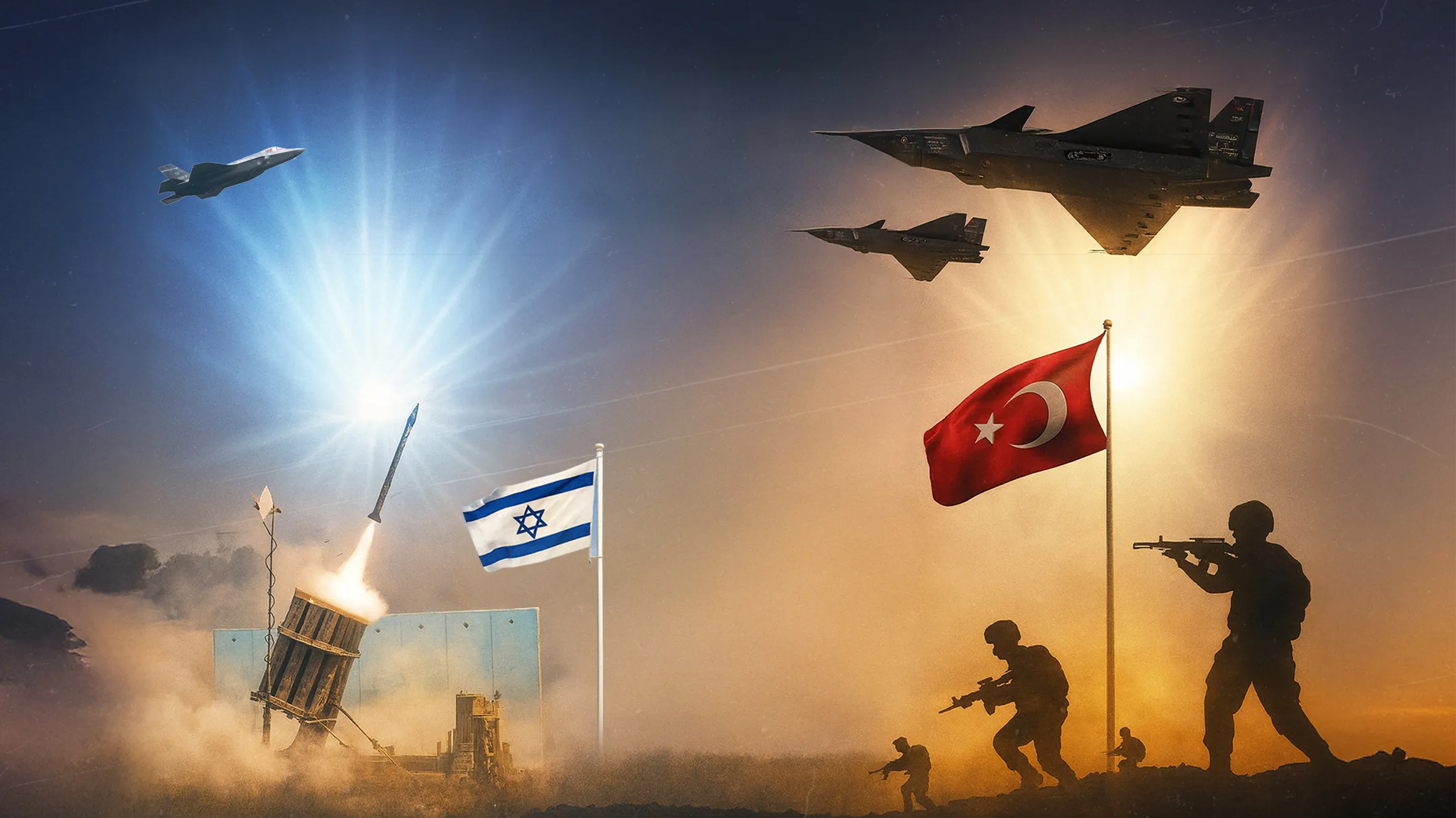


Alwaght- Tensions between Turkey and Israeli regime in recent weeks have gone beyond political dispute over Gaza war and have elevated to a more direct confrontation over Syrian future, military influence in the region, Eastern Mediterranean, and region's security formation. However, some analysts suggest that in the current conditions, Ankara does not seek to engage directly in war, rather, it seeks to activate a combination of legal, diplomatic, economic, abs military instruments to increase Tel Aviv's costs of actions and at the same time steer clear of controlled clash.
This can be described, according to Modern Diplomacy, policy of deterrence without immediate entry into war.
Tensions between Turkey and Israel have escalated sharply over Syria, which has become the primary theater for their rivalry. Following the fall of Bashar al-Assad in December 2024, Turkey has deepened its ties with the new government in Damascus and signaled an expansion of its military and security support. Tel Aviv, in turn, views Ankara's growing foothold with deep alarm, fearing the establishment of Turkish military infrastructure on its northern border.
Last week's Israeli airstrike on the Abu al-Duhur airbase in northwestern Syria marked a new phase in this confrontation. Tel Aviv cast the attack as a preemptive measure to block the deployment of Turkish forces, calling it a direct threat to its security. Ankara rejected the claim, denouncing the strike as a violation of Syrian sovereignty.
Days before the attack, Turkish Foreign Minister Hakan Fidan had already labeled Israel's assaults on Syria's sovereignty and territorial integrity as among the "greatest threats" to the country's stability and called on the international community to increase pressure on Israel. Yet even as he delivered that warning, Fidan stressed that Ankara does not seek a direct military clash in Syria. "We do not intend to get into a conflict with anyone in Syria," he said. But he also made a pointed caveat: if instability in a neighboring country threatens Turkey's national security, Ankara "will not sit and watch." In such a scenario, he added, Turkey would not hesitate to use all tools at its disposal, including military force.
Here are Turkish options against Israeli regime:
International legal pressure against Tel Aviv
One of the clearst reactions of Turkey could be transfer of part of confrontation with Israeli regime from military to legal area.
Ankara has already pursued an arrest warrant for the Israeli Prime Minister Benjamin Netanyahu and another defendant for attack on Global Sumud flotila for breaking Gaza siege. On August 21, Turkey announced Ankara asked a Red Notice of Interpol for Netanyahu, who is already under risk of arrest by ICC for war crimes in Gaza. The charges include genocide, crimes against humanity, torture, stripping freedom, and abduction. Based on a report by Modern Diplomacy, the move is unlikely to lead to Netanyahu's actual detention, as the execution of an Interpol Red Notice is not automatic, and the organization's regulations impose restrictions on cases that are predominantly political in nature. Politically, however, the move serves as a lever of pressure, enabling Ankara to raise the stakes in its confrontation with Israel without resorting to military force. In effect, Turkey is seeking to transform the Gaza issue and Israel's conduct from a bilateral dispute into an international legal case.
Maintaining and strengthening Turkish presence in Syria
An Al Jazeera report says Ankara's second strategic option is standing firm in Syria. Turkish officials have made clear that cooperation with the Syrian government will continue across security, reconstruction, and military training. In its official statement following the recent Israeli strikes, Ankara reaffirmed that it would keep working with Damascus to establish security and would not allow Syria to be destabilized.
That stance carries significant weight. The Turkey-Israel rift in Syria is not fundamentally about a single military base, rather, it is about who will shape Syria's post-war security architecture. An analysis by the Al Jazeera Center for Studies echoes this view, identifying the struggle as one of the most consequential structural fault lines between the two powers. Israel, the report argues, is deeply unsettled by Turkey's growing influence, its training of Syrian forces, and the prospect of permanent Turkish bases. Ankara, by contrast, views its presence in Syria as integral to its own national security and to broader regional stability.
Establishing mechanism to avoid military encounter
Turkey at the same time has shown that it is uninterested that bombing of its positions in Syria will escalate into a direct war with Israeli regime. After Israeli attacks on Abu Al-Duhur in Syria, the US actively embarked on efforts to establish a de-escalation and clash avoidance mechanism among Turkey and Israeli in Syria. Washington is afraid that another Syrian war can produce further costs and distract the US from Iran war. So, the White House is working towards this aim and Ankara looks aligned with it.
On the other side, Turkey has shown it is not interested into a military clash in Syria, though it does not deny military option against Israeli regime.
Military preparation in Cyprus
Among all of Turkey's options, perhaps the most significant shift is Ankara's recalibration toward Cyprus. On August 2, Defense Minister Yasar Güler announced that Turkey's military readiness on the island was being updated with "meticulous" precision. He said Ankara is closely monitoring developments there, particularly Israeli activities in the Greek Cypriot-controlled part, and stands ready to take necessary military and political measures against any potential threats.
Those comments take on added weight given that Israel, Greece, and Cyprus signed a trilateral military cooperation program for 2026 at the end of 2025, encompassing joint operational activities, special forces training, staff exercises, and military consultations. The joint declaration explicitly emphasized the strengthening of security, defense, and military cooperation, including maritime security.
Turkey's concerns, then, are not confined to Syria. Ankara is alarmed by the emergence of an Israel-Greece-Cyprus security axis in the eastern Mediterranean, one that could reshape the regional military and energy balance to its detriment.
A Modern Diplomacy analysis even argues that if a direct military confrontation between Turkey and Israel were to occur in the future, Cyprus and the eastern Mediterranean could become flashpoints more likely than Syria. The analysis notes that Ankara is reassessing its military posture on Cyprus, even as Israeli-Greek-Cypriot military cooperation expands.
At the same time, Ankara is not taking the military option off the table. The heightened readiness in Cyprus and the deepening of defense ties with regional partners signal that Turkey is actively building deterrent capacity.
Using regional capacities
At the same time, Ankara appears to be making a concerted effort not to frame its confrontation with Israel as a purely bilateral rivalry. According to the Al Jazeera Center for Studies, Turkey has been bolstering cooperation with countries including Pakistan, Saudi Arabia, and Egypt as a counterweight to Israeli power, while also advocating for a regional security framework anchored by major Muslim powers.
This strategy gained fresh momentum with the signing of the tripartite Mecca Pact last month. Earlier this month, Turkey, Saudi Arabia, and Pakistan formalized a joint defense agreement that Foreign Minister Hakan Fidan described as technically comparable to NATO's collective defense principle, though all parties have officially stressed that the pact is not directed at any specific country.
Within that context, one of Ankara's key calculations is clear: deepening defense cooperation with regional powers raises the costs for any party contemplating military pressure on Turkey or its allies.
Economic pressure against Tel Aviv
Turkey has also intensified economic pressure on the Israeli regime.
Since May 2, 2024, Ankara has completely suspended direct trade with Israel, and the Turkish Trade Ministry reaffirmed in March 2026 that exports, imports, transit trade, and free-zone operations with Israel remain halted, with bilateral direct trade now at "zero."
That makes trade and economic channels one of the tools Ankara already wields as a lever against Israel.
And should tensions rise further, Turkey can escalate its economic and diplomatic pressure, an outcome that looks increasingly likely in the near term.










