



Alwaght- The Wall Street Journal reported that Russia has practically ensured its military presence in Syria by sending a ship carrying special equipment to its Khmeimim air base in Syria recently. According to the report, the ship sailed from St. Petersburg in March and docked in Tartus port in May.
The deployed fleet included the vessel Sparta, owned by its parent companies, SC South and Oboronlogistics, alongside the Russian frigate Admiral Kasatonov and another warship, all are under US sanctions. Oboronlogistics describes itself as a company specializing in logistics services for Russia’s Defense Ministry.
Sparta is part of a small fleet of cargo ships Russia uses to transport weapons and military equipment in the region. According to WSJ, these vessels are managed through a network of companies tied to the Russian government and are being used to bypass restrictions currently blocking Russian military ships from passing through the Black Sea.
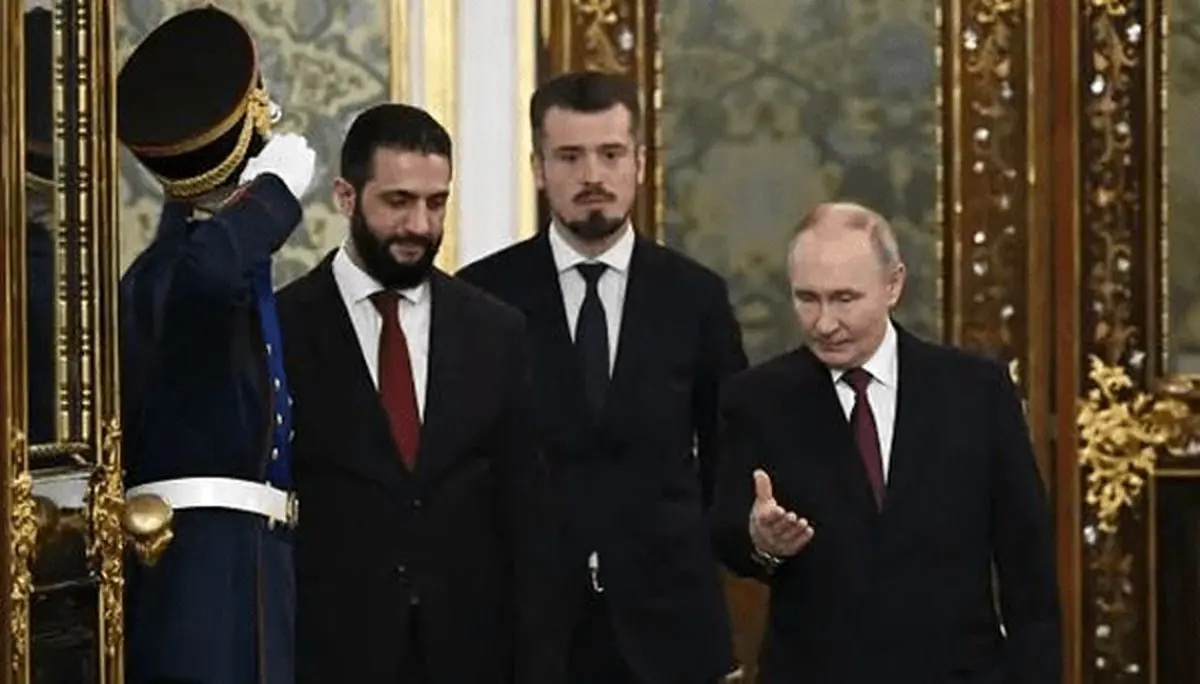
For much of the route, Russian naval vessels escorted the ship. This operation, the first resupply mission since the fall of Bashar al-Assad in late 2024, comes as Syria’s new government, led by Ahmad al-Sharaa, better known for his nom de guerre Abu Mohammad al-Jolani, has not only refrained from opposing Russia’s presence despite a history of direct military confrontation with Russian forces but appears actively eager to preserve and even deepen military cooperation with Moscow.
This paradoxical approach raises serious questions: Why would a leader who once fought Russia now want its military bases to remain on Syrian soil? What are al-Sharaa’s hidden motives, and what complex calculations is he making?
Aaron Lund, a Syria researcher at Sweden’s Defense Research Agency, said: “I think the Russians have effectively managed to hold onto their bases.” According to him, Moscow has used a mix of “carrots and sticks,” but has relied more on persuading the Syrians that keeping Russia around could serve both sides’ interests.
1. Internal, aspect: Russia as a survival guarantor against chaos
The new Syrian government is heir to a legacy of destruction:, xDevastated infrastructures, and most importantly the power vacuum in large parts of the country. In such conditions, al-Sharaa's main fear is not from a foreign enemy, but the return of chaos and full collapse. Russia here can play the role of stabilizer of security.
Despite two agreements between their leader Mazloum Kobani and al-Sharaa with an American mediation to hand over their arms and integrate into the regular army, the Syrian Kurds still insist they will maintain their arms and to some extent their independence, practically avoiding to take part in new constitution and parliamentary election arrangements. The Russians earlier had close ties to the Kurds and can play the role of a guarantor of any deal amid Kurdish growing disrupt in Washington.
Russia controlling Syrian skies: Given the severe weakness of the air force of the new government in Syria, the presence of Russian fighter jets in the Khmeimim air base is the only effective deterrent in this military base against possible airstrikes from any actor, including Israeli regime or armed groups.
Providing basic needs: As the WSJ reports, Russia still provides Syria with wheat and oil at preferential fees. While the Western sanctions are still in place, this artery is vital for preventing famine and economic collapse.
Managing the remnants of previous government: It is often said that beneath Syria’s fragile calm lies a major security puzzle, and one of its most critical pieces is the future role of key minorities like the Alawites. The initial approach of Al-Sharaa’s government toward the Alawites and Druze was highly coercive and brutal, making it highly unlikely that he will earn the trust of these minorities anytime soon. Meanwhile, thousands of military personnel still loyal to al-Assad’s government remain a threat to the consolidation of al-Sharaa’s desired regime. In this context, Russia, al-Assad’s former patron, could play a mediating role in containing these forces or, as al-Sharaa hopes, in disarming them.
In short, al-Sharaa has come to realize that military victory is not the same as running a country. At this stage, Russia has ceased to be a threat and has instead become a vital lifeline for the survival of his government.
2. Regional aspect: A pressure tool against Israel and neighbors
Perhaps al-Sharaa’s most important motive is using Russia as a “deterrent arm” against the Israeli regime. Israel, under various pretexts, occupies vast swaths of Syrian territory, including the Golan Heights and buffer zones, and relentlessly strikes Syrian military infrastructure from the air.
In the past, Moscow usually stayed silent regarding Israeli strikes on Syria. But now, al-Sharaa can send Israel and the U.S. a clear message: “If you want Russian bases out of Syria, you’ll have to pay a price.” This is the pivot to the East card that al-Sharaa wants to hold as he recalibrates relations with the West.
While Russia would not directly engage the Israeli military, its mere military presence and claim of protecting Syrian skies complicate Tel Aviv’s calculations. Should Israeli attacks escalate, Moscow could activate its air defense systems, such as the S-400, to make parts of Syrian airspace nearly impenetrable, something Turkey, al-Sharaa’s main ally, has shown itself incapable of achieving this. And if Turkey and Israel ever drift toward more serious tensions down the line, Russia may be better positioned than Western powers to keep Damascus out of regional strife.
3. International aspects: blackmailing the West by threatening to look East
Al-Sharaa tries to remind the West that look East option is still an option for Damascus. In a recent phone conversation with Trump, Al-Sharaa called for Washington to speed up sanctions relief. But Washington looks hesitant, something showing that just contrary to the media shows, Washington does not trust the new Syrian government and still wants to maintain the pressure cards in dealing with al-Sharaa.
On this point, Aaron Lund said Russia could serve as a leverage tool for Syria’s new government against the US, especially since Washington’s support under Donald Trump’s presidency is “anything but guaranteed.”
By drawing closer to Russia, al-Sharaa is effectively telling the US and Europe that if they want Russia out of Syria, or expect me to push back against Iranian and Chinese influence, then they need to fully lift sanctions, provide massive economic aid, and recognize his government. Otherwise, the East, Russia and China, will take their place.
What does Moscow want and give?
Khmeimim air base and Tartus naval base make up the pillars of the Russian military presence abroad. The country uses these military infrastructures as launching pads for military operations in other regions and also to secure its military presence in the Mediterranean Sea.
1. Maintaining Tartus base: As noted in the WSJ report, Tartus is Russia’s only direct and permanent access point to the Mediterranean Sea. The port’s significance far exceeds its size. It lies in a region of intense geopolitical tension. Losing Tartus would spell the end of Russia’s naval power in West Asia and Africa, and would severely undermine its standing as a global power. That is why the base has been called the most dangerous Russian base outside the former Soviet Union.
2. Continuing presence of the in Khmeimim air base: This base is the center of the Russian air operations for support of allies in Africa, including Libya, Sudan, and Central African Republic (CAR).
Finally, it must be said that deal between al-Sharaa and Russia is a temporary "win-win" game in the short term. Both sides need each other, and both are ready to betray if circumstances change. Al-Sharaa needs Russia’s lifeline just to breathe, and Russia needs Syria to survive as a global power.
But on the long run, al-Sharaa is walking a razor’s edge. The diverse patchwork of armed factions, large and small, that he leads may grow weary of his pragmatic, interest-based policies sooner or later. They could just as easily rebel against the militant leader-turned politician. Only time will tell whether his balancing act is a stroke of genius, or a walk through a minefield.