















Alwaght- As the Iranians are mourning their martyred Leader Sayyed Ali Khamenei and are holding his funeral, these days also offer a chance, however limited and brief, to revisit the vast treasury of his intellectual legacy, religious stature, practical philosophy, and personality dimensions. In this context, the accounts coming from prominent foreign figures are particularly noteworthy.
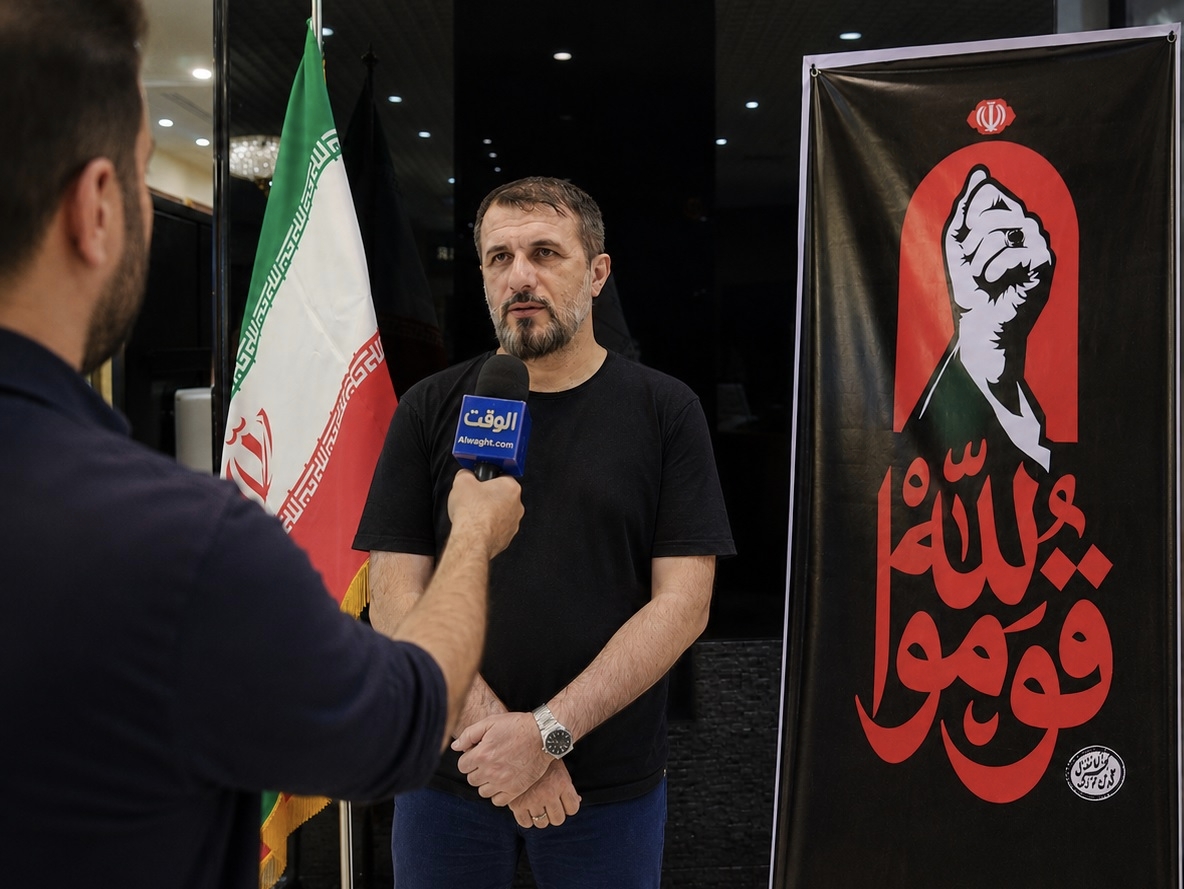
Meanwhile, Alwaght has arranged an interview with Sabit Husseinov, a Russian religious activist and Persian language professor, and religious scholar at Moscow Islamic University.
Alwaght: What was your impression when you heard of the leader's martyrdom?
Husseinov: It was earlier in the morning when my friends informed me of his martyrdom. I cannot describe my feeling, and for several days it was unbelievable to me when I talked to my relatives and friends. I told them this is impossible. We wanted to maje ourselves believe that this did not happen. Me myself and my friend felt like orphans. Because in Russia when we run into a problem or a dead end in political and social matters, we resorted to his words and we had the heart confidence that there is a leader that is knowledgeable and makes the best decision. This is why perhaps for 10 days we were mourning and weeping from the home to the workplace. It was really a hard feeling.
Alwaght: In Russia, how did the ordinary people and media outlets reacted to the news of his martyrdom?
Husseinov: I spend nearly half the year traveling for work, crisscrossing different regions of Russia. Among Muslims, over 90 percent were deeply affected by this event, and even that small segment of Sunnis who had previously kept some distance from the Islamic Republic reached out to me afterward, sending messages through tears to offer their condolences. This incident sparked a real shift, both among Russia's Shia and Sunni communities.
Wherever I went, I truly did not hear a single person question the Islamic Republic's rightness in this fight. Everyone stood with Iran, voiced their support, and offered their sympathies. I recently traveled to Siberia, and I remember the pilot himself, once he learned I was Muslim and Shia, went out of his way to express his solidarity and backing.
And it was not just among Muslims; non-Muslims felt the same. Moscow has distinct Muslim and Christian districts, and Christians we encountered on the streets and in the metro, when they caught a glimpse of the Supreme Leader's photo on our phones, would express their admiration for him. I recall that in the early days of the attack on Iran, we had organized a protest outside the Israeli regime's embassy. When we asked ordinary passersby if they recognized that image, they said, "Yes, we stand with Iran." And when we told them we were heading to the embassy to demonstrate, they cheered us on, affirming the Islamic Republic's just cause and that the late leader was a martyr for the truth. In effect, we were witnessing the emergence of an anti-Israel movement among Christians.
The media reflect the same sentiment. We follow the news and analysis programs daily, and even outlets that once broadcast pro-Israel content are now running programs about Iran's strength and the righteousness of its position in this war.
Alwaght: What personality aspect or feature of the martyred leader was outstanding for you?
Husseinov: May God have mercy on him. One of our regular plans was to discuss him when he had an address to the nation. We discussed what messages they bore for us and for the world. What we understood about him and nobody told us was that the Leader's words and conduct were very deliberate and carefully measured. He spoke with great precision about everything, even about adversaries such as Trump. That was a truly remarkable and unique quality. He never said one word too many or one word too few. It was not the case that, simply because someone was an enemy, he would say whatever came to mind against them. Not at all. He said only what he genuinely believed to be true. He treated friends the same way, he would not exaggerate or heap excessive praise on someone just because they were on our side.
For this reason, whenever the Leader spoke on any issue, we understood that this was how matters really stood, because that was what he had said. He was extremely careful in his wording. At times he would say, "According to what we have been told," or "From what we have heard," making clear the basis of his statements.
He was truly a complete role model for us, showing us how to conduct ourselves in everyday life, how to deal with friends and with enemies. In political, social, and religious matters as well, I can say that he was exceptional, even unparalleled.
Even when you read his speeches and books from his younger years and study his religious outlook, you see that, for example, his interpretation of a verse of the Qur'an was often very different from that of others. That is why we have lost someone who was, in every respect, a model and an example for us, and who was, in truth, our source of hope.
Alwaght: Over the past two decades, there was major investment to spread takfiri ideology in Russia's Muslim-majority regions and Central Asia. We saw the outcome in the outstanding presence of the takfiri terrorists in crisis of Syria and other hot spots. How do you see the role and function of the martyred leader in defusing sectarianism and Shia-Sunni proximity in Russia?
Husseinov: First, let me say this: thanks to the late Supreme Leader's support for expanding ties with Russia, Russian officials now view Shia Muslims in a positive light. I could give countless examples. For example, after Friday prayers, police officers who would come to secure the area or check undocumented migrants would ask for ID, and the moment they realized we were Shia, they would tell each other, "No need to check these ones," and their whole attitude toward us would shift.
The Russian government itself works hard to prevent the spread of divisive ideologies within the Muslim community, and the martyr's policies have been hugely influential in this regard, especially the interfaith dialogue gatherings that bring together Sunni scholars and muftis. Those have been remarkably effective, and we're now seeing the fruits. Russia's Sunnis today recognize Shia Islam as a legitimate Muslim faith, and thank God, we now have an active Shia community in nearly every city. We can even hold congregational prayers in Sunni mosques without issue. So these policies have been immensely blessed in countering takfiri extremism across Russia.
Watching developments from the outside, seeing both sides, it strikes me that the enemy initially had little hope this war would amount to anything. But recently, some operations they organized inside Iran gave them a flicker of optimism. In my view, this war did not start with the Leader's martyrdom and it was actually set in motion back in 2020, with the assassination of General Qasem Soleimani. But thank God, what we witnessed on the ground turned out exactly the opposite of what they had hoped. The Iranian people rose to the occasion magnificently, and we truly thank them for shattering the enemy's hopes. Despite all the dangers, under bombardment, facing possible martyrdom, they stayed in the streets for months alongside their families, refusing to abandon the squares. The Iranian people created such passionate, stirring scenes that even media outlets hostile to the Islamic Republic could no longer peddle the narrative of a people divorced from their government. The people, alongside Iran's armed forces, whom I also deeply thank, broke the enemy and left them despairing, which is precisely why they were forced into a peace deal and ceasefire.
Here in Russia, which has itself been locked in war with Ukraine for five years now, media analysts covering military affairs constantly hold up Iran as the model, saying we need to fight the way Iran fought in this war and in its resistance, and that is how we will achieve victory. Think about that: Russia, with all its military might and grandeur, and yet its analysts are all citing Iran as the blueprint for combat strategy and operations.
Alwaght: Were the Iranian public presence in the streets covered by the Russian media?
Husseinov: Yes, and their analyzed these rallies extensively to see who they affected the course of war and Iranian victory. After all, those coming to the streets for support to the Islamic Republic have ideological background and the Russians debate this issue and its significance in defending the country and beating the enemy. This is surprising to us, because just a few years ago there was no talk I Russian media of this.
Alwaght: Can we conclude the after, there was a boost for Iran's credibility in the eyes of Russians?
Husseinov: Yes, it grew way more than before. Perhaps I can say it grew from 10 to 100 all at once.
Alwaght: Is there a notion among the Russians that this war against Iran is a shared threat to both countries and that they need to cooperate more?
Husseinov: Yes, that perspective is very much alive, and you hear it often that strategically, we need to stand with Iran and support it. Russian analysts argue that the West's ultimate objective is to seize Iran and, in doing so, encircle Russia from all sides.
Alwaght: How do you think the funeral procession of the martyred Leader look like?
Husseinov: What we envision is something akin to the Arbaeen of Imam Hussein. That's the image we have in mind, because all the lovers of our martyred Leader are gathering, coming not just from Iran but from neighboring and even far-flung countries, carrying his memory in their hearts. I think what one witnesses at Arbaeen, the love, the solidarity, the unity, will be on full display there, alongside Imam Hussein and the bond of the Islamic ummah. God willing.
Alwaght: How did you feel after hearing that Ayatollah Mojtaba Khamenei was elected next leader to carry the flag of the resistance?
Husseinov: We rejoiced and congratulated each other. When we heard that he was elected, we believed that one of the best or perhaps the best to lead is Ayatollah Mojtaba Khamenei. After this election, we restored our hope and we rested assured that the path the martyred Leader was following will continue under the new leader.










