










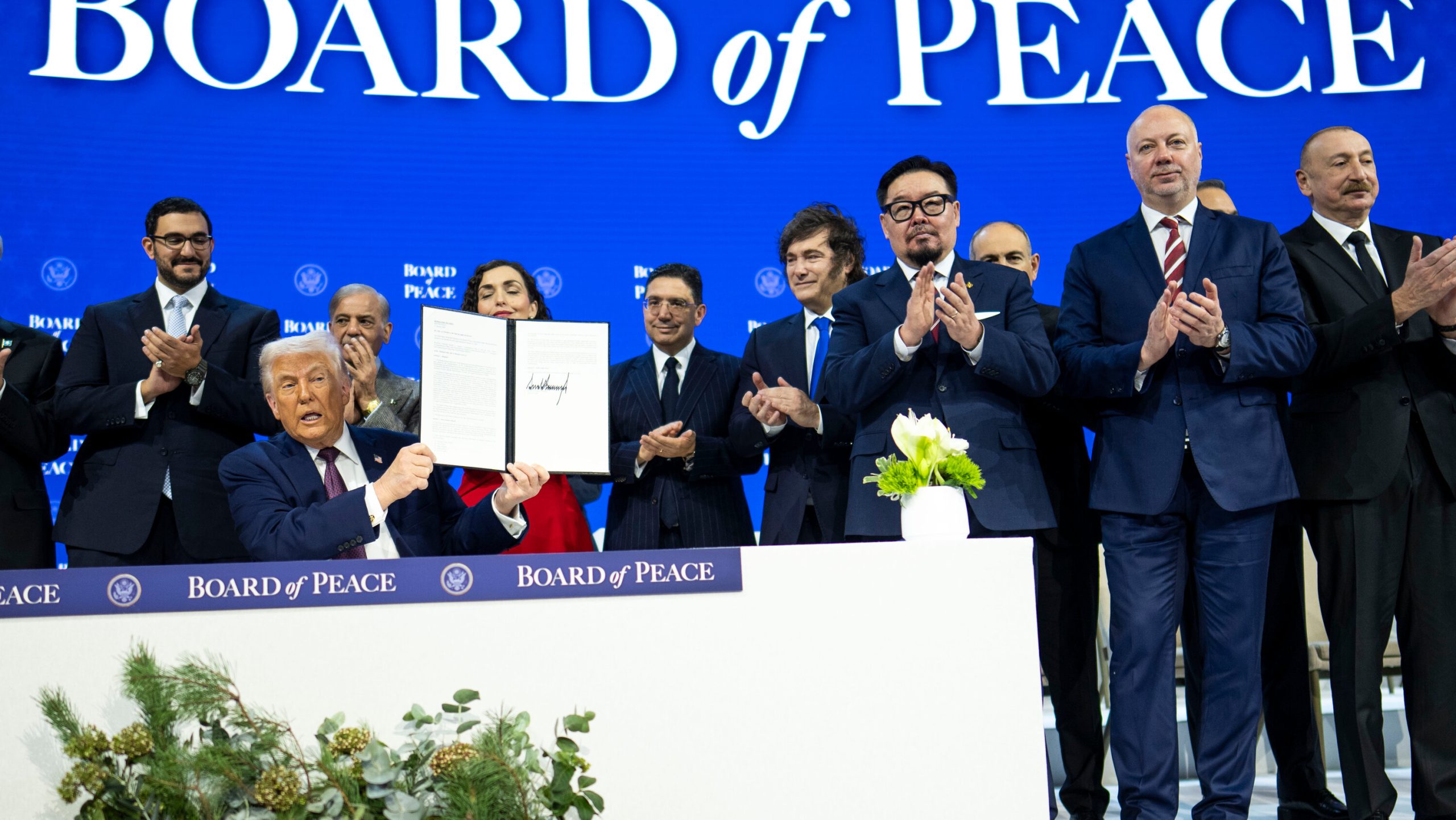


Alwaght- After months of preparations and media and political uproar, finally Trump's Board of Peace held its first session. Chaired by Trump, the board saw low attendance of many invited countries including the Security Council members and even absence of Palestinian delegation.
The American president voiced commitment of his country and the International community to make Gaza a "better place" and to reshape the governance in this Palestinian enclave. He added that the board is to allocate $10 billion in funding to Gaza, a sum in addition to the $7 billion promised by a number of countries.
Every dollar spent is an investment in stability and the hope of a new and harmonious [region],” said Trump.
But Trump spoke of reviving hope for the future of Palestinians at a time when the very format and agenda of the board's first session were riddled with challenges and obstacles to achieving genuine peace and advancing toward the real aspirations of the people of Gaza and the Palestinian nation.
A review of past political experiments, from Madrid and Oslo to the subsequent agreements, shows that these promises echo old commitments to reconstruction and prosperity, pledges that have been made time and again. Critics emphasize that peace cannot be achieved without justice, and any path that ignores this principle is prone to faltering and failure.
From an economic perspective, despite Trump's heavy emphasis on the substantial aid pledged for the forward-looking reconstruction of this completely devastated strip (including economic prosperity, energy, employment, and more), the gap between the announced figures and the reality of the destruction is staggering. The commitments made remain far below UN estimates, which put the cost of rebuilding Gaza, after the destruction of approximately 90 percent of its civilian infrastructure, at nearly $70 billion. Moreover, part of the announced budget will go toward the council's own structure and administrative expenses, leaving even fewer resources available for direct reconstruction and essential services. The reconstruction figure is so discouraging that if Trump had allocated to rebuilding even the same amount of funding the US government provided to the Israelis for bombing and destroying the people and infrastructure of Gaza during two years of war, it would have been several times the current sum.
This is while even this fragile promise is far from reliable, as since the beginning of the so-called ceasefire, strict restrictions on food, drugs, and medical equipments continue and the Israelis even deny machinery for removing the rubles, and if this continues, it will take years to clear the destruction.
In fact, even amid widespread skepticism over the resolutions' outcomes, the core issue is not merely funding, but the level of Washington's seriousness and the extent of its pressure on the Israeli regime to completely halt the war and facilitate the entry of humanitarian aid. The absence of UN Security Council members from this meeting underscores this point, as these nations view the Board of Peace as a substitute for the United Nations.
The Board of Peace has a structure that revolves heavily around its president, granting Trump the authority to invite or exclude leaders, veto decisions, and even potentially retain the council's presidency after leaving the White House. This comes despite the fact that the Trump administration has pursued the closest approach in recent decades to aligning White House policy with the Israeli regime's occupation policies in occupied Al-Quds (Jerusalem), the West Bank, and Gaza.
Dangerous riddle of international force
In all of the matters raised during the first session, nothing was as ambiguous, contradictory, and potentially dangerous as the idea of international force deployment to Gaza. The idea on the surface is meant to establish security and help the transition period, but deep into it carries questions about the nature, mission, and limits of power, and even the ultimate goal of it.
At Thursday's meeting, General Jasper Jeffers, commander of the international forces deployed in Gaza, announced that five countries, including Indonesia, Morocco, Kazakhstan, Kosovo, and Albania, have expressed readiness to participate in the mission. Indonesia has even mentioned its readiness to deploy more than 8,000 troops, with the possibility of increasing this number to 20,000. Egypt and Jordan have also committed to training these forces. Meanwhile, Nikolay Mladenov, the coordinator of the board, announced the launch of a recruitment process to form a new police structure in Gaza, one intended to be "independent of Hamas influence."
However, emphasizing the disarmament of Hamas without establishing a clear mechanism to compel the Israeli regime to withdraw its military forces from Gaza only adds to the ambiguity and challenges facing the international force's mission. According to Trump's ceasefire plan for the second phase, an "international stabilizing force" would replace the Israeli troops currently controlling about half of the Gaza Strip. On the surface, this framework could be interpreted as a reduction in direct Israeli military presence; but in practice, the ground reality is more complex than this official picture.
The first major obstacle is the continuation of military operations by the Israeli army despite the announced ceasefire since October 10. The almost daily attacks have not only failed to maintain the region's fragile security but, by continuing to kill and shed the blood of civilians and preventing the return of displaced persons, have cast doubt on any transitional plan. The second obstacle is the lack of clear and binding guarantees for the complete withdrawal of Israeli forces from the areas they control in Gaza. Without such a guarantee, the deployment of an international force could become a complement to the occupation rather than a replacement, particularly if contact lines, security zones, and crossing points remain under Tel Aviv's control.
This is precisely why the plan has become a "dangerous conundrum." Here a question presents itself: Is the international force meant to be a precursor to a genuine end to the occupation, or a shield to manage it at a lower political cost for Israel and the US?
The reaction from Palestinian actors shows these doubts are not merely theoretical. Hazem Qassem, a spokesman for Hamas, made it clear that the real measure of the council will be its ability to force Israel to halt its aggressions, open aid routes, and begin reconstruction. On the other hand, Munzer al-Hayek, a spokesman for Fatah, criticized the structure of the meeting, stating that the Board of Peace "did not accept the Palestinian Authority, but did accept the Israelis, who have killed over 75,000 Palestinians." He also warned that this mechanism could become a tool to separate the West Bank from the Gaza Strip and effectively replace the United Nations and the Security Council.
The core ambiguity lies in the nature of this force's mission. Will it be tasked solely with maintaining security, or will it also play a role in managing the political transition? Which body will oversee it? To whom will it be accountable? And most importantly, will this force have the authority to confront ceasefire violations by the occupying army, or will its only mission be to contain Palestinian actors?
Benjamin Netanyahu's statements before the meeting lifted the veil on the true interpretation, revealing that Tel Aviv does not consider itself bound by this council's decisions in any way. He openly declared that he had agreed with the US that no reconstruction would take place until Gaza is "disarmed." This stance demonstrates that reconstruction has been turned into a political and security leverage tool. Within such a framework, an international force could become an instrument to enforce this condition of disarmament, rather than a guarantee for the protection of civilians.
Another concern is that the international force might be limited to merely managing the consequences of the conflict instead of addressing its root causes. Recalling the incidents involving the "Gaza Humanitarian Foundation," where civilians were targeted while queuing for food, Palestinian activists warn that any new security mechanism, if it operates without clear accountability and a defined international legal framework, could lead to a repetition of the same atrocities on a different scale.
Significant questions also arise from the perspective of international law. The deployment of an international force typically requires a clear mandate from the UN Security Council; yet the absence of Security Council member powers from the recent meeting is itself a sign of the lack of global consensus behind this initiative. Without such backing, the legitimacy of the mission and the scope of its authority could become a perpetual point of contention.
Finally, if this proposed force lacks transparent political agenda, clear timetable for its mission end, and true guarantees for transition of power to elected Palestinian institutions, it risks turning into mandatory management or indirect occupation, something that may not be under the Israeli occupation banner, but will create the same Tel Aviv-favored balance of power.
This is precisely why the riddle of the international force is not merely a technical security debate. It cuts to the very heart of the Palestinian issue: Are these new initiatives intended to pave the way for the Palestinian right to self-determination, or are they a more modern version of political and security engineering imposed on their land and destiny?