





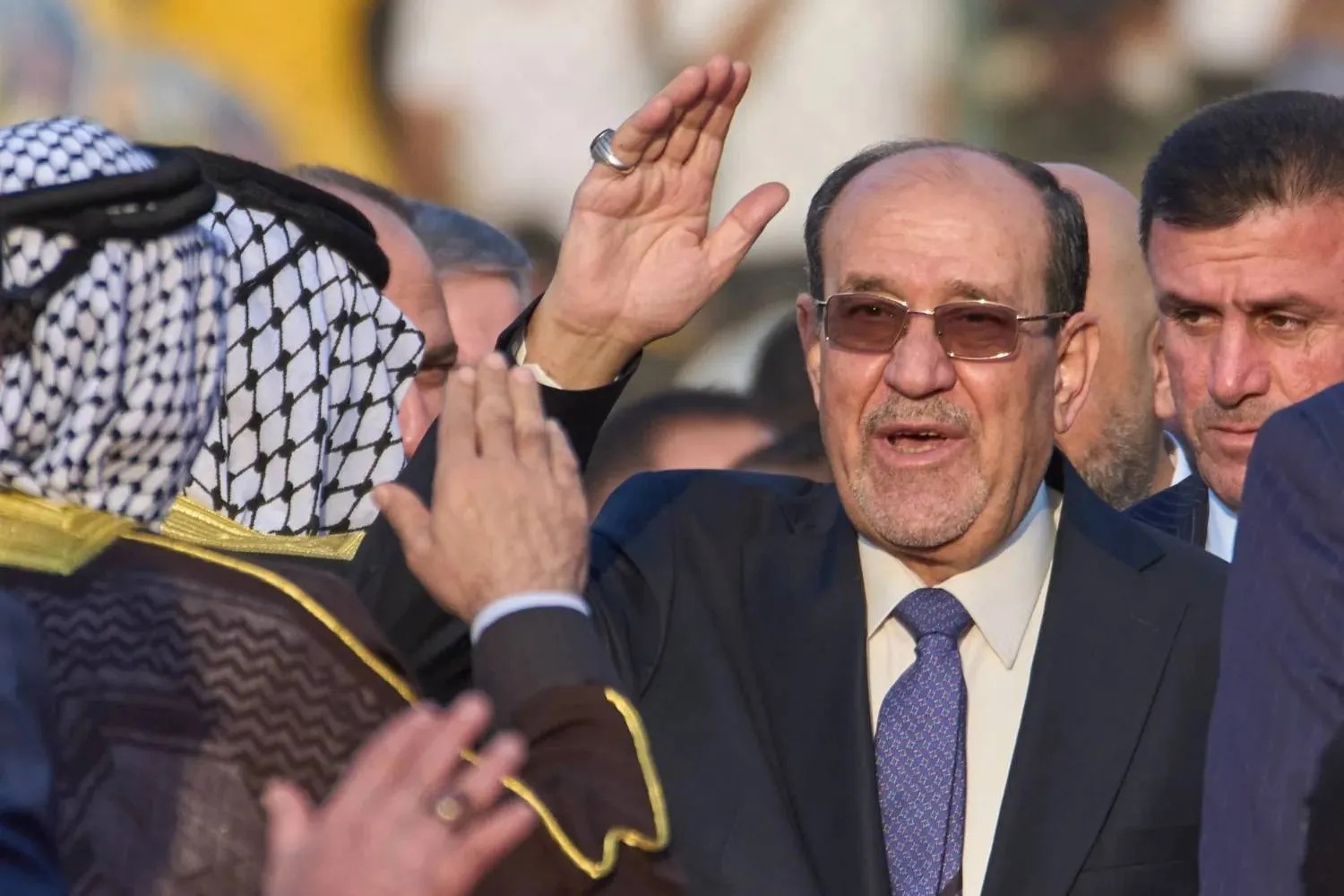


Alwaght- Iraq's parliamentary elections of November 11 with a 55-percent turnout marked a turning point in establishing a relative political order after years of instability. The swift formation of parliament's presidium and the initiation of the process to elect a president initially suggested that Baghdad might, unlike previous years, adhere to the constitutional timeline for forming a new government. However, the moment the selection of a prime minister began, the political landscape became gripped by a palpable paralysis, with Nouri al-Maliki's name at its very center.
While securing consensus among political forces for key posts, including the premiership, is hardly a new challenge, indeed, it has been a recurring feature in almost every electoral cycle, what sets this current deadlock apart is the overt and unabashed intervention of Donald Trump in Iraq's internal affairs. This interference has not only upended fragile domestic balances but has also resurrected a fundamental question: Can Iraq's political system still generate a solution from within, or is it now compelled to yield to external pressure?
The Shiite Coordination Framework and choosing the default option
According to the Iraqi constitution, the parliament has to pick a president at most 30 days after holding its first session and the president should name the prime minister within 15 days. The candidate must be one named by the parliamentary majority and be given 30 days to name his government.
After end of the election, the Shiite Coordination Framework (SCF) as the ruling parliamentary bloc retained the power by holding about 200 seats. This coalition, which includes the majority of the Shiite factions like the State of Law, National Wisdom, Fatah Coalition, and Asayeb Ahl Al-Haq announced candidacy of al-Maliki in a moment critical in terms of security and regional dynamics.
The announcement of Nouri al-Maliki’s candidacy for prime minister did not appeal to Washington. Fearful of the growing influence of resistance factions in the next cabinet, the Trump administration has abandoned diplomatic niceties. By dismissing Mark Sawaia, the US special envoy to Iraq, Trump has effectively drawn his sword against al-Maliki's return, throwing Iraq's political forces into a new dilemma as they try to exercise their most fundamental sovereign right.
In Baghdad, the move was instantly interpreted as a "direct veto." Any ambiguity about Washington's position was quickly dispelled, and then complicated, by Trump’s subsequent remark that the US is "looking at who is going to be the prime minister of Iraq" and has "options."
This message has fractured the ruling SCF, creating two opposing interpretations:
First, some see it as a relative retreat. In this view, the softened tone and the mention of "options" suggests Washington is keeping the door ajar for al-Maliki—not as a consensus candidate, but as a "default option." This reading posits that the Framework is clinging to the "strongman model" to impose political and security order, specifically by controlling arms, a key US demand that al-Maliki previously demonstrated during his first term when he confronted Moqtada al-Sadr’s Jaish al-Mahdi.
Second, others interpret it as a pressure tactic. By floating the existence of alternative candidates, Washington may be preparing the ground to impose a compromise figure, effectively using the threat of a veto to force the SCF into a negotiation.
Caught between these two readings, the fate of the premiership hangs in the balance, suspended between the internal calculations of the SCF and the volatile signals emanating from Washington.
Adding fuel to the fire, warnings from Secretary of State Marco Rubio regarding the potential formation of a "government loyal to Iran" have heightened the sectarian and geopolitical sensitivities surrounding the negotiations. This overt intervention must be understood within the fraught history of US-Iraq relations. Since 2005, Washington has consistently played a role in government formation, whether through public pressure or backchannel diplomacy.
However, this time is different. The blunt language, coupled with implicit economic threats, such as tightening controls on financial transfers or revoking energy waivers, has escalated US interference from a mere "signal" to a full-blown "destabilizing tool."
Baghdad in the shadow of Tehran-Washington confrontation
The crisis over Iraq's premiership cannot be analyzed in isolation from the escalating tension between Iran and the US. With Tehran and Washington engaged in delicate talks in Muscat, and the very real possibility of their collapse, Iraq is rapidly transforming into a potential battleground for proxy conflict.
Washington is maneuvering to contain any future confrontation with Iran, aiming to keep it limited and swift while preventing its spread to Iraq, Yemen, or Lebanon. Meanwhile, resistance factions across the region, including those in Iraq, have declared they will stand with Iran in the event of aggression by Trump and Netanyahu.
The US is deploying political and economic leverage to prevent a localized conflict from escalating into a full-blown, protracted regional war.
This strategy was recently laid bare by The New York Times, which reported Trump's urgent desire for a "quick, decisive, and short" victory, one that would bolster his political standing without dragging the US into a quagmire. According to the paper, Trump is acutely aware that any prolonged engagement could destabilize the US economy and alienate his voter base, making him determined to avoid getting stuck in the regional "swamp."
For the SCF, the return of Nouri al-Maliki would send a powerful message of "decision-making independence" from foreign interference. But for Washington, his name is a red flag, perceived as a direct conduit for Tehran's influence. This duality has transformed Maliki into ground zero for geopolitical competition, a single figure upon which the broader US-Iran struggle is now being waged.
Washington's goal, therefore, is to reshuffle the deck in Iraq's political scene and effectively overturn the national will expressed by voters, as embodied in the SCF's choice. The US administration is fully aware that the mere threat of sanctions has a direct impact on Iraq's fragile domestic situation. Trump holds significant punitive tools: sanctioning Iraqi banks, tightening controls on financial transfers, including withholding oil revenue, and revoking waivers that allow energy trade with Iran.
The implementation of such measures would be devastating for ordinary Iraqis. It would unleash economic chaos: a skyrocketing dollar exchange rate, a collapse in essential services, and soaring unemployment. This, in turn, would ignite public discontent. These are not abstract threats; they are the cards Washington is prepared to play to force the hand of Iraq's political factions.
The US intervention would have direct consequences:
1. Deepening internal divisions: Rather than forcing consensus, the external signal from Washington has been interpreted in contradictory ways by Iraq's political forces.
2. Undermining national sovereignty: When Trump openly speaks of "reviewing" who will be Iraq's prime minister, the very principle of national sovereignty is eroded.
3. Escalating economic risk: The threat of banking sanctions or the revocation of energy waivers has injected extreme uncertainty into Iraq's fragile economy.
4. Paralyzing the constitutional timeline: Fear of external repercussions has frozen domestic decision-making.
On the Kurdish front, Trump's intervention has produced a cautious recalibration. Masoud Barzani and the Kurdistan Democratic Party initially congratulated al-Maliki on his candidacy, but following Trump's remarks, a strategic reassessment is underway.
Foreign Minister Fuad Hussein, speaking on the sidelines of the Munich Security Conference, articulated the delicate balancing act. Baghdad, he stated, takes "American signals" seriously, while insisting that selecting a prime minister remains a domestic affair. This dual-track approach, neither confronting Washington nor making an overt retreat, reveals the Kurds' true position: they are waiting for the SCF to make the first move before committing.
So, Washington has practically become a factor reproducing instability in Iraq in the short term.
Scenarios ahead
As the political stalemate continues, a number of scenarios are likely:
Scenario 1: Extending the Caretaker Government
The least disruptive option would see Muhammad Shia al-Sudani continue in a caretaker capacity with limited powers, effectively parking the political process until the storm passes. This would require parliamentary consensus, which currently does not exist. While it offers a temporary buffer, it merely postpones the inevitable confrontation.
Scenario 2: al-Sudani returns
If consensus on Maliki proves impossible, al-Sudani could return as a full-fledged prime minister, viewed in Washington as a "lower cost" option.
Scenario 3: A compromise candidate from within the SCF
This would involve al-Maliki's tactical withdrawal and the introduction of a consensus figure to avoid direct confrontation with Washington. Names such as Hamid al-Shatri and Ihsan al-Awadi have already surfaced unofficially in media speculation. This option preserves the SCF's unity while defusing external pressure, but would require al-Maliki to step back, a move he has historically resisted.
Scenario 4: Doubling down on al-Maliki and defying foreign pressure
As of now, the SCF continues to insist on its right to choose without foreign interference. Aqil al-Fatlawi, spokesman for the State of Law Coalition, has declared there will be "no compromise" on al-Maliki's nomination.
Some analysts suggest the SCF may be betting on an "unwritten understanding" with Washington: a strongman government that can address US concerns about weapons off state control. This is a high-stakes gamble. Not only has it been fiercely rejected by resistance factions, but it also risks triggering intensified economic pressure and social unrest if Washington follows through on its threats.
Iraqi political system's big question
In such a complex situation, the ultimate question is: Can the SCF strengthen the domestic consensus? Or under the shadow of the US veto, the Iraqi prime minister post remains undecided for months?
What is certain is that the fate of this case will not only determine the next government, but also influence the balance of power across the region.