













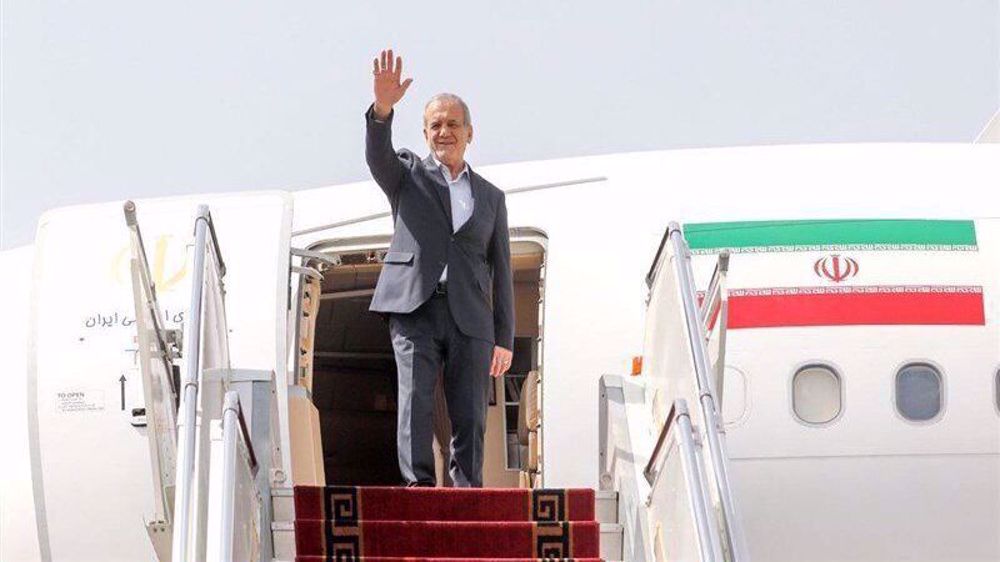


ALWAGHT- President Masoud Pezeshkian left Tehran for a two-day Central Asia trip to Kazakhstan and Turkmenistan, with plans to secure trade deals and attend a peace summit, according to his office.
Iranian President Masoud Pezeshkian departed Tehran for Astana, Kazakhstan, on Wednesday at the invitation of President Kassym-Jomart Tokayev. In statements before his departure, Pezeshkian emphasized that the visit provides a significant opportunity to deepen bilateral relations, specifically in economic, industrial, mineral, cultural, and transport fields. His chief of staff, Mohsen Haji-Mirzaei, noted that several cooperation agreements on expanding trade are set to be finalized during the stay. A ministerial delegation is accompanying the president for talks in key sectors, and a large Iranian Chamber of Commerce group is already in Kazakhstan preparing business partnerships, with a joint merchant meeting scheduled in Astana.
Following his official visit to Kazakhstan, President Pezeshkian will continue to Turkmenistan to attend the World Conference on Dialogue for Peace and Trust in Ashgabat, at the invitation of President Serdar Berdimuhamedov. He described the summit as a platform to express Iran’s views on international peace and stability, criticizing what he called warmongering by certain powers and referencing crimes and genocide in the region. Pezeshkian is scheduled to deliver an official address at the conference and hold bilateral meetings with other attending heads of state and government, aiming to foster practical dialogue on peace and trust.
The visit builds upon ongoing regional engagement, advancing discussions in areas such as joint free trade zones, border markets, energy contracts, and cross-border infrastructure. It underscores Iran’s determined effort to strengthen economic and trade links within Central Asia, leveraging shared membership in regional organizations like the ECO, SCO, and BRICS+ forums. This diplomatic push is framed as part of a broader strategy to enhance Eurasian integration and bolster economic resilience amid regional tensions.
Overall, the two-day trip signals Iran’s intention to capitalize on historical, religious, and cultural ties with Central Asian nations to foster multi-layered cooperation in sectors including energy, agriculture, and transportation. This outreach aims to enhance connectivity and counter geopolitical challenges, positioning Central Asia as a strategic bridge for Iran’s foreign policy and economic partnerships.










