




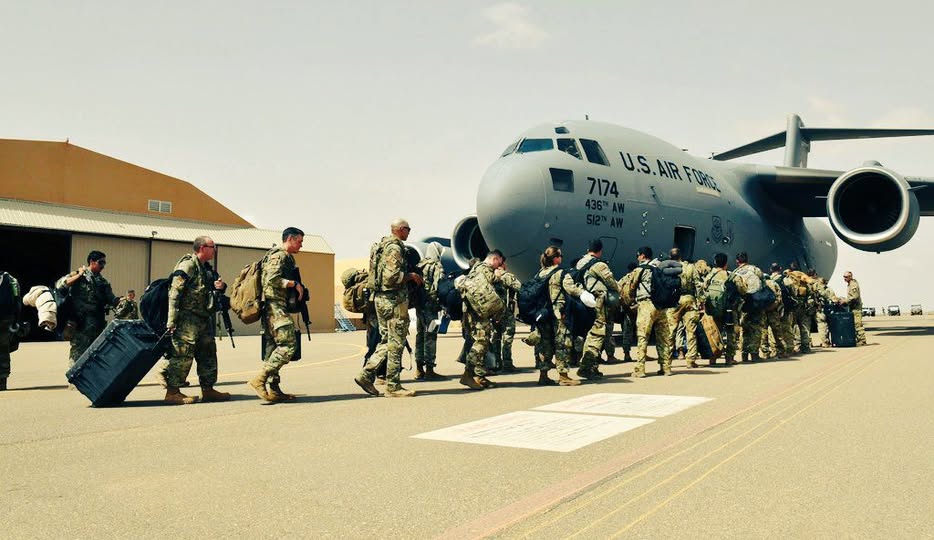


Alwaght- The US military pull-out of Iraq on September 30 marked an end to a 23-year-long occupation period. A major part of the American forces had been withdrawn over the past few years and in the closing day of their presence, the remaining equipment and hundreds of troops stationed in the military bases left this country. The US also announced exit from Harir base of Erbil in Kurdistan region, putting and end to the military mission in Kurdistan. Now the question is: Where did these forces go and is there any military capacity of the US left in Iraq?
Where were the last forces stationed?
A Washington Post report says that in the weeks that preceded the exit, around 1,500 forces under the so-called anti-ISIS mission were present in Iraq. This number was the total of the American and coalition forces and so the number of the Americans was several hundred or less. After pulling out of various Iraqi regions, these forces resided in Kurdistan, specifically in Harir air base. Citing American military official, The Post reported that the remaining forces in northern Iraq will be relocated mainly to Jordan and other regional states.
In a statement it published on September 30, the CENTCOM confirmed the complete exit from Erbil base. According to CENTCOM, Erbil base was the key military operations infrastructure of the Americans in Iraq and a major part of 1,500 forces presence in Iraq acted in this region.
So, the remaining forces in the final days were just several hundreds.
Jordan, the main destination
The most important known destination for the forces withdrawn from Iraq is Jordan. With US's withdrawal from Iraq, the mission of the anti-ISIS coalition led by America was not declared over; rather, the center of gravity of operations shifted from Iraq to Jordan. CENTCOM has announced that the joint command headquarters for Operation Inherent Resolve (the anti-ISIS coalition) is now stationed in Jordan, and American forces will continue to pursue anti-ISIS operations in Syria from that country in cooperation with coalition partners. In simpler terms, the US has transferred the anti-ISIS mission from Iraqi soil to a regional base.
The Washington Post had also reported before the completion of the withdrawal that the remaining American forces in northern Iraq would mainly head to Jordan.
What happened to Ain al-Asad base?
Ain al-Asad military base in Anbar province of Iraq was no longer the main center of the American presence in the final days. The Americans withdrew from Ain al-Asad base in January, and control of it was transferred to Iraqi forces. Reuters reported on January 17 that the Iraqi Ministry of Defense had taken full control of this base. Therefore, the September 30 withdrawal was mostly related to the last part of the American presence in northern Iraq, especially Erbil.
What equipment were were moved out of Iraq?
Most important removed equipment were air defenses. In the months before exit, the US had removed Patriot battries from Erbil. Al-Monitor in a July report had said that all of the Patriot interceptors stationed in Erbil were moved to an unspecified location. They had been used to detect and intercept missiles and drones.
C-Ram CIWS systems, which were developed to counter rockets, artillery, and similar threats to the bases, were also part of the American air defense network in Erbil.
New Arab in September reported that final exit included Patriots and C-RAMs in the autonomous Kurdish region.
What happened to drones and intelligence systems?
The issue was not only missiles and air defense systems. American capability in Iraq was not limited merely to the number of soldiers or tanks and aircraft. The intelligence network, aerial reconnaissance, communications, logistics, and technical support formed an important part of the US-led coalition's operational capability. The Washington Post had also reported that military equipment, including air defense systems, would be withdrawn along with American forces, and even surveillance balloons were taken down.
In the months leading up to the withdrawal, other signs of the collection of American intelligence equipment in Erbil were seen. The National newspaper reported in early August that American forces, in addition to relocating air defense equipment, had also brought down a high-altitude surveillance balloon, or "Aerostat," from above Erbil. Local sources had also reported the transfer of logistical containers and defense equipment.
These measures show that the withdrawal process was not merely a relocation of personnel, and that fixed and semi-fixed equipment related to reconnaissance, air defense, and support had also been removed.
What role did transport planes have?
For the withdrawal of heavy equipment, military transport aircraft were used. During the initial stages of the withdrawal from Erbil, Rudaw reported that heavy transport aircraft, including the American C-17 Globemaster III and the British A400M Atlas, were observed at Erbil Airport. These aircraft played a role in transporting coalition equipment and forces.
Has Washington left behind anything in Iraq?
CENTCOM has announced that the withdrawal of forces and equipment from Erbil base has been completed. A Pentagon spokesman also emphasized the "orderly withdrawal" of forces and equipment.
The US President Donald Trump also emphasized after the withdrawal was announced that no American equipment remained in Iraq. The Guardian reported this position of Trump and wrote that he at the same time celebrated the end of American military presence; but this does not mean that all physical traces of the US presence have been erased from Iraq.
Bases such as Ain al-Asad and other military facilities are now at the disposal of the Iraqi side. Buildings, runways, infrastructure facilities, and some fixed installations are part of the base environment and are not necessarily transferred back to America along with the soldiers.
So, the US has announced that it has withdrawn its military equipment and operational forces from Iraq; however, the infrastructure of the bases that were previously at Washington’s disposal has in various cases been transferred to the Iraqi side or placed under Iraqi control.
Were any weapons delivered to Iraqi forces?
Over the past years, the US has given part of its equipment, vehicles, munitions, and military capability to the Iraqi forces under deals with Baghdad. Even official reports by the CENTCOM show that equipment and munitions were handed over to Iraqi security forces from Ain Al-Assad logistic centers.
Therefore, part of the equipment over the past years were transferred to the Iraqi forces.