






Alwaght- In a landmark move and amid escalating tensions between the US and Iran and speculations about a new war in the region, some factions within Iraq's Public Mobilization Forces (PMF) have displayed part of their weapons.
Saraya Awliya Al-Dam which is a branch of the PMF in a footage unveiled part of its underground rocket arsenal, drawing media and observer attention.
The military showoff included tunnels where rockets and launchers are stored and could be moved and mobilized for firing.
The released footage shows the group’s fighters moving underground alongside a truck carrying several ballistic missiles. This demonstrates both the Iraqi resistance's acquisition of advanced ballistic missiles and the scale and capacity of the group’s missile storage facilities.
Alongside the display of equipment, the appearance of several senior regional resistance leaders in the videos adds a symbolic dimension to the unveiling. The message was clear: the recent action is not a limited or local decision, but one framed within the broader Axis of Resistance, a regional bloc comprising anti-American actors, and in coordination with major regional developments.
Saraya Awliya Al-Dam has previously taken clear positions against the US military presence in Iraq, directly linking current developments to regional conditions, especially the situation concerning Iran. The group has repeatedly emphasized that in this sensitive phase, there is no room for neutrality.
The group announced its formation in September 2020 following the assassination of Iran's General Qassem Suleimani and Iraq’s Abu Mahdi Al-Muhandis, two of the key anti-terror commanders in the region. Since then, the movement has been named in security and media reports as one of the active actors opposing the presence of American forces in Iraq.
For example, reports from the Washington Institute for Near East Policy have also attributed responsibility for attacks on the Ain al-Asad airbase, as well as operations against the Harir base in Erbil, to this group.
PMF's missile capabilities
The "missile city" is a part of broader arsenal the Iraqi resistance groups have gradually built in over a decade.
Though there is no official and precise information available about the range, type, and precision of the missiles, field developments and unofficial reports suggest that the Iraqi resistance has at its possession a diverse range of rockets and enjoys considerable operational power.
Currently, the PMF operates rockets of Zilzal (quake) and Fajir (Dawn) of Iranian origins. These rockets are mainly designed for multi-launches and play an effective role kn short and mid-range firings.
Additionally, the Iraqi resistance factions have managed to develop domestic types of Batar rockets, as well as versions of Salam-1 missiles. Batar rocket, which has a range of 5 kilometers, is capable of carrying relatively heavy payload and and is seen as one of the primary weapons achievements of the PMF. The rocket was used extensively during anti-ISIS combats and played an integral part in liberation of parts of Salahaddin and Anbar provinces captured since 2014 by the terrorist group.
While the technical details of the Salam-1 missile, such as its precision and destructive power, have not been officially released, initial test launches have demonstrated its high effectiveness in close-quarters battle.
Alongside these weapons, some Iraqi resistance groups also possess guided anti-armor missiles like the Kornet, designed to counter heavy armor and posing a serious threat to enemy mechanized equipment. 122mm Katyusha rockets continue to form part of these groups' arsenals.
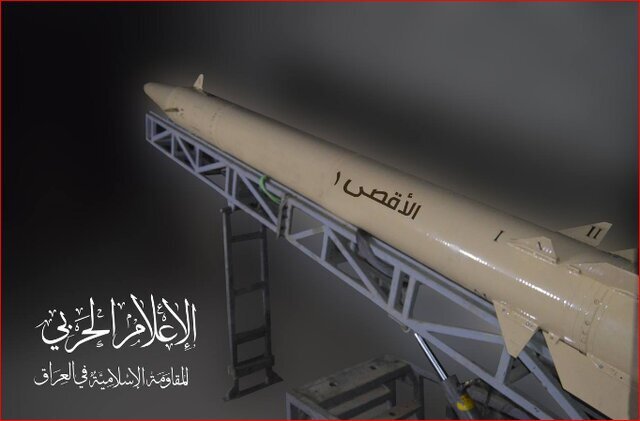
Furthermore, with the eruption of the Gaza war, the Iraqi resistance announced the operational deployment of the Aqsa-1 medium-range missile, signaling expanding missile capabilities of these groups.
Message of warning
Unveiling the underground rocket infrastructure by Iran-aligned Saraya Awliya Al-Dam bears a clear message to the US and Israeli regime, telling them that the resistance groups hold the full capacity and capability to respond to any aggression against Iran and Iraq.
Defining themselves as part of the broader Axis of Resistance, these groups find any strikes against Iran's territorial integrity or its political system as a strike to the while Axis, and they have several times repeated their warnings about any American miscalculation.
Reports indicate Iraqi armed groups have stepped up their readiness and declared full support for Iran should any conflict break out. The Badr Organization in a statement described the current situation as a decisive battle and explicitly stated that in such conditions, silence and neutrality are "meaningless."
The Iraqi Hezbollah Brigades also issued a statement calling on their forces to prepare for a comprehensive confrontation. The Al-Nujaba Movement adopted a similar stance, warning that any attack on Iran could push the region toward a broad conflict.
In this climate, a key message of unveiling the underground military installations is to display the depth of the Iraqi resistance's capabilities that have been developed covertly and continuously, even during the country's prolonged occupation.
This fact is highly significant that despite over two decades of American military presence in Iraq and its access to the most advanced intelligence systems, the construction of the resistance's missile city remained hidden from the occupying forces.
Furthermore, the unveiling by one of the smaller groups within the PMF paints a clear picture of the potential capacity of other factions, such as Hezbollah and Al-Nujaba, which possess greater resources and capabilities, and have likely not yet revealed a significant portion of their strength.
This move, beyond reinforcing deterrence, sends a clear message to regional adversaries that any military adventurism will incur heavy and unpredictable costs. Additionally, the Iraqi resistance's achievement in designing and deploying missiles alters the regional balance of power and will nullify American efforts to weaken or dissolve these groups.
Iraq's role in a regional war equation
Developments of recent years have shown that the resistance groups in the region from Lebanon to Iraq to Yemen to Palestine do not depend absolutely on Tehran in their decisions and actions and they take action independently whenever they feel a need to defend the oppressed and protect the interests of the Resistance camp.
Gaza war was a clear example of this reality. This conflict was a point where various branches of resistance, coordinated on the ground under the "unity of fronts" strategy, played their part and each held a specific responsibility in the fight against the Israeli regime and its main ally the US. At present, relying on its strategic position, Iraq follows an independent path in the confrontation between Tehran and Washington while the resistance groups of this country act with fire-at-will approach.
The logic steering this approach is that a threat against Tehran could serve as a prelude to targeting Iraq. From this dimension, countering aggression and protecting the interests of the Resistance camp is seen an obligation, independent of external directives. This process indicates that Iraq has evolved beyond a mere supporter into an active and deterrent player in the regional balance of power, while maintaining its operational independence within the framework of the Axis of Resistance.