



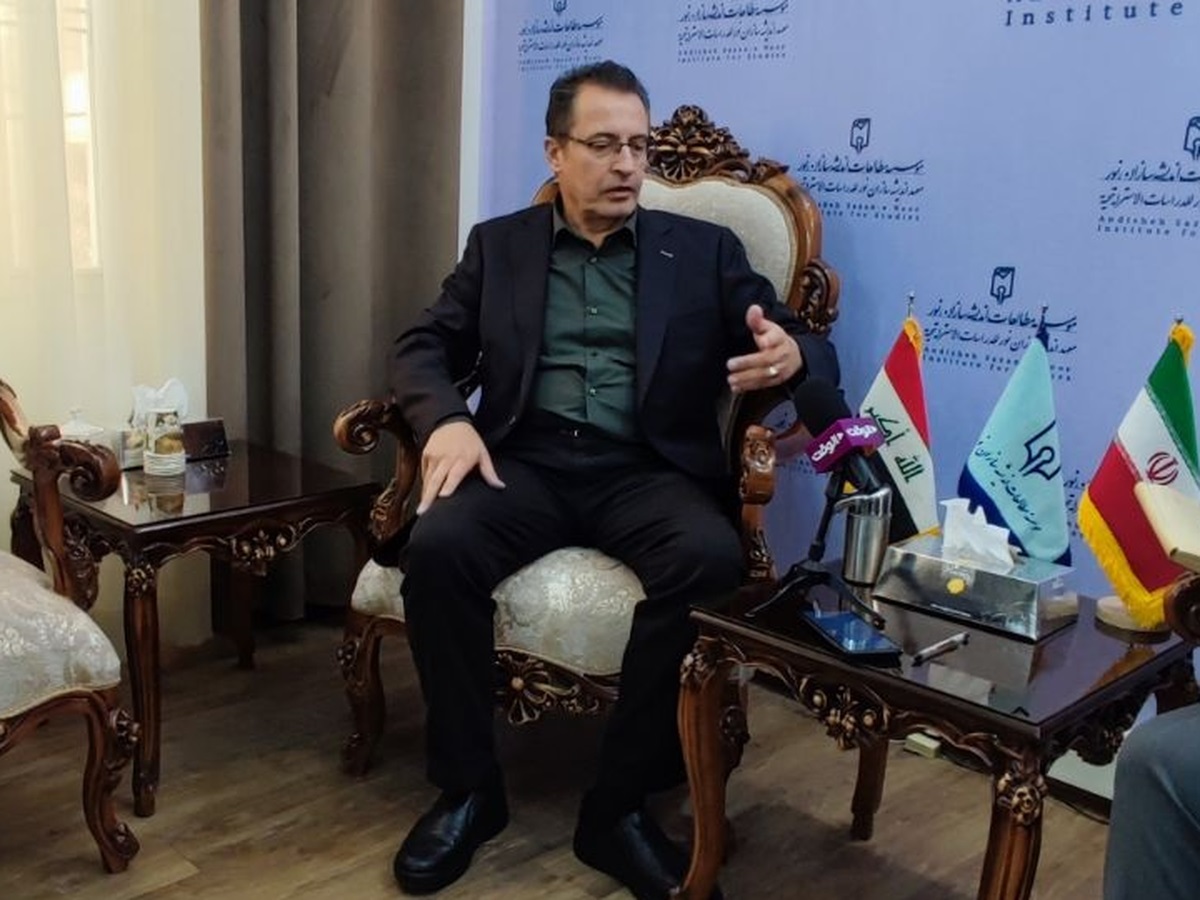


Alwaght- Amid heightened disputes between Kurdistan Democratic Party (KDP) and the Patriotic Union of Kurdistan (PUK), Iraq's Kurdistan region is grappling with a political stalemate and serious challenges in formation of government and unified administration of the autonomous region. Simultaneously, the region's relationship with neighboring Iran, especially in security area, border control, and trade in the current conditions is of strategic significance to Tehran.
In this context, Alwaght arranged an interview with Adnan Othman Mohammad, head of the nongovernmental Ru'ya Center for Strategic Studies, to examine the Kurdistan Region's political crisis and the outlook for its relations with Iran.
Alwaght: It seems that the recently surfaced disputes between KDP and PUK leaders have deeper roots and we can see that the past agreements of the two parties to share power have lost their efficiency. What do you think?
Mohammad: As you noted, the rift between the two main parties is long-standing. From the outset, the dispute centered on how the region should be governed and on the two parties' divergent views over the management of cities, districts and the structure of governance. Over the years, the feud has at times escalated into open tension and at other times subsided, but it has never been fully resolved.
Ultimately, these differences produced two separate administrations in the Kurdistan Region. Distinct management structures took shape, particularly in areas such as oil and economic resources. In effect, Iraq's Kurdistan has been split since 1992 into two zones of influence: one under the KDP and one under the PUK. This division, known as the two-zone system, has persisted despite some changes and attempts at reform.
After Iraq's political upheaval, the fall of the former regime and the drafting of a new constitution, efforts were made to form a joint government in Kurdistan. A power-sharing agreement between the PUK and the KDP was struck with the same goal: a unified government for the region. In practice, however, the joint government was run with the same old mindset and machinery and failed to dismantle the dual administrative structure.
Unfortunately, efforts to establish a single administration came to naught, and the issue remains one of the region's fundamental problems, one whose effects have spilled over into various sectors and areas across Kurdistan.
The rift has widened in the recent period, especially since its parliamentary elections roughly two years ago. After the vote, the two parties unfortunately failed to form a new government, as each held a different view of the nature of the government and how the region should be run.
One view holds that the autonomous region should have a centralized, unified government responsible for administering all parts of the region. Under this view, the mechanism for forming a government should rest on democratic principles and the election results, meaning the party that won more seats gets a larger share of the government, while the party with fewer seats assumes the role of the minority. That is the standard mechanism in democratic systems.
But there is a competing view and it is that the Kurdistan Region should continue to be governed with the reality of the two zones of influence in mind, and the makeup of the cabinet should reflect that division. In other words, each party's share of the government should be determined by its zone of influence and its power and standing, not simply by the number of parliamentary seats it holds.
This clash of views has itself become one of the main obstacles to forming a government. The dispute is not merely over the number of ministries, who becomes speaker of parliament or which party secures more ministries; it is a fundamental disagreement over the nature of the governance system in this region.
In fact, one side wants a single, centralized government and cabinet administering all parts of the region, while the other continues to insist on preserving the political and administrative reality of the two zones.
If this dispute is not resolved and no practical solution is found, and if Kurdistan is not governed in a decentralized manner, Kurdistan will in practice drift toward entrenching the dual arrangement, a situation that could in the future take on an even more formal and explicit shape, with the region turning into two separate areas with two separate jurisdictions instead of a single unified political and administrative entity.
This could carry significant consequences for Erbil's relations with Baghdad and for the future of its political structure, potentially seeing the two zones recognized as two separate regions in Iraqi Kurdistan and engaging with Baghdad on that basis. Actually, all scenarios remain on the table and open.
Alwaght: Concerning Iraq presidency this issue is seen between the two parties and actually there is a political standoff. Under past agreements, it should have a proportionate share and standing in the power structure, but the KDP, for its part, has its own views and demands. In your assessment, can the two parties reach a common agreement? Can they restore the traditional power-sharing formula that has collapsed and caused so many problems?
Mohammad: As I pointed out, the dispute is not over power sharing, but over the government structure and how to create balance in power. However, if they have political will, a deal is possible, though it is a hard path.
I think both parties must step back from their hardline positions and show flexibility and compromise to reach an agreement. That compromise needs to happen at every level, both in Baghdad and in the Kurdistan Region.
In the past, the late Mam Jalal (Jalal Talabani) was present in Baghdad while Mr. Masoud Barzani played a central role in the Kurdistan Region. That created a kind of division of responsibility and balance between the two sides. Conditions have now changed, and this balance needs to be restored across all levels of power.
The PUK argues that just as Mam Jalal was in Baghdad in the past, now that he is no longer alive, all power in the Kurdistan Region, from the presidency of the region to the premiership, should not be concentrated in the hands of the KDP.
Having in mind that this region is in practice made up of two zones of influence, that reality must be taken into account when dividing responsibilities. For example, if the president of the region comes from one zone, the head of government or prime minister should come from the other, and vice versa. This is a political view and reading of how the region should be governed and how it should deal with Baghdad.
The two parties should, therefore, be able to strike a deal on these issues, including in Baghdad on the posts of parliamentary speaker and president and on the government. Such agreements could once again help strengthen the Kurdish position in Baghdad and improve the political situation in the Kurdistan Region.
What matters, of course, is that any such agreement be built on an acceptance of differing views and within the framework of a kind of political partnership, not on one side being forced to retreat from all its positions and convictions.
This partnership must be built on the reality in Kurdistan, namely, the existence of two zones of influence. This situation was neither our wish nor the wish of the Kurdish people; it came about as a result of past wars and internal conflicts. Still, it has now become a political reality, and a solution must be found to manage it.
Ultimately, if such a will exists among the two parties, I believe their differences, both in Baghdad and in the Kurdistan Region, can be resolved with ease. But if that will is absent, the problems will persist.
Alwaght: In the recent developments, given Talabani's positions, especially his remarks about ending the previous power-sharing agreements, is there likely that the PUK will no longer accept the earlier deals and will instead demand that the same legal and political structure governing Erbil be applied in Sulaymaniyah? Is this scenario really on the agenda and has a decision been made about it, or is it merely a position aimed at boosting its bargaining power and extracting more concessions from the KDP?
Mohammad: The governance system in the Kurdistan Region is built on a partnership between the PUK and the KDP. On that basis, although procedurally parliament can convene with 51 seats, a parliament without the PUK's participation would be politically discredited. The same holds for the regional government: a cabinet without the KDP is not possible. That is the first point.
The second point is that my reading of Bafel Talabani's remarks is that he believes if the current situation continues, the PUK will be forced to move toward another scenario.
In his view, what happened in parliament effectively amounted to setting aside the agreements that had previously existed between the two parties. I do not want to use the word coup, but Bafel's reading is that what happened in parliament was a kind of upending of the earlier agreements and understandings. That is why, if this process continues, the PUK and the area under its influence will be forced to take action.
Such measures could mean taking a decisive decision or even distancing itself from the region's current structure, and the law provides for such a scenario through the collection of a large number of citizens' signatures. Of course, such a scenario is not easily implemented, and the reality is that it would be very difficult and unpleasant for Kurdistan.
That is why the best path is for both parties to reconsider their positions once again, to put parliament to work in a more appropriate and active manner, and to pave the way for forming a new government. The political and parliamentary process must also be recognized again, and instead of continuing confrontation, the two sides should return to the path of understanding and cooperation.
The desirable solution, thus, is for the two parties to return to the negotiating table once again, activate parliament, and, by forming a joint government, prevent the political and administrative rifts in the Kurdistan Region from deepening further.
Alwaght: Iran's relations with the Kurdistan Region of Iraq have always been of high significance, and economic ties have formed an important part of that relationship. These relations matter especially to Iran. One of the key issues Tehran has stressed is the presence of opposition groups based on Kurdish soil. Iran has repeatedly demanded that these groups be moved away from the border areas and that their activities be prevented. However, it appears that Iran's demands on this front have not been fully met. What is the current status of these groups? How much will and readiness do the Kurdistan Region's leaders have to confront them? And have Iran's military strikes on these bases affected their approach?
Mohammad: Kurdistan's official policy has always been to prevent any threat to any of its neighbors from being launched from its soil. This policy has been pursued toward both Turkey and Iran. Especially regarding Iran, the region's official position and that of its political parties has been that no military activity against the Islamic Republic should take place from Kurdish territory.
This policy has largely been implemented. Indeed, new conditions and equations have now taken shape in Kurdistan, particularly in connection with paramilitary forces. One reason for this shift is the developments and events that have unfolded in the region and the world.
Among Kurdish currents, the view has gradually gained strength that there should be no more moves toward military action, armed activity or military operations, because such actions exact a toll on both sides and ultimately harm innocent people and civilians.
I think, the best path for Kurds across all Kurdish areas is to pursue civil struggle and to be able to engage in dialogue and interaction with the region's governments and authorities, whether with the Islamic Republic of Iran, Turkey or Syria. In Syria, for example, a new era has begun, and in Turkey a new process has taken shape.
Especially now, as we are witnessing new developments, this issue has become more important, and no particular threat to the Islamic Republic of Iran has emerged from inside the region. This is itself a positive development, and for that reason, this should be reinforced.
Alwaght: Iran-Kurdistan Region border crossings are key to Erbil and Iran's foreign trade. In present conditions, the US is pressing for closure or restriction of trade in these crossings. What do you think about these pressures?
Mohammad: As you know, the Iran-Iraq border is very long, and Iran's border with the Kurdistan Region is also considerable. Iran and Iraq share deep religious and sectarian ties and extensive historical relations. The Kurdistan Region's relations with Iran are likewise rooted in deep ethnic, cultural and historical bonds. Since 1991, a significant share of the region's border trade has been with the Islamic Republic, with another portion conducted with Turkey through the Ibrahim Khalil crossing.
As a result of these economic, commercial and cultural ties, the relationship between Iran and the Kurdistan Region is very deep and extensive, with mutual interests at stake, which is why the Kurdistan Region cannot easily disregard its relations with Iran and their shared border crossings.
The current pressures should therefore not be seen as permanent and enduring, but as temporary. It should be kept in mind that Iraq itself is under widespread pressure. Financially, a significant share of Iraq's resources and revenues is held by the US, and the country is not in a favorable economic position. In effect, heavy pressure is being brought to bear on Iraq's economy and sovereignty.
Still, all sides must work to end the war. It has become clear that war cannot be resolved through weapons, bombardment and airstrikes, and that problems will not be settled that way. Persian Gulf states and other regional actors are now making extensive efforts to find a solution. This opportunity should be seized so that differences can be resolved through negotiation and peaceful means.
Recent developments have shown that changes are also taking place in US policy, that Trump's war policy failed outright and that American public opinion does not support it. In Israel, too, Netanyahu's policies have met with failure. At the international level, shifts in approaches and political equations are taking shape, and Europe had already opposed this war. We hope these developments will lead to an end to the war, the start of a peace process and a reduction of pressure on Iraq.
I believe the current pressures on Iraq and Iran are temporary. The Iraqi government needs its deep relations with the Islamic Republic of Iran, and I believe the Islamic Republic also understands the conditions and pressures bearing down on the Iraqi government and the Kurdistan Region. Both sides can get through this phase at minimal cost, though emerging from these conditions will take time.
The autonomous region has a fundamental need for its relations with Iran, and I do not think these pressures will have much impact. But if the border crossings are closed, it is first and foremost the people of the Kurdistan Region who will suffer. Many people and businesspeople in the region depend on cross-border trade, and closing the crossings could confront the region's market with serious problems.
The consequences of such a step would not be purely political. Its political effects might be temporary and fade after a while, but its economic fallout would be very heavy and damaging. We hope we do not reach such a situation, that this period ends soon and that peace and peace return to the region once again.