









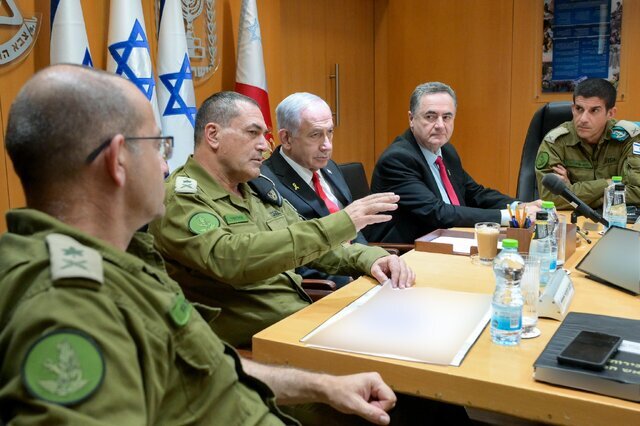


Alwaght- The Israeli Prime Minister Benjamin Netanyahu who over the past three years has been running rampant in regional wars in a bid to, as he thinks, eliminate Tel Aviv's enemies inside and outside the occupied territories these days is eyeing a new adventure before the parliamentary elections, but has run into the firm obstacle of the army.
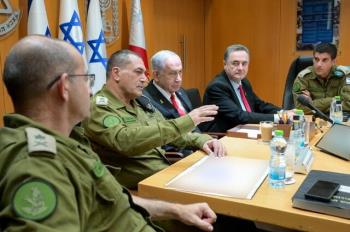
Netanyahu had recently repeatedly said he wants to wage a new war on Iran in association with the US President Donald Trump, but the cost has run so high that even the military leaders are defying his orders, with reports revealing serious dispute between Netanyahu and army chief Eyal Zamir about the way of confronting Iran.
In this regard, Israel's Channel 13 reported that in secret talks Netanyahu has said that if he wins, he will fire Zamir. The new details of the gap between the PM and the army chief suggest that the Iran attack plan was rejected following an opposition by Zamir, and assessments suggest that he will be removed if Netanyahu retains power after elections.
In recent weeks, tensions have escalated between Israel's military and political leadership, with Netanyahu attempting to launch a third round of war against Iran before the elections, only to be blocked by Zamir, who refused to greenlight the plan.
The New York Times, citing Israeli officials, has reported that the rift between Netanyahu and Zamir over a pre-election strike on Iran is real, even as Israeli Defense Minister Israel Katz has claimed no such disagreement ever existed.
Zamir, the report said, has in recent days voiced alarm over pressure from Netanyahu to take independent action against Iran, with the dispute degenerating into a verbal clash between the two.
Why is Zamir opposed?
The real reason Israel's military refused to fall in line with Netanyahu this time has less to do with Iran than with the political calculus inside the occupied territories. Zamir cited the need to prevent postponement of elections in the occupied territories as his rationale for objecting. He argued that such a strike would be a blunder that could invite an Iranian attack on the occupied territories.
The Israeli occupation army has concluded that Netanyahu, on the eve of Knesset elections, is inflating the threat of an Iranian strike on the occupied territories to buy time and delay the vote. But contrary to Netanyahu's claims, there was no clear signal that Iran was inclined to enter a new round of confrontation with Tel Aviv, and that is precisely why his plan did not unfold as he had hoped.
The PM knew that polling pointed to a likely defeat for Likud and its right-wing allies in the Tuesday Knesset elections. He, therefore, hoped that launching a third round of war with Iran would postpone the vote for a while and give him more time to shore up his political standing and that of the far-right camp. But the army, on the front line and wary of the consequences of a possible Iranian response, refused to go along.
The Israeli military, which has been drawn into multiple fronts during Netanyahu's tenure, is now under the strain of successive wars and inconclusive results, and has no appetite for a new confrontation, one that could sink it even deeper into a quagmire created by Netanyahu's military policies.
In the two previous wars with Iran, Netanyahu portrayed the conflicts as great achievements. But critics argue that the threats to the occupied territories have not only not been eliminated but that Israel's security situation has worsened compared with three years ago, with multiple fronts now open.
The main reason the Israelis have gravitated toward Netanyahu's rivals is dissatisfaction with conditions that have stripped settlers of their sense of calm. The protests by thousands against Netanyahu's government before the elections also showed that the public and opposition parties want to put an end to four years of a reign of terror.
The chief of staff, given these conditions, does not want to send army forces into a new war and sacrifice them for Netanyahu's personal and political goals, especially when the PM's political future after the Knesset elections is shrouded in uncertainty.
Zamir has, therefore, chosen this time to prioritize the security of Israelis over entering a new war with Iran, security that Netanyahu's bellicose policies over the past four years have badly damaged. Netanyahu's fury at Zamir, therefore, shows that the army's opposition has shattered his dream of another attack on Iran.
Additionally, given the election equations and potential formation of a government of anti-Natanyahu coalition, Zamir's political calculus should not be ignored: That the opposition to war, in addition to military and security reservations, is a bid to maintain his position in the future power structure. So, he can promote this daring decision to the future government as a measure to safeguard Israeli security to retain his current post as army chief.
In general, Zamir's opposition to Netanyahu's Iran attack plan indicates that the decision for war, even in critical political atmosphere, is not merely held by the PM and the security and military assessments can prevent the political calculations from translating into a new conflict.