






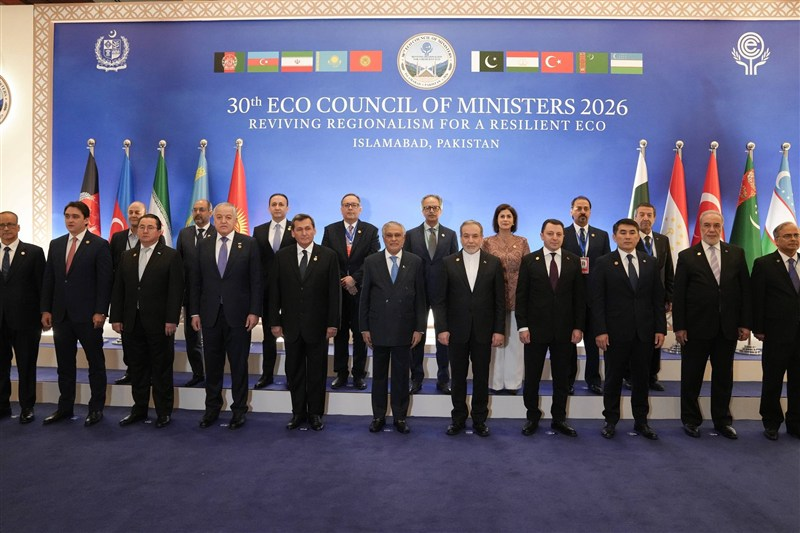


Alwaght- The recent meeting of foreign ministers of the Economic Cooperation Organization (ECO) in Pakistan unfolded under a growing shadow from regional tensions to disputes among some member states, now weigh more heavily than ever on the organization's future. The situation threatens to steer ECO away from its core mission of strengthening economic ties and expanding regional trade, jeopardizing the opportunities available to its members.
Against this backdrop, Alwaght spoke with Ismail Bagheri, an expert on Indian Subcontinent affairs, to examine ECO's strategic outlook and the obstacles standing in the way of economic convergence in the region.
Alwaght: What consequences do border tensions between Afghanistan and Pakistan and scaled down trade between the two neighbors have on the economic structure and trade convergence of the ECO?
Bagheri: Before addressing that question, it is worth noting that the founding philosophy of ECO was, above all, for member states to tap into the region's indigenous capacities to develop trade and expand economic ties. One consequence of deeper economic relations was the growth of political ties. Cultural relations mattered greatly as well, since member states are bound closely by shared history, civilization, and culture, drawing, in effect, on one vast cultural sphere in the region.
Without doubt, escalating border tensions between Afghanistan and Pakistan erode mutual trust and weaken ECO. This is especially damaging in the trade sphere, creating problems for the transit and transport of goods and services and ultimately blocking the expansion of commercial and economic ties to the desired level, something we have witnessed in practice.
Alwaght: Despite emphasis of the ECO member states on expanding economic cooperation and deepening trade ties, the US is pushing to restrict these countries' relations with Iran. What effect have the American pressure so far left on the level of trade between ECO members and Iran? What challenges do Washington pressures put ahead of the regional cooperation?
Bagheri: American pressure, particularly on countries that do business with Iran, has effectively forced those countries to weigh political considerations in their economic dealings with Tehran. The clearest example is the "Peace Pipeline," which Iran financed all the way to the Pakistani border, yet Iranian capital has sat in limbo for years. Pakistan, despite agreeing to build 80 kilometers of pipeline on its own soil, has postponed the project for years over American sanctions and economic calculations, taking no practical action. American pressure thus depresses the level of trade and economic exchange between countries, making it costlier and riddled with obstacles, a problem visible right now in our relations with Pakistan.
Even Turkey has its own political calculations and feels the weight of American pressure, but Turkish officials think more wisely than Pakistan. We currently face problems at border customs with Pakistan, yet Pakistan needs this route too and, in practice, suffers from the situation itself, which is why it cooperates to some degree.
American pressure, meanwhile, pushes countries to seek alternative transit routes, and we are seeing exactly that: Pakistan is trying to use other trade corridors, and Turkey is pursuing routes such as the Armenia-Azerbaijan corridor and the Caspian Sea route to Turkmenistan. All told, various corridors have been designed, and some of them owe their existence to US sanctions and pressure.
The key variable here is how dependent different countries are on the US and Western financial and banking system, a factor that itself shapes outcomes. That dependence effectively leads countries to maintain relations with Iran as far as their needs require, even under sanctions. Kazakhstan, for instance, is sometimes sanctioned by Washington over its economic ties with Iran, but those ties continue as long as both sides' needs are met. American pressure, then, makes relations harder, costlier, and at times attritional, erecting obstacles to economic cooperation among countries.
Alwaght: The ECO in recent years has tried to, through reviving it's capacities, turn into a regional economic and trade hub. How does restriction of trade with Iran impact this aim and the cohesion of the ECO trade network?
Bagheri: ECO set out to help member states leverage each other's capacities through trade and economic convergence, building complementary economies that would, in practice, turn the region into an economic pole. That never happened. Countries' political calculations, deferring to US positions and to incentives some received from the West, pushed them to scale back ties with Iran.
Even economic relations among some member states, such as Afghanistan and Pakistan, have always been marked by ups and downs. Afghanistan's ties with Central Asian countries and Turkey's relations with other ECO members have expanded at times and contracted at others. These dynamics have weighed on economic cooperation.
So, restricting or cutting off other members' trade with Iran ultimately hurts both sides. Member states, whether they like it or not, must accept that Iran, given its geographic location, territorial size, and geoeconomic position, is one of the best transit routes available, and that any route bypassing Iran carries a higher price. By failing to use this capacity, these countries lose out, and so does Iran.
Sustainable economic development and the promotion of intra-regional trade, among ECO's most important goals, certainly require that countries pursue their national interests in the economic sphere and prioritize cooperation among member states. Unfortunately, that cooperation has been compromised by other considerations, meaning some countries, by aligning with the US, are in practice dealing a blow to ECO. As a result, the potential that ECO and its members could have unlocked together, to develop and strengthen economic ties and expand trade, remains unrealized.
Alwaght: What agenda does Pakistan shutting down of its border crossings with Iran under security excuses follow? What are the fallout for bilateral trade and border transactions?
Bagheri: Pakistan, it must be said, has serious security considerations. The country is currently positioning itself as a mediator between Iran and Saudi Arabia, yet at the same time it has deployed more than 8,000 troops and a squadron of several fighter jets to the Saudi-Yemen border region in support of Riyadh. That shows just how double-tracked Pakistan's policy is, and how much financial interests matter to it.
Meanwhile, Pakistan has closed the Mirjaveh border crossing under the pretext of fighting terrorist groups, including Jaish al-Adl and Baloch separatist groups such as the Baloch Liberation Army. At other crossings, like Rimdan and Pishin, the necessary infrastructure is far from complete. At some border markets, Iran's infrastructure is superior while the other side lacks the needed facilities; elsewhere, the situation is reversed. These problems have slowed truck traffic in practice, and visa and truck-transit issues are also taking a heavy toll on trade.
There are also obstacles on the rail lines, particularly in the Mirjaveh–Taftan stretch, where the two countries' rail gauges differ, a problem that creates difficulties for both sides. The Mirjaveh–Taftan line, it should be noted, connects Iran's rail network to Pakistan's Balochistan and the key city of Quetta.
The consequences of these constraints are clear: trade will shrink. The economic target set by Iran and Pakistan, $10 billion in trade within five years, is wildly optimistic unless the obstacles cited are removed, Pakistan sets aside its political considerations, and it steps back from the dual approach it has always pursued. For all the warmth Pakistani officials show in meetings with their Iranian counterparts, rolling out the red carpet and receiving them graciously, on the ground at the borders we are staring down thousands of problems.
Alwaght: Handing part of Chabahar Port's operations to the Taliban raises an obvious question: What new economic and transit opportunities does it create for Iran and Afghanistan, and does the Taliban have the capacity, executive capability, and political will to make effective use of them?
Bagheri: The reality is that if Iran plays the decisive role in economic relations, it can pursue bigger goals, like reaching Central Asia and China through Afghanistan. That approach is sound, provided we advance it according to our own plan and strategy, rather than letting the Taliban set the strategy and having us serve merely as the instrument of its realization.
The Taliban, for example, may want to use Iran's capacity because of its problems with Pakistan and the closure of transit routes. But the more its position and power grow, the freer its hand becomes for harsher measures, including against Shiites. The Taliban has trouble even with Persian vocabulary and won't tolerate it, to the point of objecting to certain Persian words at universities. If such conditions are to prevail, these issues deserve serious attention and a more careful look at economic relations with Afghanistan.
Another point is that Iran's trade volume with Afghanistan is put at roughly $3.5–4 billion, with the bulk consisting of Iranian exports. We are, in effect, mostly the exporter. Still, the current Afghan government, squeezed by US sanctions, landlocked, with its borders to Pakistan closed and a dire need for Iranian goods, from industrial and construction materials to food, medicine, and consumer products, meets some 30–35 percent of its needs from Iran, especially since Iranian goods are competitively priced and of good quality. Rebar, cement, and many construction materials are simply easier and more cost-effective for them to source from Iran. Importing these goods, in turn, opens the door for Iranian technical and engineering services exports.
So, a considerable share of the benefits from these relations goes to the Afghan side, despite the seemingly lopsided trade balance. We should not assume that simply because the trade balance favors Iran, Iran is necessarily the winner and Afghanistan the loser.
As for handing part of Chabahar Port to the Taliban, steps have been taken, and the Taliban has managed to build the Qosh Tepa canal, its first phase completed, the second nearing completion. Some may assume the Taliban lacks technical capacity, but the reality is that its approach to these matters and to economic development is strategic: it pays attention to transit, railways, road-building, even air routes.
Moreover, the Taliban has plans for economic sectors and has trained the manpower it needs, visible in the projects underway in Kabul and elsewhere. So technically, they are capable of executing such projects, though securing that technical and engineering capacity will likely come through cooperation with engineers and specialists from Turkey, China, India, and other countries.