









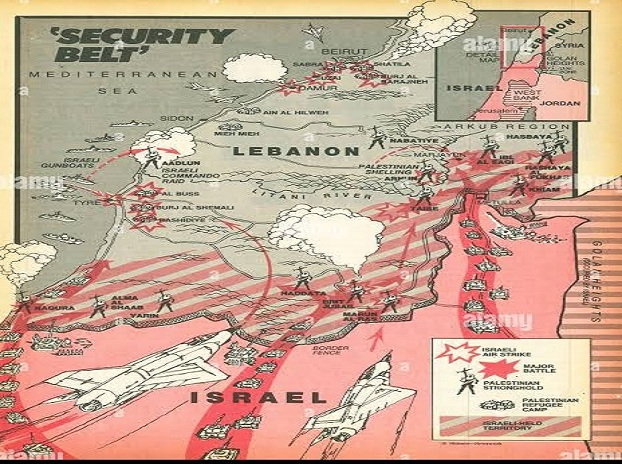


Alwaght- Since the start of Gaza war on October 7, 2023, the Israeli regime not only expanded scope of its military operations to the whole region, but also it is establishing a new geopolitical reality on the common borders with neighboring countries; one Tel Aviv leaders call "security belts", designed to change official borders and to impose new security order on West Asia.
The Israeli army now occupies 800 square kilometers of Lebanon territory, over 60 percent of Gaza, and large tracts of southern Syria in the Golan Heights to Jabal Al Sheikh (Mount Hermon) and plans to evacuate locals under the guise of setting up buffers and hold them permanently. This is pushing the observers to suggest that the Israeli regime is breaking with its old strategy of deterrence towards a new strategy aimed at gaining direct control of territories and establishing permanent buffer zones.
This development is not merely a periodic military measure; it is the starter to a new phase of geopolitical competition and chronic instability in West Asia.
New security doctrine of Israel
Benjamin Netanyahu and Israel's military brass argue that October 7 attack, combined with Hezbollah's rocket and drone barrages from Lebanon, proved that current borders can not secure Israel. From this view, creating "strategic depth" beyond Israel's official borders is an unavoidable necessity to prevent such attacks from recurring.
But Netanyahu's argument, which has become the justification for expanding military operations into neighboring countries, is hardly new. At its core, it draws on Israel's claimed right to defensible borders, something rooted in the strategic and legal realities that emerged right after the 1967 Six-Day War, when Israeli forces captured the West Bank, Egypt's Sinai Peninsula, and Syria's Golan Heights.
Yet under Netanyahu's right-wing cabinet, the interpretation has shifted. To guarantee permanent security for Israeli settlements and towns along Gaza (and even the Rafah border with Egypt), southern Lebanon, and southern Syria, they say, these areas must be fully decoupled through buffer zones, or security belts, carved inside enemy territory. The Israelis contend that a direct military footprint in these zones improves surveillance of enemy movements, enables faster response times, raises the cost of any attack on Israel, and thus provides tangible security guarantees for Jews living in kibbutzim.
This security redesign has also extended into the regime's foreign policy paradigm. The 2002 Arab Peace Plan was built on "land for peace", withdrawal from occupied territories in the West Bank and Gaza in exchange for normalization with Arab states. Today, however, the expanding occupation in Gaza, Lebanon, Syria, and even Jordan effectively reverses that logic. The regime now pursues normalization not by giving up land, but by expanding regional hegemony and sustaining a permanent threat to hostile states and neighbors. Interestingly, the definition of "hostile" among the regime's elites no longer stops at border states with territorial disputes, it' is now engulfing countries that simply refuse to normalize ties.
Here a question presents itself: Is there a larger design behind this security belt push? More importantly, does seizing more territory actually produce lasting security for the regime, or will this policy become its own Achilles' heel? Before answering, we need to examine the blueprint for four security belts stretching from Syria to Lebanon, Gaza, and Jordan.
Gaza, the lab to new doctrine
Gaza was before any region where the Israeli leaders tested the true nature of their new strategy to set up security belts.
After October 2025 Sharm El Sheikh ceasefire deal, the Israeli occupation army unveiled the "yellow line" to determine its control region in Gaza with an area of around 200 square kilometers. However, Israel did not stop within this area and expanded its borders.
Haaretz has recently reported that Israeli Prime Minister Benjamin Netanyahu officially confirmed that Tel Aviv has broadened its control of Gaza from 53 percent to 60, violating the terms of deal with Hamas.
Official data published by Al Jazeera confirm this. For example, in northern Gaza, Israeli military has expanded its control from 67.3 square kilometers to 73.9 square kilometers and so now controls 54.7 percent of the north. Satellite imagery also confirm massive and unannounced devastation outside the stated military zones, like Shejaiya neighborhood.
So control of 60 percent of this enclave under the push to create a security belt and buffer zones shows that Tel Aviv is redefining Gaza's political geography. Many political analysts believe that Tel Aviv is eying a situation in which Gaza will not operate as a united cohesive geographical and political unit. Even some hardline figures like National Security Minister Itamar Ben-Gvir have proposed that Israeli forces should stay in the newly occupied territories and launch new settlement projects.
Syria, from the significance of borders to looting the water resources
Perhaps the most important part of the new Israeli strategy is expansion of presence in Syria.
After fall of President Bashar al-Assad in Syria, which led to a security vacuuming parts of the country, Israel seized the opportunity for advances inside Syrian border territories. Control of Jabal Al Sheikh in Syria's south is of extraordinary military importance for the Israeli regime since this mountain provides a vantage point for intelligence and militarily operations over a large part of the southern Syria, Lebanon, and even the northern occupied territories.
However, this presence can have consequences going beyond Syria. Turkey that now sees itself the main player of the Syrian developments will likely regard the Israeli military foothold a threat to its long-term interests. Over the past few years, Ankara has been working to cement its influence across northern and central Syria to counter the Kurdish threat and Syrian affiliates of the PKK. Now, however, it may find itself facing a rival that is steadily morphing into a decisive power broker in southern Syria.
At the same time, the push to dominate southern Syria and its border with Lebanon is also aimed at pressuring Hezbollah, a move that the Iran-led Axis of Resistance will undoubtedly view as a direct threat to its strategic interests. Southern Syria, then, could become a major flashpoint for competition between Israel and Turkey.
This dynamic is already playing out in the rhetoric of Defense Minister Israel Katz, who has made it crystal clear that the regime would not just push Hezbollah fighters north of the Litani River, it intends to dismantle the entire "support environment" along the border strip. According to Israeli military reports, the plan entails razing every Lebanese village and town from the frontline up to depths of 3 to 8 kilometers. The goal is to permanently block residents from returning and turn the area into a depopulated wasteland stripped of infrastructure.
But this is not purely about security. The buffer zone also gives Israelis a pretext to plunder more water resources from southern Syria. The region hosts several major springs and water sheds, from the Yarmouk River basin to the Al-Wehdeh Dam, Al-Muntar, Kodneh, Ghadir Al-Bustan, and the Al-Raqqad Dam, all of which are now directly threatened by Israeli expansionism, whether through outright control or by manipulating flow and quality. Local sources say Israeli patrols have already accessed all these dams and water sources, and can cut off supply to the southern Syrian provinces of Quneitra, Daraa, and Sweida at will.
The fallout can include the springs running dry, reservoir levels plummeting, and water networks collapsing, spelling a growing risk of food insecurity across these regions.
Lebanon, along the Litani River
The strategy of establishing security belts along the borders has also spread to Lebanon. The Israeli army occupies 600-800 square kilometers of Lebanon lands and is pushing to link it to a west-east belt to the Syrian borders along the Litani River.
The Israeli military is applying the Gaza playbook to Lebanese territory, progressively expanding its footprint. Evacuation warnings that once focused on border villages and areas south of the Litani River have, in recent weeks, spread to towns and cities below the Zahrani River, including Sidon and Nabatieh.
While the army frames its push north of the Litani and its pressure on residents to flee areas south of the Zahrani as measures to counter Hezbollah's operations, the reality tells a different story. The forced displacement of populations and the systematic destruction of the region's economic and agricultural infrastructure point to a far larger scenario: long-term occupation of these areas, coupled with a deliberate effort to block displaced residents from ever returning, all in service of the regime's broader strategy of carving out permanent security belts.
Jordan Valley, the eastern security belt
While the public opinion over the past two years have been focused on the security belts set up in Gaza, southern Lebanon, and southern Syria, many strategic Israeli circles believe that the most important link of this security doctrine is the eastern front, namely the Jordan Valley. Just unlike northern and southern regions that caught attention after Gaza war, Jordan Valley has been for decades recognized as "final defense border" in the Israeli security mindset. It is a region that, in the eyes of military and political leaders, not a temporary buffer zone but an inseparable part of the long-term security architecture of this regime.
Retired Major General Uzi Dayan in a recent article titled "Defensible Borders for Securing Israel's Future" flatly states that on the eastern front, there is no alternative to the Jordan Valley. In his view, the region's unique geography and topography make it Israel's only natural and defensible eastern border. With the occupied territories averaging just 64 kilometers in width from the Mediterranean to the Jordan River, "strategic depth" has always ranked among the top concerns for Israeli military circles. For Tel Aviv's security establishment, the Jordan Valley is not a political bargaining chip, it is a survival imperative.
The region's importance becomes even clearer when you look at its terrain. The Jordan Valley is only 7 to 14 kilometers wide in places, but the elevation gap between the river and the West Bank highlands exceeds 1,000 meters. That makes it a rare natural military barrier, one that, if controlled, enables effective surveillance and defense against any military movement from the east. That is precisely why the Israeli army maintained a heavy military footprint there even after signing the peace treaty with Jordan, consistently framing the deployment of combat forces and monitoring systems as non-negotiable national security requirements.
But the Jordan Valley's significance is not purely military. In recent years, specially under far-right governments, it has become a cornerstone of the creeping annexation of the West Bank. The prevailing view within the regime's ruling circles is that any independent Palestinian state without Israeli control over the Jordan Valley would pose a direct threat to Israel's security. The new security belt doctrine, therefore, has effectively become a tool to block any full Palestinian sovereignty over the West Bank's eastern borders.
In this vein, Israeli officials are increasingly likening the Jordan Valley to the Philadelphi Corridor on the Gaza-Egypt border. Their logic is that just as weak oversight along Gaza's border previously allowed weapons and equipment to reach Palestinian groups, any drawdown of Israeli presence in the Jordan Valley could turn the West Bank into a conduit for arms smuggling and regional influence-peddling. That is why Israel's security elites insist that, even in the event of a political settlement with the Palestinians, full control over the eastern border must remain in Tel Aviv's hands.
However, many analysts believe that what is raised these days as "security requirements" in the Jordan Valley in practice goes beyond a pure defense strategy. Permanent control of this region will practically separate the West Bank from the Arab world, shatter the possibility of a Palestinian state with independent borders, and pave the way for gradual annexation of further Palestinian territories to the already occupied ones. That is why the Palestinians and many other Arab countries see the Israeli policies in Jordan Valley as part of broader project to consolidate occupation and change the geopolitical realities of the region.
Furthermore, expanding the security view of Israel to the Jordanian borders sends an important message to the Tel Aviv-Aman relations. Though Jordan is one of the small number of countries having peace deal with Israeli regime, any Israeli push to establish control over Jordan Valley can draw new political and security sensitivities of Aman, especially that a considerable portion of the Jordan's population is of Palestinians descents and any change in the West Bank directly impacts Jordan's home dynamics.
In sum, the Jordan Valley must be understood as the eastern link in the Israeli regime's new security belt doctrine, a link that, unlike Gaza, Lebanon, and Syria, has not yet erupted into open warfare, yet strategically may well be the most critical piece of the entire project. If the northern and southern belts are designed to create defensive depth against military threats, the eastern belt carries a dual weight: beyond its security function, it will play a decisive role in shaping the future of the Palestinian issue, the fate of the West Bank, and even the final borders of the occupied territories. This underscores that the security belt strategy is not merely a military blueprint but it is an integral component of a far broader geopolitical redesign of the region, engineered to lock in permanent advantage for the Israeli regime.
Security requirements or "Greater Israel" project?
One of the most important debates about the New Israeli regime’s policy of establishing buffer zones is its real motivation.
Part of the Israeli elites, especially far-right groups inside the coalition government of Netanyahu, not only deeply believe in the "Greater Israel" project, from Nile to Euphrates, but also stress on seizing the current historical chance, facilitated by Trump administration's staunch support to the Israeli expansionism and instability caused by the Israeli military operations across west Asia over the past three years.
So, the new occupations are not a response to the security threats but a part of an ideological project to change the region's political map.
Some analysts believe that Netanyahu also has home political drivers behind this project. He is grappling with major personal judicial cases and broad social gaps. Continued war atmosphere can mobilize the Israeli public around claims of foreign threats and ease pressures on the government.
This is precisely why many observers argue that the sustained tension in Gaza, Lebanon, and Syria is not an unintended byproduct, but a calculated feature of the current government's political calculus.
Before 1967, Israel's "narrow waist", namely the distance between its coastal cities in the central region and the then-Jordanian-controlled West Bank, was barely 12 kilometers wide, a glaring vulnerability in strategic depth. The regime's fragility was compounded by the fact that 70 percent of its population, 80 percent of its industrial capacity, and its most critical infrastructure assets, Ben Gurion Airport, the Trans-Israel Highway, the national water carrier, and high-voltage power lines are all crammed into that slender coastal strip.
That reality has driven the architects of the regime's national security doctrine, from Yigal Allon to Moshe Dayan to Yitzhak Rabin, to consistently and unequivocally oppose any return to the 1967 borders. Israeli strategists and leaders have always pursued new frontiers that would enable Israel to defend itself, an objective that crystallized in the concept of "defensible borders" and has since become an inseparable pillar of the regime's defense and security strategy across every government.
Historical experience: Why do Israeli security belts fail?
One of the most important questions about the New Israeli strategy in Lebanon, Gaza, Syria, and the Jordan Valley is here: Does this policy have a successful precedent in Israeli 8-decade history? A look at past experiences shows that Tel Aviv times and again tried to, through occupying border regions, set up a buffer zone and rely on its local proxies for its security, but in most cases, it delivered the reverse, leaving it facing bigger security threats.
A glaring example is southern Lebanon, where Israel after 1982 attack created a security belt along the northern borders with Lebanon to destroy Palestinian Liberation Organization (PLO) and to uproot cross-border attacks. For nearly two decades, this region, occupied by the Israeli military and its allied proxy forces, was meant to serve as a permanent buffer between occupied territories and resistance groups. But what actually unfolded was not lasting security; rather, the emergence of one of the most powerful anti-Israeli players in the region: Hezbollah.
Understanding why this strategy failed requires a deeper look at southern Lebanon's evolution. After Israel's establishment in 1948 and the mass displacement of Palestinians that followed, thousands of residents from northern Palestine sought refuge in southern Lebanon. The region, which had long enjoyed deep economic, social, and family ties with the Galilee areas in Palestine, gradually became the front line of the Arab-Israeli conflict. As tensions escalated, Israel from the 1950s onward pursued a policy of creeping encroachment along the border strip, manipulating boundary lines, seizing farmland, and ratcheting up pressure on local communities.
By the 1970s, with Palestinian militant groups expanding operations in southern Lebanon, the area turned into an ever-intensifying battleground. Exploiting Lebanon's internal fractures and the chaos of its civil war, Israel kicked off a project to build a local proxy force. The result was the South Lebanon Army, led by Saad Haddad, a militia fully bankrolled, armed, and intelligence-backed by the regime, tasked with acting as Tel Aviv's security shield on the northern border.
In effect, Israel was trying to replicate in southern Lebanon the same model it pursues today in certain occupied areas: a buffer zone managed by local forces that cuts the costs of direct occupation. Alongside military backing, initiatives like the "Good Fence" were rolled out to win over local residents and tether the border region's economy to the occupied territories. But these policies never managed to gain the social legitimacy they needed.
But the treasonous function of Southern Lebanon Army and the discriminatory policies of Israeli regime broadened the ethno-sectarian gaps. Destruction of villages, forced displacement, and the push for demographic re-engineering in border areas heightened the anti-Israeli sentiments in a large part of the Palestinian population. It was in such conditions that Hezbollah, as a force with anti-occupation slogans and agenda, rose to existence and gradually cemented its position among the local communities.
The end outcome for Israel was a complete reversal of its original objectives. In 2000, under the relentless pressure of sustained resistance operations, the Israeli military was forced into a full withdrawal from southern Lebanon, and within days, the South Lebanon Army collapsed. Many of its members fled to the Israeli regime, and a structure painstakingly built over nearly two decades to maintain the security belt unraveled with no strategic gain to show for it. More critically, Israel's pullout did not weaken Hezbollah, but it elevated the group into a symbol of victory over the so-called invincible army, boosting its political and social legitimacy to unprecedented heights.
The Gaza experience is, in many ways, a repeat of the same pattern. After decades of direct occupation, the Israelis unilaterally withdrew from Gaza in 2005. But the absence of a political solution, the continued siege, and the persistence of conflict ensured that Palestinian resistance groups were not only not eliminated, but also they became the dominant players on the Palestinian scene. And today, despite occupying more than 60 percent of Gaza and pushing to carve out new security belts, there is no guarantee this policy will achieve Israel's stated aims.
On the contrary, just as occupation in southern Lebanon gave rise to Hezbollah, the wholesale destruction of infrastructure in Gaza, the displacement of millions of Palestinians, and the unraveling of the social fabric could well lay the groundwork for new generations of resistance. Historical experience shows that seizing land and carving out buffer zones may yield short-term military advantages, but over the long haul, they tend to breed new resistance actors, deepen societal enmities, and drive up security costs exponentially.
From this viewpoint, Israel's current strategy of establishing security belts is more than being reminiscent of an innovation is a return to the past tested-and-failed models. That is why many observers suggest that the new security belts will face the same fate they faced in southern Lebanon, namely turning into an instrument reproducing insecurity and posing new threats to the Israeli regime.