














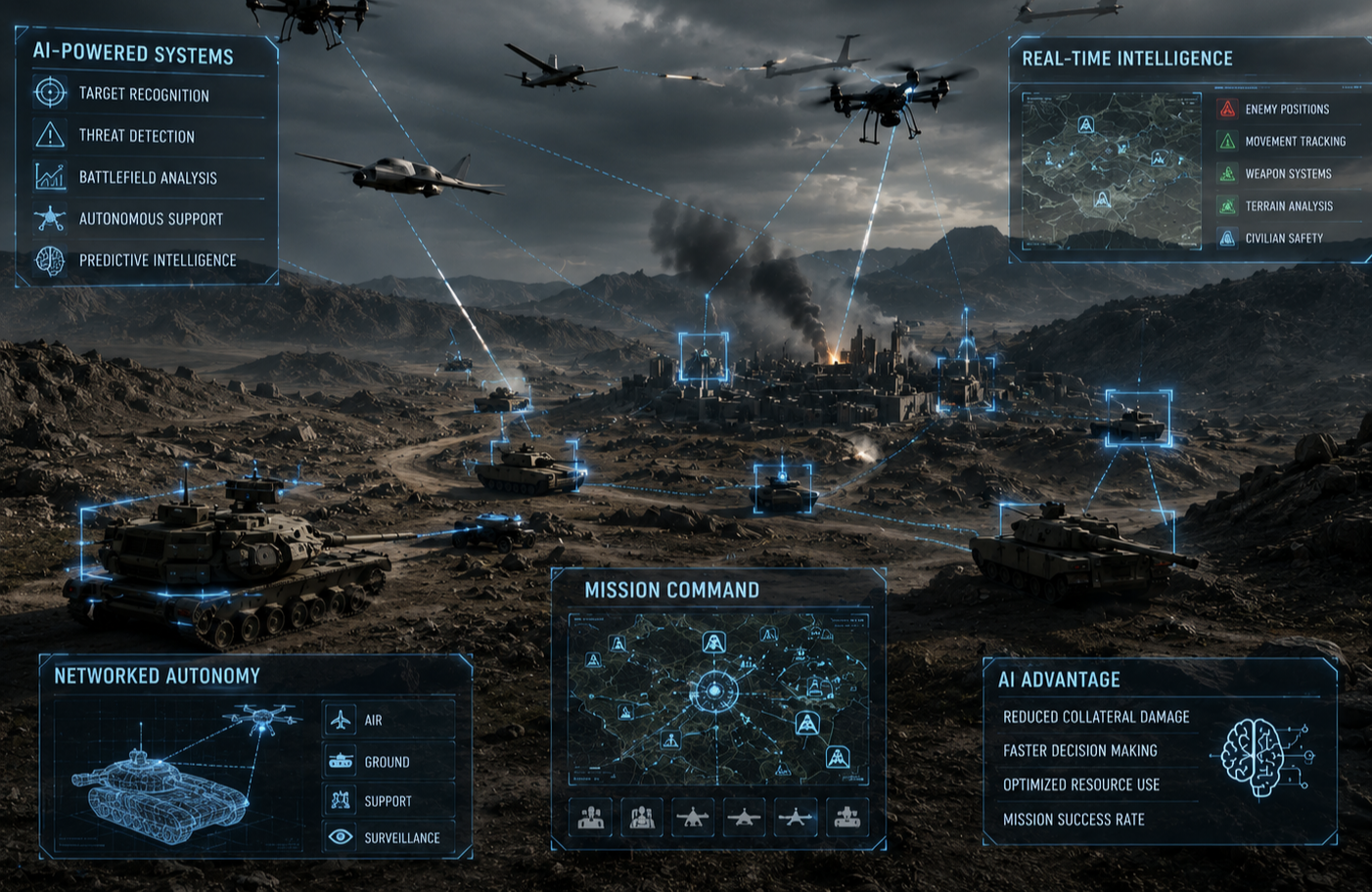


Alwaght- The recent Israeli-American war of aggression against Iran witnessed for the first time deployment of AI-guided targeting systems against an independent country and this conflict was practically used as a testing ground for the use of AI in the wars. The use of AI against Iran is something completely proven, and recently the AFP reported that a legal report by the US government shows that the military used Grok artificial intelligence belonging to the SpaceX owned by the tech billionaire Elon Musk in the illegal war against Iran.
Federal prosecutors have introduced testimony from Pentagon AI chief Cameron Stanley to back that claim, with Stanley swearing under oath that Grok is now being used in Project Maven, the US military’s AI-assisted targeting program, which originally ran on Anthropic’s Claude model. In his statement, Stanley said Maven’s intelligent systems “enabled US forces to strike over 2,000 munitions against 2,000 distinct targets within 96 hours” during Operation Epic Fury.
A report from the Bloomberg Intelligence and Security think tank (BISI) describes the joint US-Israeli operation against Iran as the first large-scale deployment of generative AI targeting systems against a sovereign state, effectively turning it into a laboratory for “algorithmic warfare.” The author argues that this conflict shows how AI is eroding traditional military operational constraints, while raising urgent questions about human oversight of combat decisions, the role of private tech companies in warfare, and compliance with international humanitarian law.
Performance of of the AI in war
According to the BISI, the Iran war marked the first real test of AI systems at the scale of classic state-on-state warfare. The author notes that Tel Aviv had previously deployed these technologies in Gaza (2023–2025), but Iran was different, the opposite side fielded a conventional military with integrated defense networks and sprawling military infrastructure.
The report says that in the first 24 hours alone, American and Israeli forces identified and struck over 1,000 targets using AI assistance; within a week, that number surpassed 2,000. That pace, the author argues, was simply impossible for human analysts in the past.
The US operated a system called Maven Intelligent, an AI platform built by Palantir that runs on Anthropic's Claude language model. Its job is to crunch vast data streams, suggest target coordinates, recommend optimal munitions, flag potential international law violations, and present commanders with actionable options.
But here is where it gets interesting. The Trump administration later sidelined Claude, the report says, because Anthropic refused to grant unlimited licensing for autonomous weapons. So Washington pivoted to OpenAI's technology instead.
According to the report, the AI does not pull the trigger. It generates recommendations. A human commander still makes the final decision.
Israelis vastly use the AI in war
In its report, BISI mentioned the Israeli use of AI in Iran war. The report suggests that Tel Aviv deploys two main AI systems. Gospel for detecting and locating military infrastructure and the Lavender system for identifying suspects based on their communications, social media accounts, and behaviorial models. These systems do not just process data, they predict human behavior. According to the report, the AI platforms crunch an immense volume of intelligence feeds, satellite imagery, and intercepted communications to surface potential targets. And they have reportedly been used to track Iran's top leadership as well. This is described as "predictive AI", meaning the system doe not merely identify where targets are, but attempts to forecast where they will be and what they will do next.
How has the AI assisted the aggressors?
Another report of US media reports on AI's battlefield role points to one shift above all others: the targeting cycle has gone supersonic. Where generating dozens of targets once took weeks or months, the Iran campaign churned out hundreds per day, making the striker's job almost trivial. That AI-driven velocity has effectively erased one of the military's oldest operational bottlenecks: the chronic shortage of viable targets. No more rationing. No more waiting. The pipeline never runs dry.
And that is precisely why many experts now say future wars will be, above all else, data-processing races, and they would not be fought solely between states. Tech companies are strapping in as primary players, their algorithms as decisive as any battalion. The battlefield of tomorrow belongs to whoever processes fastest.
Criticism for AI use in the war
Yet many experts are pushing back against the military's expanding use of AI, warning that it threatens to erode the core principle of distinguishing combatants from civilians. Their concern is that algorithms decide based on statistical probabilities, not legal certainties, and that muddies who bears responsibility for wartime decisions.
Put simply, when an AI system picks the wrong target, no one is clearly accountable, not the programmer, not the defense contractor, not the commanding officer.
Another major criticism is that humans are growing dangerously reliant on AI outputs. Commanders increasingly trust the system's recommendations even when those recommendations are flawed.
Lack of transparency compounds the problem. Most military algorithms are classified, making independent review of targeting decisions impossible, and that complicates legal oversight and post-strike accountability. The bottom line, critics warn, is that unchecked AI integration could drive up civilian casualties, accelerate an arms race, and lower the threshold for war by making military decision-making faster and cheaper than ever before.
Dangerous use of AI in Iran war
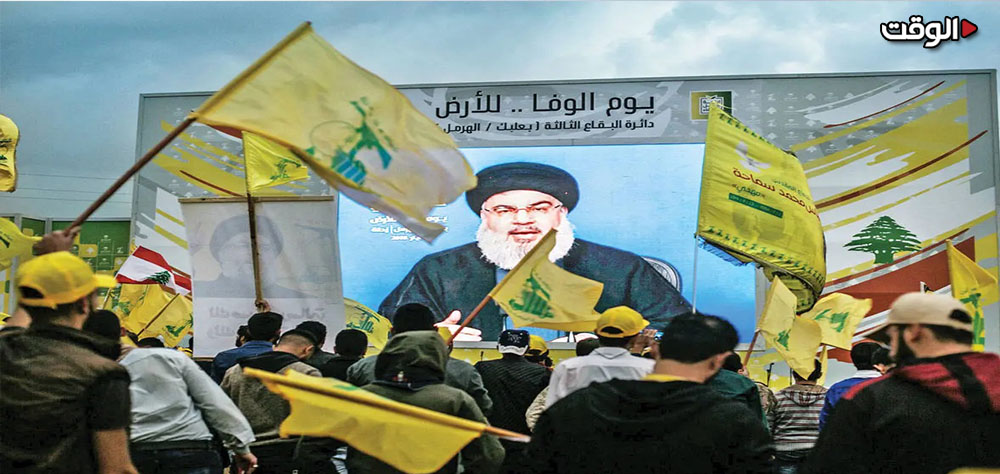
Some experts point to what they call one of the most consequential uses of AI in the recent conflict, the one that later surfaced in operations targeting figures like Hezbollah chief Hassan Nasrallah, his aide Hashem Safieddine, and other resistance commanders. That capability was AI-driven cross-referencing of intelligence data to pinpoint high-value targets with surgical precision.
In a report, Al Jazeera has tried to show how some tech giants like Amazon, Microsoft, Google, and Oracle have become the backbone of the US war machine while publicly they pose as supporters of the privacy of users and opponents of engagement in military affairs.
In its key component, Al Jazeera report has revealed the direct role of the commercial tech heavyweights in the war against Iran. According to the Qatari broadcaster, an AI software that ordinary is used to respond to the questions of users was weaponized during the war to detect and prioritize military targets.
The software is Claude, developed by Anthropic, and it is deployed through the Maven system. Maven, built by Palantir in partnership with the Pentagon, serves as the backbone for intelligence data processing. It ingests and fuses satellite imagery, drone feeds, and signals intelligence from espionage networks into a single, unified platform.
To run, Maven leans on massive cloud infrastructure provided by Amazon (AWS) and Microsoft (Azure). In plain terms, battlefield data gets stored and processed on servers owned by these commercial tech giants, then fed into Claude for analysis.
Claude's wartime job is sifting through mountains of satellite photos, geolocation data, and intercepted communications in fractions of a second, giving commanders the ability to pick the best targets and match each one with the optimal weapon. What was built for civilian purposes has now become a critical link in the military kill chain.
Craig Jones, a researcher at Newcastle University, puts it this way: "The AI machine offers recommendations on what to target at speeds beyond human thought." Operations that once took weeks now unfold in minutes, powered by this commercial-tech backbone.
The result of this partnership is terrifying pace of strikes never seen before. In the first 24 hours of the war against Iran, an astonishing number of targets were hit.
In other words, if it took weeks and months to process data and prepare for such a large volume of operations, now it takes only a few days. The interesting point is that Project Maven, from which Google withdrew in 2018 following protests by its employees, was not only not shut down, but also was completed by Palantir, today turning into the core of the US targeting system.