















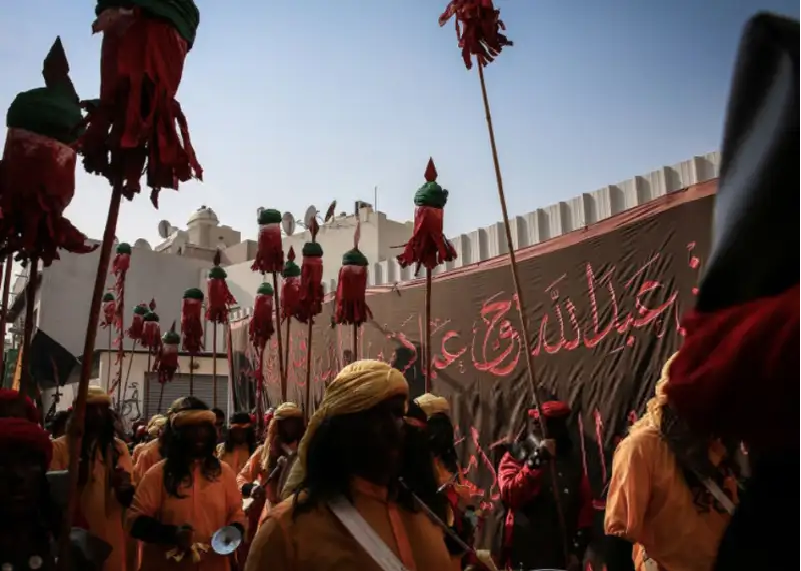


Alwaght- While the regional public opinion has been focused on the US-Iran tensions in recent weeks, the Bahrain government has exploited the conditions and mounted pressures on the Shiites of the country. Reports said that security forces of Al Khalifa regime have announced a fresh crackdown on the religious ceremonies as the month of Muharram has started.
In the latest case, local media reported on Friday that security forces and their armored vehicles were deployed near the Imam Sadeq Mosque in Hamad Town of the capital Manama to clamp down on the mourning ceremonies for Imam Hussein, the grandson of Prophet Muhammad.
Despite the security crackdown, protest rallies broke out in several areas of Bahrain, where participants condemned restrictions on religious rites and demanded an end to government meddling in religious affairs. Protesters also voiced outrage over curbs on friday prayers, pressure on clerics, detention of religious activists, and the continued imprisonment of political detainees.
Bahraini activists say the pressure is not limited to religious ceremonies. In recent months, cleric arrests have increased, religious preachers have been summoned, restrictions on religious gatherings have tightened, and Shiite activists face mounting pressure. Bahrain's Interior Ministry has also recently imposed a travel ban on citizens heading to Iraq and Iran, including pilgrims visiting religious sites there.
Ibrahim Al-Arrayedh, head of the political bureau of the February 14 Coalition, sees these measures as part of a broader campaign to silence opposition that began nearly four months ago.
Against such a suffocating backdrop, it is astounding that Foreign Minister Abdullatif Al-Zayani recently claimed Bahrain is on track to become a global model of peaceful coexistence and respect for religious diversity, remarks that seem to describe a completely different society, as the gap between rhetoric and reality could not be more glaring.
Al Khalifa's long record of crackdown on Shiites
The clampdown on the Shiites of Bahrain is nothing new and since the eruption of the protests in 2011, tens of political leaders, clerics, and civil activists of Shiite majority have been detained or handed heavy judicial rulings.
One of the controversial cases was dissolving the political and religious societies of Shiites, closing of critical media outlets, and detaining prominent opposition figures.
The Al Khalifa suppression of the Shiites in recent months is seen as a sequel to the scenario of social pressure imposed on the Shiite community since February 2011 uprising, a scenario aimed at eliminating any opposition and cementing the pillars of the largely despotic rule in the tiny Persian Gulf island state.
On the other hand, the Al Khalifa's enmity toward Shiites is not purely religious and part of it is also rooted in political tensions and confrontation with Iran. Some analyses suggest that Manama is actually ramping up pressure in response to Iran's regional role, particularly amid recent heightened tensions between the two sides. By imposing severe restrictions on Shiites, Manama's rulers are trying to vent their frustration over losses they have suffered against Iran.
Within this framework, a Bahraini court recently handed down 10-year prison sentences to 12 individuals in a series of cases, on charges of endorsing, encouraging, and supporting actions attributed to Iranian attacks targeting the US military bases in Bahrain, as well as spreading false information and news online. Meanwhile, Seyyed Morteza Al-Sindi, head of Bahrain's Islamic Al-Wefaq movement, released new figures on the crackdown against Shiites in recent days, reporting 560 arrests and the revocation of citizenship for 69 Bahrainis on charges of voicing support to Iran.
Bahrain's government accuses these individuals of threatening national security, but a significant portion of these cases carry political overtones, and the prevailing security atmosphere has increasingly blurred the line between political activity, religious practice, and security-related charges.
Manama rulers, who have repeatedly accused Iran of interfering in their internal affairs in recent years, are now monitoring domestic movements with even greater vigilance, and that very dynamic has driven the intensifying pressure on the Shiite community.
Quiet policy of demographic change
While the Shiites account for over 70 percent of this tiny kingdom, one of the most controversial policies of Al Khalifa regime over the past two decades has been the change of demographic fabric of the Shiite community through revoking citizenship of the opposition figures and granting citizenship to the foreigners.
According to figures published by rights groups, from 2012 to 2025, at least 738 were stripped of their nationality and in April alone, this number was 69.
Furthermore, Bahrain Center for Human Rights has reported that by 2006, some 30,000 foreign nationals had been granted Bahraini citizenship over the course of a decade, with another 10,000 applications still under review.
A significant portion of these naturalized citizens were recruited from Pakistan, Syria, Jordan, Yemen, and Sudan, and many have been funneled into Bahrain's military and security forces, effectively deployed to crack down on the Shiite population with full force.
Critics argue that the Al Khalifa strategy behind intensifying pressure on Shiites, through arrests, political restrictions, citizenship revocations, and the concurrent naturalization of thousands of foreign nationals, is aimed at reducing the political and demographic weight of the Shiite majority and cementing Sunni rule over the long term.
Rights groups stay silent
Though restrictions on the Shiites political and religious activists continue, international reactions have dwindled compared to the past.
Earlier, some rights groups, including the Amnesty International, had brought the rights conditions in Bahrain to the spotlight through publishing various reports, describing Bahrain one of important cases of right violations on the world stage.
However, in recent months and amid escalating regional conflict, Bahrain case has largely moved off focus of international organizations and media.
This monitoring vacuum and ease of foreign pressures on Al Khalifa have given Manama rulers a broader space to press ahead with their security crackdown without fearing political and legal price. Many analysts suggest that the more the world focus on Bahrain developments ease, the greater are the possibilities of continuing this clampdown.
Bahraini Shiites expecting international support
The past two decades have shown that the Al Khalifa political structure, with its heavy-handed security approach against Shiites, has crossed the line beyond any rational measure. In this context, debates have persistently swirled around the role of regional players, including Iran, in offering political support to Shiite communities across the region.
For years, Iran has operated within the framework of the Axis of Resistance alliance, extending support to Muslim, and even non-Muslim, communities in the region against the oppressive occupation and aggression of the Israeli regime, as well as against takfiri groups like ISIS.
In the current period too, while Arab and Islamic countries have sat on their hands in the face of Israel regime aggression and atrocities in Lebanon, Tehran has tied its agreement with the US to a ceasefire in Lebanon, seeking to expand its security umbrella over the country.
Therefore, some observers say that the Shiite community in Bahrain, which is systematically and chronically under discrimination of the ruling regime of Al Khalifa, is in need of more meaningful support of the Axis of Resistance. This is actually a demand that is growing steadily day by day due to the involvement of the Western and Arab countries in the suppressive policies of Manama rulers.










