










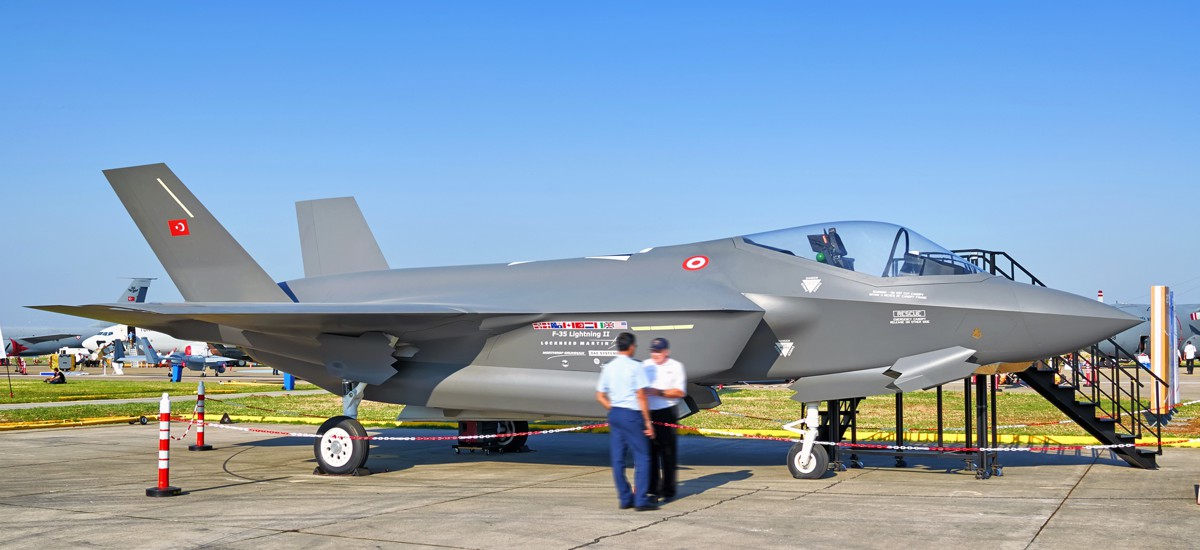


Alwaght- After multiple years of cleavage between Turkey and the US over sale of F-35 fighter jets to Ankara, it seems that the obstacles ahead of this project are being cleared away.
Recently, the American ambassador to Ankara Tom Barrack announced that the Turkish government is due to decommission Russian-supplied S-400, a move paving the way to receive the F-35s in the next six months.
The American diplomat added that Ankara plays an important role in the F-35 program, and four of this model of fighter jet are now ready for delivery, but Turkey has not accessed them so far. Barrack said that in the recent meeting of the US and Turkish presidents, most of the disparities, including those related to the S-400 air defenses, have been settled between the two countries.
These statements signal that the path is now clear for Turkey’s reintegration into the F-35 fighter jet program, marking a significant warming in Ankara’s military relations with Washington.
The rift stems from 2017, when Turkey, frustrated by years of delays in acquiring the US-made Patriot air defense system—turned to Moscow and signed a deal to purchase the advanced Russian S-400 missile defense system. Despite repeated pressure and offers from Washington to replace the deal with American Patriots, Ankara took delivery of the S-400 batteries in the fall of 2019.
The deployment of the Russian interceptors triggered a major crisis within NATO. The US responded by expelling Turkey from the F-35 development consortium and imposing sanctions on several key Turkish defense entities. While Turkey currently possesses the S-400 missiles, radars, and related equipment, it has declined to activate them. NATO has consistently warned that operating the S-400 alongside the F-35 could allow Russia to gather critical intelligence on the stealth fighter’s capabilities.
Washington’s current willingness to reconsider its stance and move toward delivering the F-35s to Ankara is driven by several strategic factors, including shifting regional security dynamics and Turkey’s pivotal role as a NATO ally.
Geopolitical logic behind delivery of F-35s to Ankara
In the current conditions, the US intention to re-integrate Turkey in the F-35 program can be seen from the lens of substantial geopolitical considerations in the three main areas of Eastern Mediterranean, West Asia, and NATO security structure.
In the Eastern Mediterranean, Washington supplied Turkey’s historical rival Greece F-35s and boosted its military presence in that country. These measures, if ignoring the balance with Turkey, can produce a sense of strategic insecurity or injustice in Ankara. In the eyes of Washington, a relative balance between two NATO members is crucial to steer clear of uncontrolled crises and avoid damage to Eastern Mediterranean by security cooperation with Athens.
In West Asia, the US supplied F-35 fighter jets to key ally Israel and is set to deliver also to Saudi Arabia. While this move strengthens Washington’s security network in the region, it also carries an obvious risk: if Ankara feels sidelined in this strategic equation, it may lean further toward rival players like Russia or China. Consequently, Washington is keen to keep Turkey within its “circle of friends” and prevent a strategic drift.
Thirdly, from NATO’s perspective, Turkey plays a pivotal role in controlling Russia’s access to the Mediterranean, managing Black Sea security, and overseeing other sensitive peripheral areas. Therefore, providing F-35s to Ankara could further integrate the country into the Western security architecture and increase its incentive to align with US and NATO policies. Thus, Washington’s decision is not merely a military transaction but an effort to maintain geopolitical balance, prevent Turkey’s divergence, and bolster NATO cohesion amid complex regional developments.
F-35s do not realize Turkish objectives
Despite the optimism of Turkish officials that acquiring F-35s could shift the regional air balance in Ankara’s favor, geopolitical realities and Washington’s strategic red lines suggest this perception is more political wishful thinking than a calculated assessment.
The American regional policy over the decades has consistently adhered to one unwavering principle: no regional ally should attain an air capability that challenges Israel’s qualitative military edge (QME). This principle remains a cornerstone of Washington’s security strategy in West Asia and has not changed.
Accordingly, the version of the F-35 likely to be offered to Turkey would mirror the model intended for Saudi Arabia, a downgraded variant with more limited capabilities compared to those supplied to Israel. This technical and operational disparity structurally prevents Ankara, even with F-35s in its fleet, from challenging the Israeli regime’s air superiority. In other words, the regional air balance will remain firmly within the framework dictated by Washington.
The situation in the Eastern Mediterranean is also unfavorable for Turkey. Over the past decade, an increasingly cohesive alliance has formed between the Israeli regime, Greece, and Cyprus, all of which have competitive, if not hostile, relations with Ankara. This tripartite axis not only enjoys Western political support but also shares common interests in Eastern Mediterranean energy resources. They have clear plans for resource extraction and positioning themselves as alternative energy corridors to Europe. Naturally, within this structure, Washington is unwilling to elevate Turkey’s military capability to a level that could disrupt this alliance or threaten energy supply arrangements critical to the West.
Therefore, while receiving F-35s may appear as a symbolic political gain for Turkey, in reality it will neither alter the West Asian air balance nor upset the power balance in the Eastern Mediterranean. What the US offers this NATO partner is calibrated precisely enough to keep Ankara content, but never to a degree that could challenge the strategic balances Washington maintains with its core allies.
An old NATO member and host of the US nukes in its Incirlik, Turkey for years thought that it has special place in the eyes of the West due to its geopolitical position and the important military role it plays in the NATO. However, experience of past decades shows that this Turkish picture does not match the reality of Washington and its European allies’ policies. In other words, Washington and NATO have never regarded Ankara a reliable ally and have looked at its independent decisions with doubt, especially after the country bolstered its military cooperation with Russia.
A prime example of this distrust was evident during the Syria crisis. Despite Turkey playing a central role in supporting Western-backed terrorist groups, Washington consistently ignored Ankara’s key requests, such as establishing a no-fly zone or providing concrete operational support to manage the crisis. Regarding Syrian Kurdish groups, the West, instead of aligning with Turkey’s security concerns, often positioned itself opposite Ankara and supported the Kurds as tactical partners on the ground.
Subsequently, as tensions escalated in West Asia and Europe, Ankara sought to acquire advanced air defense systems. However, the United States not only failed to offer substantial cooperation but, through delays and imposed restrictions, effectively pushed Turkey toward purchasing the Russian S-400 system. In Eastern Mediterranean disputes, NATO has also largely sided with Greece. This pattern of actions demonstrates that Ankara cannot rely solely on Western support to bolster its defensive and security capabilities, as the strategic priorities of Washington and NATO do not necessarily align with Turkey’s interests.
Competition to claim leadership of Muslim world
One of the key issues in the Turkish military policy is the intensive rivalry that is ongoing among the Muslim countries to secure a superior military position and Ankara is trying not to fall behind its rivals.
The UAE and Saudi Arabia that in many cases are aligned have considerably enhanced their position in the regional military equations through purchasing advanced American fighter jets and modern air defenses like Patriot. Riyadh signed security pact with the US, establishing its strategic place in the West Asian policies of the White House, and Abu Dhabi is on its way to buy F-35s to boost its military capabilities and regional foothold.
On the other side of the regional equation, Turkey and Qatar, as representatives of the bloc supporting the Muslim Brotherhood, are strengthening their defense capabilities. Qatar recently signed a security agreement with the US, securing a guarantee of American military support in case of aggression. Against this backdrop, Ankara, which perceives itself in a position of relative weakness compared to rivals like Saudi Arabia and the UAE, sees the acquisition of F-35 fighter jets as a means to both solidify its strategic position and bolster the influence and weight of the Muslim Brotherhood-aligned camp in the face of the Saudi-Emirati axis.
Will F-35s fill the place of S-400?
Contrary to the prevailing belief in Ankara, acquiring a downgraded version of the F-35 is unlikely to secure Turkey’s core strategic interests. Rivals such as Saudi Arabia and the Israeli regime are not only equipped with advanced fighter jets but also have also integrated cutting-edge modern air defense systems, giving them a significant qualitative edge over Turkey. Therefore, the air superiority balance that President Erdogan’s government seeks through the F-35 purchase is unlikely to materialize. As a result, Turkey risks finding itself in a position of being “neither here nor there", alienated from its NATO allies without gaining a decisive military advantage.
This predicament highlights the enduring strategic value of the S-400 system. The S-400 remains one of the world’s most advanced air defense platforms, capable of detecting, tracking, and engaging a wide array of aerial threats, including stealth aircraft, drones, and ballistic missiles. Its ability to simultaneously monitor hundreds of targets makes it a potent deterrent against air and missile attacks, providing its operators with a distinct strategic advantage.
So, the S-400 through its special capabilities can, to some extent, make up for the Turkish air weakness in the face of foreign threats, including those posed by F-35s possessed by the rivals. But forsaking this air defense system and merely relying on F-35s will not meet the strategic objectives of Turkey. Therefore, though purchase of the F-35s symbolizes the closeness to the US, in practice it cannot fill the void left by putting aside the S-400, since in today’s world, even air superiority, without sufficient air defense coverage, cannot protect security of countries.