













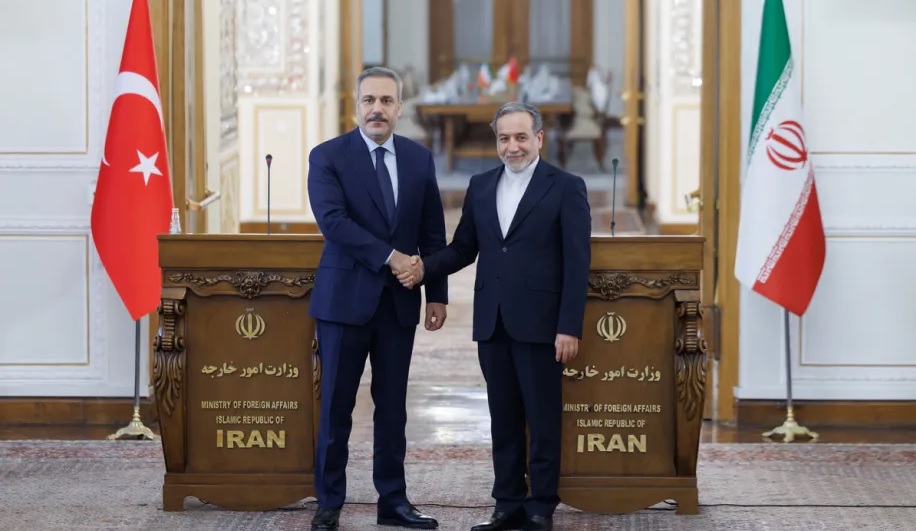


Alwaght- The spirit of ancient trade is returning to the body of the region in a new world. West Asia, a region whose name is mainly associated with security and political agreements, these days is experiencing some trade cooperation beside geopolitical and political interactions. This security and trade cooperation among the regional nations can be seen in the latest visit to Iran of the Turkish Foreign Minister Hakan Fidan, a visit in which the two sides discussed issues of interest in trade and security areas where the two countries are set to follow common interests.
Frim Syria to Israeli regime
For Turkey and Iran, there are common interests both in Syria and the occupied Palestinian territories.
Cooperation on Syria stability: In a meeting in Tehran, the foreign ministers of Turkey and Iran emphasized the necessity of establishing stability in Syria. Iran’s Foreign Minister Abbas Araghchi stated during talks with his Turkish counterpart that Syria’s stability and security are directly tied to preserving its territorial integrity, and the greatest threat to it is the actions of the Israeli regime. This emphasis comes as observers note that Israel’s recent activities in Syria have heightened Ankara’s concerns about the future of Abu Mohammad al-Jolani and his cabal. Ankara appears to be seeking closer cooperation with Tehran to curb the growing instability in its southern neighbor. Some experts speculate that during this visit, the Turkish FM aimed to establish a new security framework with Iran regarding Syria to secure its support.
The roots of this concern trace back years. Prior to the fall of the al-Assad government in Syria, Turkey primarily grappled with two major challenges: issues concerning the Kurds and the return of refugees. Although the rise of groups aligned with Ankara in Damascus initially raised hopes for advancing Turkey’s interests, the one-year rule of al-Julani has not brought stability. Instead, escalating conflicts have pushed the prospects for peace and Syria’s territorial integrity further away than ever. This trend of instability, particularly centered around Israel’s actions, has significantly heightened Ankara’s apprehension. Iran’s top diplomat in this connection said in the press conference that the duty of all regional countries is to stand in the face of the Israeli aggression and expansionism in the region, including Syria and Lebanon.
Common enemy in Tel Aviv: A critical factor is the repeated aggression by the Israeli regime against nations across the region, which has now ensnared Qatar, a key Turkish ally, alongside the Palestinians. This escalation has demonstrably unsettled officials in Ankara. It is increasingly clear that Turkey and Iran find themselves aligned against a common adversary in Israel, making closer coordination between Ankara and Tehran to counter Tel Aviv’s actions an apparent necessity for both countries. During his meetings in Tehran, Fidan underscored this regional security alignment, stating that both Iran and Turkey “consider Israel the greatest threat to stability in the Middle East.” The Turkish diplomat further emphasized Ankara’s support for Tehran in the nuclear negotiations, calling for an end to “unjust” sanctions.
Beyond this shared threat, major geopolitical shifts are redoubling the strategic importance of Tehran-Ankara relations. As the international system gradually moves toward multipolarity and regional actors take on greater roles in crisis management, both Iran and Turkey are maneuvering to cement their positions within the emerging security architecture, with a keen eye on their mutual rival.
Adding a significant layer to this dynamic is the nearly simultaneous visit of a Saudi deputy foreign minister to Tehran. Despite official silence from both sides on any connection between the two diplomatic trips, the timing is widely interpreted as a signal. It suggests that three major regional powers are converging, united by shared concerns over the geopolitical threats posed by the Israeli regime to regional security.
Iran-Turkey joint railway
In talks with his Turkish counterpart, the Iranian FM discussed railway cooperation. Some media have reported that during the Turkish FM’s Tehran visit, a proposal was made to link Iran from a northern rail route, one that relies on completion of Marand-Cheshm Soraya railway. After crossing Cheshm Soraya, Iranian trains enter Kars city and from there to northern railway of Turkey and then Europe. This route pursues two main objectives: completing Turkey’s east-west axis and providing an east-west transit corridor for Iran. India’s Keshan Information Technology Investment Company, which is active in the railway transport sector, stated in its assessment of the potential for Iran-Turkey railway cooperation that the proposed new railway line between the two countries is a joint effort of historic dimensions, acting as a strategic gateway between two vast territories. Officially known in Iran as the Marand-Chashmeh Soraya railway transit line, it will extend to the Aralık border region in Turkey.
Reports say that this railway will be approximately 200 kilometers long. Iranian officials estimate the total cost at around $1.6 billion and predict the project will take only three to four years to complete. Both foreign ministers also emphasized the importance of the new railway link between the two countries.
Currently, the rail connection between Iran and Turkey has very low capacity. On this route, the rail line is interrupted at Lake Van, and wagons must be transported across the lake via ferries or similar landing craft. The journey then continues on Turkey’s relatively old and slow southern line. Furthermore, in its development plans, Turkey has focused more on developing its northern line rather than the current southern axis.
Big trade potential
One significant aspect that has been largely overlooked in Turkey-Iran relations over past decades is the immense trade potential between the two countries. In an interview with the newspaper Iran, Tehran’s ambassador to Ankara Mohammad Hassan Habibollahzadeh outlined a clear picture of the growth in bilateral trade. He highlighted the 65 percent surge in trade volume last year, reaching approximately $19.4 billion, describing this figure as a clear indication of the necessity and continuity of geopolitical cooperation between Tehran and Ankara.
He added that in recent years Tehran and Ankara have exerted maximum effort to expand trade and economic relations. A network of 13 joint technical committees between various ministries – covering areas such as transportation, customs, energy, education, culture, security, border affairs, agriculture, trade, health, industry, and technology – serves as the primary framework for coordinating cooperation and regularly provides executive solutions.
Alongside this, the “Joint Economic Commission” is one of the most active economic mechanisms in bilateral relations, pursuing extensive agreements in banking, investment, transit, energy, trade, tourism, and customs.
Energy cooperation
According to experts, in energy sector, Tehran-Ankara relations are a combination of sustainable cooperation and new opportunities and Iran is the stable supplier of gas and other hydrocarbons to Turkey. So, in the eyes of Tehran, Ankara is not a rival but a strategic partner in energy sector and cooperation with it can ensure and boot energy security of the region and enhance the position of the two countries.
Araghchi said that Iran is ready to extend a gas deal with Turkey signed nearly three decades ago and is ready to expand mutual energy ties with Ankara.
He said: “Iran is a reliable energy provider to Turkey and we are ready to extend gas deal also develop cooperation in energy sector.”
According to the top diplomat, Iran and Turkey have the potential for full cooperation especially in trade and economy and that the two nations should take steps for filling the existing gaps and removing the trade and investment. The present contact to annually supply 10 billion cubic meters of Iranian gas to Turkey will expire in November 2026, and the two countries are negotiating a new contract.










