



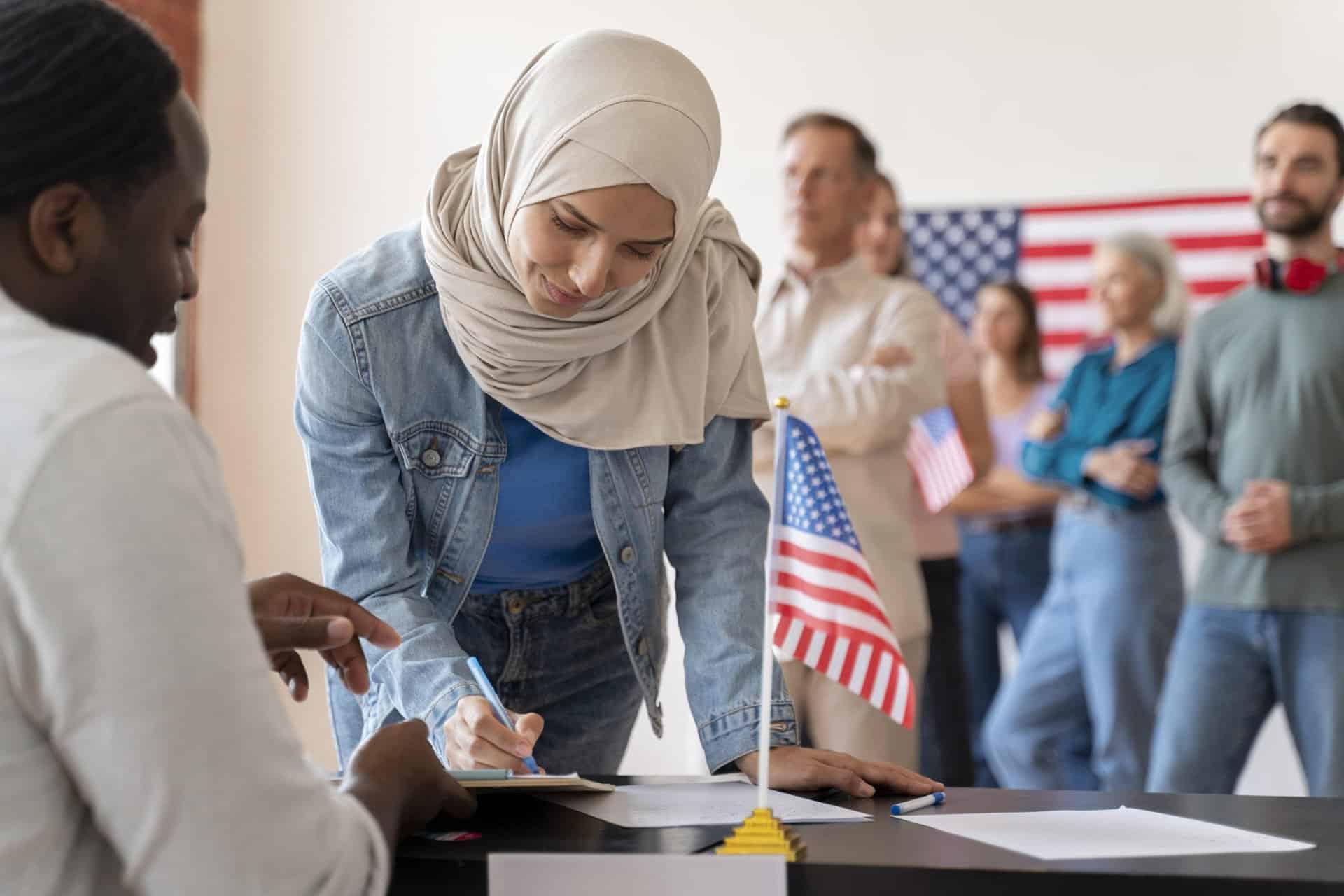


Alwaght- In contemporary times, elections have always been one of the best instruments and criteria to measure the scale of public support for government policies, to understand the taste of the majority of people in various economic, political, and cultural areas, and, in deeper study layers, to identify and survey the political and social changes inside the society.
In the US, which is home to one of the most intricate and diverse electoral systems on the planet, and where political and social currents invariably send ripples across the globe, the quadrennial ritual of national elections inevitably thrusts the country into the media and analytical crosshairs. This time, however, the stakes are particularly charged. The outcome of November’s congressional races could significantly accelerate or slow the trajectory of the Trump administration’s combative, right-wing agenda, both at home and abroad.
Against this backdrop, one shift has seized analysts’ attention as a possible sign of gradual political reinvention: the rise of a new generation of candidates from previously marginalized communities, Arab and Muslim Americans, coupled with the apparent waning of the once-formidable Zionist lobby’s grip on the right flank of the electorate.
In recent days, Donald Trump and his vice president’s remarks about Abdulrahman Al-Sayed’s likely victory in the Senate primary have ignited a media firestorm—especially their comparison of themselves and their spouses to Al-Sayed and his wife, both physicians, as representatives of “two different Americas.” Commentators have read the president’s words as a window into his deep anxiety over the prospect of unflinching critics entering the Senate chamber.
Currently, four Muslim Democrats serve in the House of Representatives: André Carson, Ilhan Omar, Rashida Tlaib, and Latifa Simon. But the Senate has never seated a Muslim—a fact that makes Al-Sayed’s potential victory in the November 2026 midterms all the more historic. Should he win, he would become the first Muslim senator since the nation’s founding 250 years ago. And that, observers say, is only the tip of the iceberg.
First: Size of political power of Muslims
The significance of transformation of the US Muslims' political power is solely not limited to the rise of a number of Muslim candidates in the elections. Rather, this phenomenon has happened simultaneous with the growth of the political infrastructure of the Muslim community. For years, Muslims in the US have been recognized as a relatively small and sporadic election bloc distributed among two parties, but Gaza war changed priorities of a part of this community, motivating many to review support to candidates that backed the US policies in favor of Israeli occupation of Palestine.
Within this framework, some of the Muslims instead of playing a merely electoral role moved towards direct presence in politics and candidacy for public posts.
On August 11, 2026, the Muslim Girl organization, led by Amani, convened a gathering featuring Abdulrahman Al-Sayed, Ilhan Omar, Rashida Tlaib, and Dr. Adam Hamwi. The central question on the table was: When will Muslim political presence shift from exception to norm?
The panelists did not treat this as some distant prospect. They argued that the transition is already underway, a phase in which Muslims are evolving from a demographic to be courted into a political force that demands a seat at the decision-making table, with its own policy agenda to advance.
Current estimates put the American Muslim population at roughly 4.5 million, including more than 1.7 million registered voters. Their concentration in battleground states, Michigan, Georgia, Illinois, and New Jersey, amplifies their electoral clout, particularly in races decided by margins of just a few thousand votes.
According to Tlaib, some 200 Muslims have been elected to various offices nationwide since 2019, spanning local councils, Congress, school boards, and state positions. A report from the Islamic Circle of North America on August 5, 2026, put the number even higher: 230 Muslims currently hold elected office across the country, with 46 serving across 23 state legislatures.
That trajectory is visible on Capitol Hill as well. Four Muslim Democrats now serve in the House—and since the chamber's founding in 1789, only six Muslim lawmakers have ever been seated.
Academic research from Cambridge University, published in March 2026, documents a sharp uptick in Muslim American candidates between 2018 and 2022. During that window, between 50 and 80 Muslim Americans ran for office each year, and the number of Muslim names on ballots hit record highs.
Muslim political organizations are turbocharging the trend. Emgage PAC, describing itself the largest Muslim American political committee in the US, says it has endorsed more than 500 Muslim candidates since its founding; of those it backed in the 2024 cycle, 21 won. The group has expanded its 2026 operations into Michigan, Texas, Florida, New York, New Jersey, Pennsylvania, and Maryland.
The 2024 election also saw the "Million Muslim Votes" campaign mobilize more than 1.08 million registered Muslim voters.
So, the most consequential shift this cycle is the gradual movement of Muslims from influential voting bloc to candidates and decision-makers in their own right. With Zohran Mammadani's victory, four Muslims in the House, and Al-Sayed's Senate bid, that transformation is no longer theoretical, but is a live political reality.
Second: AIPAC and its declining role in elections
This shift in Muslim political power is unfolding against another major development: the diminishing clout of AIPAC in certain corners of the American electoral landscape.
For decades, the American Israel Public Affairs Committee has been a colossus of US politics, bankrolling candidates from both parties and working tirelessly to preserve a bipartisan consensus in lockstep with the Israeli government. Since its founding in 1954, the organization has held special place in Washington.
That consensus, however, has been gradually cracking. A pivotal moment came in 2015, during the Iran nuclear deal fight, when AIPAC threw its weight behind Benjamin Netanyahu's campaign against the accord, putting it on a collision course with the Obama administration.
Then came Trump's presidency and the 2018 withdrawal from the nuclear agreement, which widened the rift within the Democratic Party. A progressive wing emerged that did not merely diverge from Israeli policy but openly criticized it. Figures like Alexandria Ocasio-Cortez, Rashida Tlaib, Ilhan Omar, Jamaal Bowman, and Cori Bush became the face of this new current, and AIPAC saw this a long-term threat for its influence.
The Gaza war has only deepened the fracture. Campus protests and the proliferation of alternative media introduced narratives that competed directly with the pro-Israel orthodoxy. Younger voters, especially Gen Z and millennial, increasingly turned to sources outside the mainstream press, and with that shift, different perspectives on Palestine and the Gaza conflict gained traction in the American public square.
The result was that Palestine is no longer just a foreign policy issue. It has become a battleground in the internal Democratic struggle over identity, values, and the party's future direction.
Third: Resistance of the weak to the strong
The new current criticizing Israeli, which has slose bonds to the student and political movements supporting Palestinian rights, has never gained a place as strong as now in the past elections. But the push to quell student protests and administrative pressures against the activists, instead of weakening this current, led to its strengthening.
In this evolving landscape, Zahran Mammadani has emerged as a leading figure in the new socialist current. He has leveraged his political influence to back like-minded candidates in House primaries, most of them aligned with the Democratic Socialists of America.
Rather than chasing long-shot races, this movement has zeroed in on a more strategic target: "safe Democratic seats." The goal is a gradual leftward realignment of the Democratic Party from within.
Through this lens, Gaza is no longer just a foreign-policy issue, but it has become an electoral mobilization tool. Candidates backed by this wing have harnessed the Gaza debate to galvanize support, demonstrating that critical stances toward AIPAC, far from being a political liability, can in certain contests be turned into an electoral asset.
Fourth: Financial power comparable to AIPAC's
A critical factor fueling this movement's expansion has been the emergence of financial firepower to counter AIPAC's deep pockets.
While AIPAC has poured staggering sums into the electoral cycle through its United Democracy Project (UDP), a new political committee, American Priorities, launched in February 2026. Its mission is to prioritize domestic needs like public education and healthcare over taxpayer dollars bankrolling Israel's war against Palestinians.
Months before the primaries, American Priorities funneled millions into supporting candidates critical of both Israeli regime and AIPAC, aiming to create a balance. According to CNN, the group drew inspiration from the grassroots financial energy that galvanized Mammadani's own campaign.
AIPAC and its allies have pushed back, branding the effort contradictory. Their argument was that the left decries big money's corrupting influence on politics while relying on its own super PACs fueled by deep-pocketed donors.
The movement's supporters counter that pushing back against AIPAC's financial dominance is essential, and that new money entering the fray is simply a democratizing force that brings transparency to campaign finance.
The result is a confrontation that is no longer purely ideological, but it has become a financial arms race.
AIPAC's electoral losses in 2026 have forced strategy review. The organization is now weighing plans to ramp up donor engagement, recruit more candidates, and push back against the spread of anti-AIPAC sentiment.
But the data suggests this is more than a temporary setback. AIPAC's power for decades rested on a bipartisan consensus between Republicans and Democrats, a consensus that has frayed, particularly among younger Democrats.
Meanwhile, efforts to paint AIPAC's critics as antisemitic have run into a complication as Jewish activists and organizations opposed to the Gaza war and supportive of Palestinian rights have pushed back forcefully, complicating that narrative.
The string of victories by socialist and AIPAC-critical candidates signals a turning point. Pro-Palestinian positions and open criticism of AIPAC's influence, once fringe stances, have become, in certain corners of the American electorate, a genuine political asset.
Fifth: Role of student activism and generation shift
One of the most critical catalysts for this shift was the 2024 campus protest movement. Thousands of students were arrested at more than 130 American universities during the pro-Palestinian demonstrations, and what ignited at Columbia University quickly spread to campuses across the country and eventually to universities around the world.
Columbia, with its deep history of student activism and its outsize academic and political footprint, became ground zero for the upheaval. In April 2024, the university saw the establishment of a solidarity encampment that turned it into one of the movement's nerve centers.
The arrest of students and the deployment of riot police did not quell the protests—they galvanized broader support. The demonstrations soon jumped to campuses including UCLA, Yale, the University of Southern California, and a host of public universities across the nation.
Administrative crackdowns, surveillance of activists, and disciplinary measures drew sharp rebuke from international human rights organizations like Amnesty International and Human Rights Watch.
Over time, the movement's demands expanded beyond Gaza. Students began linking the war to broader economic and structural issues, calling on universities to divest from companies doing business with Israel or profiting from the war in Gaza, and to sever ties with defense contractors like Elbit Systems, Lockheed Martin, and Raytheon.
The movement also trained its sights on university endowments and their financial holdings, turning institutional investments into a strategic battleground.
Beyond the financial tactics, the deeper significance lies in how this wave is shaping the political consciousness of a new generation. Gen Z and millennials, consuming news through social media and alternative platforms, encountered narratives of the Gaza war that diverged sharply from the mainstream, and that exposure has fundamentally reshaped their views on the US foreign policy and its unwavering support for Israel.
The protests, moreover, did not stop at American borders. They ricocheted across the Atlantic to Britain, France, Germany, Italy, and Spain, and reached as far as Australia, Japan, and nations across South America, Asia, and Africa. What emerged was a transnational network of young activists, a vivid demonstration that alternative media can now route protest narratives and tactics across the globe at dizzying speed.
So, the Gaza war has become a generational inflection point. Its political aftershocks are already visible in shifting voter attitudes, and in the rising tide of support for candidates who challenge the orthodoxies of the US policy toward Israel.
Sixth: Participation of Jewish students
One of the most striking dimensions of the American student protest movement was the active participation of Jewish students in pro-Palestinian demonstrations.
According to the text, anti-Zionist sentiment has grown among a segment of Jewish millennials and Gen Zers, and Jewish teachings on justice and tikkun olam, the imperative to repair the world, have played a significant role in shaping that perspective.
Organizations like Jewish Voice for Peace have also played a key role in mobilizing Jewish support for Palestinian rights.
The presence of Jewish students in the protest ranks has posed a serious challenge to the claim that criticizing Israeli policy is inherently antisemitic. Their participation has lent the movement broader social legitimacy, and made clear that opposition to the Israeli government's policies runs through a meaningful segment of the American Jewish community.
For these activists, the driving forces include the humanitarian catastrophe in Gaza, documented human rights violations, and a conviction that the status quo is untenable.
What has emerged, in turn, is a transnational popular base that is pressuring governments worldwide to rethink their relationships with Israel. Here in the US, pro-Palestinian activists have leveraged this global groundswell to fortify their own position, arguing that their views are not fringe perspectives but part of a much broader international realignment.
Seen through that lens, the electoral shifts of 2026 cannot be understood in isolation from the global upheaval set in motion by the Gaza war.
Seventh: Impact of socialist current inside the Democratic party on democratic youth
The primary victories of this new political current have plunged the Democratic Party into a deep internal rift. The party now finds itself split between a faction clinging to traditional pro-Israel orthodoxy and another challenging those positions with a new moral and political framework.
Republicans have moved swiftly to exploit the divide. Their strategy: paint the Democratic Party as captive to a radical, anti-Israel left wing, and turn that into a liability heading into the midterms.
Trump himself has embraced this framing, describing his Democratic opponents with scorching rhetoric that at times as "jihadis."
But those attacks may backfire. Rather than weakening the insurgent current, political pressure could strengthen its hand, fueling recruitment and expanding its electoral appeal. The backdrop is crucial: generational and ideological shifts are already reshaping traditional political allegiances across American society.
In this volatile landscape, Mammadani's victory in New York City's mayoral race in November 2025 was both a symbolic milestone and a political earthquake. He became the first Muslim to lead the nation's largest city.
Yet the significance of his win went far beyond his faith. Mammadani's campaign demonstrated that a Muslim identity could anchor a broad electoral coalition built on issues like housing, the cost of living, social services, and transit. He did not run as a Muslim candidate, but he ran as a New Yorker, and that distinction changed the calculus. Actually, Mammadani has transcended local politics to become a national symbol of the battle over the Democratic Party's future, and, by extension, over the very meaning of American political identity in a changing era.
That rise, of course, has been met with a barrage of attacks from the right. In some cases, Mammadani's Muslim identity was blatantly conflated with terrorism and "Sharia law", a stark reminder that Islamophobia remains a persistent and cynical tool in American political warfare.
But for the Trump camp, the most sensitive development is Abdulrahman Al-Sayed. He did not just win a primary race in Michigan, he clinched the Democratic nomination for Senate in that crucial battleground state, overcoming the major establishment funding apparatuses in the process.
What makes this moment particularly significant is that Al-Sayed did not run simply as a "Muslim candidate." He has woven his Muslim identity into a broader progressive platform, tethering it to a rejection of big money in politics, a critique of US military support for the occupation of Palestine, and a vision for working-class economic justice.
If Al-Sayed wins in November, he would not just become the first Muslim ever seated in the Senate. He will have forged a new model for Muslim political engagement at the national level, one that proves a Muslim candidate can compete in a swing state, on national terrain, without watering down his convictions or being reduced to a single identity.
Conclusion
The electoral shifts of recent years make one thing clear: Muslim political power in the US is no longer just about voter numbers or the ability to nudge election outcomes. A community once viewed primarily as a small, scattered voting bloc is now building political infrastructure, fielding its own candidates, and claiming a direct seat at the decision-making table.
Alongside this transformation, the Gaza war and its fallout have emerged as one of the most potent catalysts for changing attitudes across broad swaths of the American public. Campus protests, the rise of alternative media, youth mobilization, and the visible presence of Jewish students in pro-Palestinian movements have all contributed to a counter-narrative that challenges decades of US policy orthodoxy toward Israel.
At the same time, AIPAC finds itself confronting what the text describes as a structural, not temporary, crisis. The erosion of bipartisan consensus, shifting views among younger Democrats, the emergence of rival funding streams, and the rise of candidates who openly challenge AIPAC's influence are all symptoms of a deeper realignment.
In this environment, Muslim Americans are outgrowing their role as mere voters. Mammadani's electoral victories, the presence of four Muslim House members, and Al-Sayed's Senate bid all signal that Muslim entry into the corridors of American power is no longer exceptional, but it is becoming part of the new political fabric.
If Al-Sayed wins in November 2026, that process will reach a symbolic watershed: he would become the first Muslim in US history to serve in the Senate. But the real significance extends far beyond a single seat. The question now is whether the American Muslim community is evolving from a demographic that parties court for votes into an independent political force—one that helps set the agenda, choose the representatives, and shape the policies of the nation.
Should that trajectory hold, 2026 may be remembered not merely as a battle for congressional control, but as a milestone in the US's gradual political and social transformation, one in which previously marginalized identities, younger generations, student movements, and new political currents are steadily moving from the periphery to the center of power.