






Alwaght- Exactly at a time the Lebanese president and prime minister are sitting in their offices and waiting for success of the Washington negotiations for end of the barbarous Israeli attacks on Lebanon, the Israeli army is making advances deep in the Lebanese territory, marching beyond Litani River and close to the city Nabatieh in the south. The Israeli push is so hard that if it was not for resistance of Hezbollah fighters, the presidential palace would have been occupied now.
The Israeli army has pushed north of Lebanon’s Litani River and seized the medieval Beaufort Castle in the southern Nabatieh province, the very fortress that once symbolized the south’s invincibility. Released videos show Israeli occupation soldiers inside the Crusader-era stronghold, flying Israeli flags and the Golani Brigade’s banner.
Avichay Adraee, the Israeli military’s Arabic-language spokesperson, openly stated that operations in the Shaqif Heights (Beaufort) and Wadi al-Salouqi have been launched to destroy Hezbollah’s infrastructure. Israeli forces near Nabatieh, he added, “are prepared to expand the attack if necessary”, meaning they are ready to lay siege to the major city of Nabatieh.
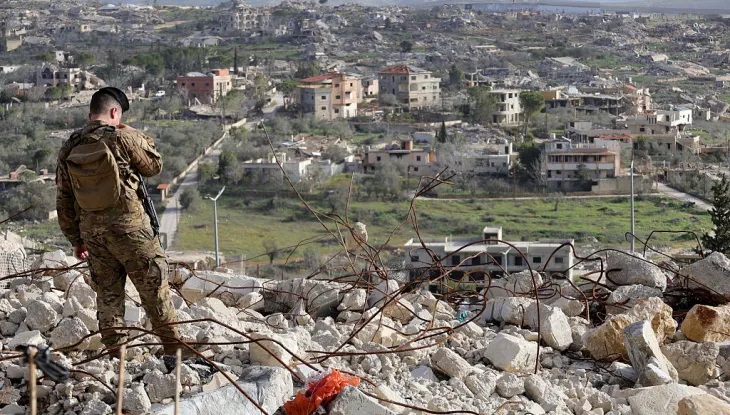
This advance follows evacuation orders issued in recent days for twenty-three villages beyond the Yellow Line, signaling that the army is effectively trying to impose a wider security zone, far larger than the previous buffer zone.
In the western sector, these villages include: Mazraat Beit al-Sayyad, Majdal Zoun, and Zibqin. Central sector villages include: Yater, Sarbin, al-Tiri, Kounin, Haddatha, Beit Yahoun, Shaqra, Majdal Silm, Qabrikha, and Froun. To the north of the Litani River lie Zawtar al-Sharqiya, Yahmar al-Shaqif, and Arnoun. In the eastern sector are Deir Mimas, Marjayoun, Abla al-Saqi, al-Mari, Ain Abla, Ain Ata, and Kafr Shuba.
The people who once lived in these areas have been displaced. Many Lebanese now fear attack at any time, anywhere, because the constant hum of regime surveillance drones has become the nonstop soundtrack of their daily lives.
Amid this grave situation, Lebanese officials cling to fruitless Washington-brokered talks. In a baffling move, instead of reinforcing defense mechanisms, they’ve declared Hezbollah’s military operations illegal, and the prime minister has called for handing over weapons, effectively speeding up the enemy’s advances.
An example of this discordant, obstructionist tune against national resistance played out last week at Beirut’s military tribunal. Three Hezbollah fighters had been caught at a checkpoint carrying weapons toward the front lines. After a five-minute hearing and a ten-dollar fine, they were released. During that farcical session, held for people defending their own land, they said: “We’re trying to defend our country. Our place is in the south.”
On the ground, Lebanon’s military is deployed far behind the Yellow Line, in places like Kfardounine and Marjayoun, watching as Israel evacuates 23 villages. The army ranks 118th out of 145 countries in the 2026 Global Firepower index and lacks any real air defense system. Its air force has become a daily joke.
After the last Hezbollah-Israel war ended in 2024, the Lebanese army was tasked with dismantling Hezbollah’s arsenal. By January, the army announced it had completed the first phase of that disarmament plan: clearing weapons caches, deactivating tunnels and missile sites, and seizing abandoned Hezbollah positions—often with the group’s consent, a goodwill gesture to avoid a domestic crisis. But now it’s clear that Israel has exploited the Lebanese government and military’s actions to the fullest, advancing unchallenged across the Litani River.
The army’s response to these violations was limited to issuing statements, even when Israeli forces target its troops, killing and wounding them .
But this weakness is not accidental. International and Lebanese analysts say it is the direct result of a deliberate US policy: the Qualitative Military Edge (QME) doctrine. Codified into US law in 2008, QME prohibits Washington from selling any weapon to any Middle Eastern country, except for Israeli regime, that could erode Israel’s military superiority . The flip side of guaranteeing Israel’s edge is the forced weakness of the Lebanese armed forces.
Mohamad Bazzi, director of NYU’s Hagop Kevorkian Center for Near Eastern Studies, put it bluntly: “My critique is that we constantly hear that the Lebanese army must provide security in Lebanon, especially in the south. But what we don’t hear in this debate is that the Lebanese army is purposefully kept weak and under-equipped by the United States and Western countries that provide military aid and weapons."
The result of this policy is plain to see on the ground. Israel has received over $300 billion in US military aid and keeps adding new layers to its Iron Dome, while the Lebanese army can not even shoot down a single Israeli drone.
Even as these areas are systematically depopulated, one after another, the Lebanese government keeps sending conflicting signals that undermine its own front. To the international community, it says: "If Israel withdraws, the army is ready to take control of the land"—code for disarming the resistance. To the Lebanese people, it promises "state authority will soon be restored" while indulging in fantasies about changing the "Dahiya Doctrine."
The Dahiya Doctrine, first formulated after the 2006 war to impose a heavy cost on Hezbollah's support base, has now become a pretext for destroying Lebanon's infrastructure. Some Israeli hardliners openly say that "the security of northern Israel can only be achieved through a fundamental change in the reality across the border", in other words, the annihilation of everything in southern Lebanon.
But President Aoun and Prime Minister Salam, still hoping to change this doctrine, sit in the presidential palace waiting for a call from Washington. They remain oblivious to the fact that with each passing day, the Israeli military's front lines creep closer to Beirut's palaces.
In the meantime, operating under its resistance doctrine, Hezbollah remains on the front lines, that it is the only real force defending Lebanon.
Lebanon today is trapped in a historic contradiction. On one side, Hezbollah fighters, with minimal resources, are holding the line in the south and defending their land against the Israeli invasion. On the other, the official government and army, clinging to negotiations that have only ever cemented occupation, stand by as the country’s territorial integrity collapses. If Lebanon truly wants national sovereignty, it must stop fantasizing about changing Israeli doctrine. Instead, it should immediately declare all-out war or mobilize the army, and more crucially, offer practical support to Hezbollah as the only force on the ground that has stopped Beirut from falling. Otherwise, the enemy's "buffer zone" will gradually expand to swallow all of Lebanon. And when that day comes, Washington will have no answers, and the presidential palace will be no safe place.