














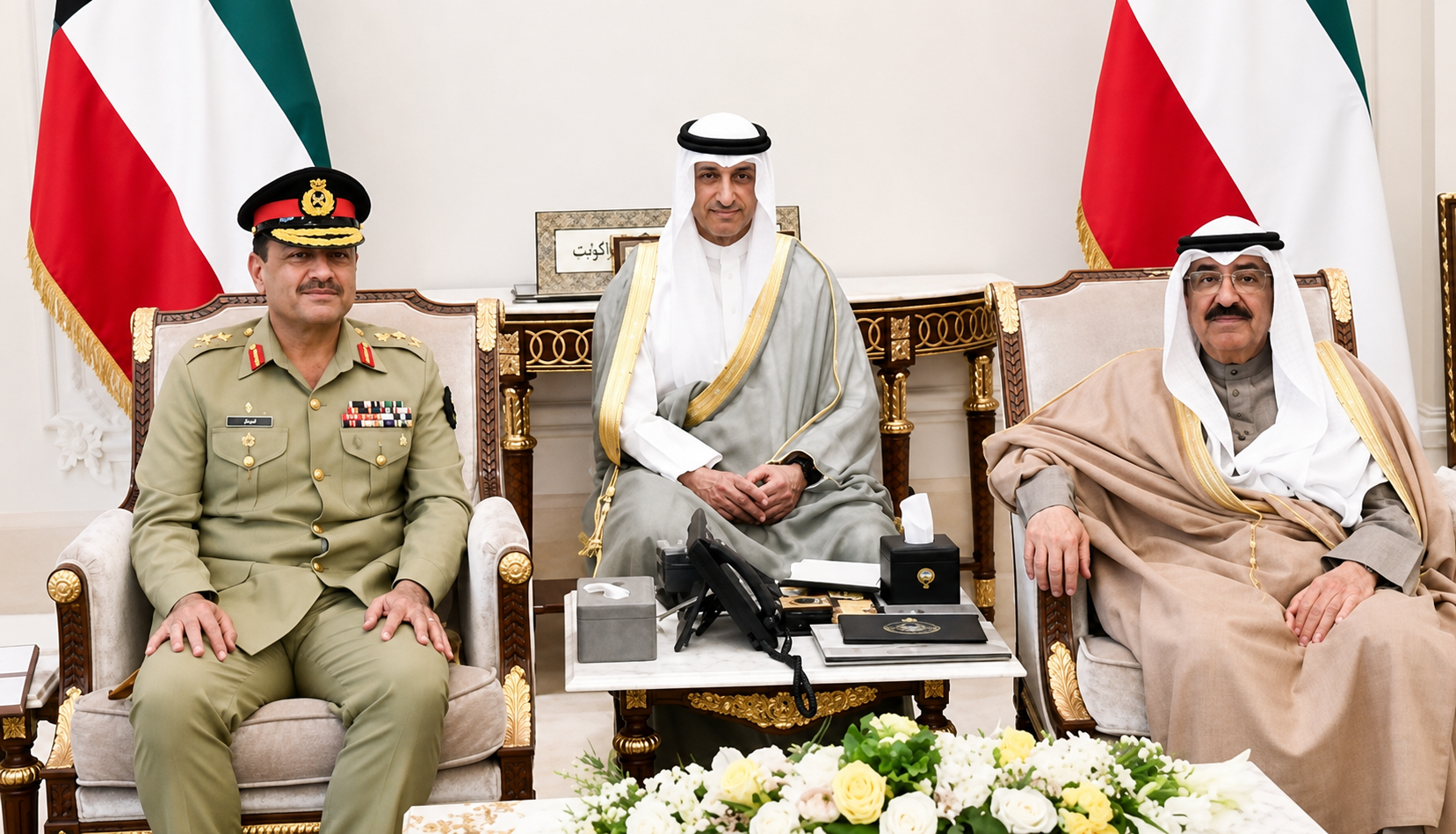


Alwaght- Kuwait's royal order for ratification of the security agreement with Pakistan three years after signing the draft agreement amid current sensitive regional conditions has drawn many analyses about its aspects and outcomes. Observers majorly focus on four key factors in their assessment of this pact: Changes in regional security order, its distinction from the Pakistani security pact with Saudi Arabia, strategic motivations of the two countries, and the novel place of Pakistan in West Asia's emerging dynamics.
1. Revision of Persian Gulf security order: Dropping trust in US security guarantees
Analysts agree that the primary driving force behind activating this agreement is the weakened Persian Gulf states' confidence in the US security umbrella and to push for diversifying defense partners. Abdulbasit, a security analyst, contends that the US security guarantees in the region have eroded, driving Persian Gulf monarchies toward a "diversify partners" strategy.
The escalation of military tensions in the region and attacks on US targets in Kuwait have convinced the country that relying solely on the US military presence no longer guarantees security. Kuwait's aim with this deal is to bolster its defense capabilities by tapping into Pakistan's military expertise and building a multilayered security network, one that does not compete with the American presence but complements it.
2. Strategic distinction with Saudi-Pakistani pact: Coordination, not mutual defense
Analysts stress one key distinction: the Kuwait agreement is far more limited in scope than Pakistan's joint defense pact with Saudi Arabia.
The Riyadh deal explicitly states that "an attack on either country constitutes an attack on the other." The Kuwait accord carries no such mutual-defense clause, focusing instead on training, technology transfer, logistics, and military-industrial cooperation.
Brigadier General Mahmood Shah, a military analyst, puts it this way: "With Saudi Arabia, the mutual-defense commitment is crystal clear. With Kuwait, itbis strictly about training and structural cooperation." That gap reflects Islamabad's strategic caution—avoiding direct entanglement in regional conflicts while preserving the latitude to act independently in West Asia's complex power games.
3. Mutual advantages: Kuwait eyes Pakistani experience and expertise, Pakistan seeks influence and energy
This deal brings about mutual advantages to the two sides. Kuwait, a wealthy country but with a small population and low military expertise and experience, is seeking to take advantage from the well-trained Pakistani armed forces which are recognized for their war skills, counterterrorism operations, and operational coordination.
On the Pakistani side, Islamabad is seeking economic and energy advantages from this deal. It also seeks markets for its defense products, including JF-17 fighter jets and drones. Some analysts, including India's Pravin Sawhney, see this a move towards formation of an "Islamic security framework" where Pakistan as a nuclear power plays the top role.
4. Pakistan, from being a security consumer to a security exporter
On a broader level, experts view this agreement as a sign that Pakistan is shedding its role as a mere security consumer and emerging as a "security exporter" and a regional security player in its own right.
Bilal Khan, a defense affairs expert, believes that this cooperation agreement demonstrates that Marshan Asim Munir's foreign policy to boost Pakistani regional influence has come to fruition. However, experts warn that activation of this deal can draw reactions from Iran and India and put Islamabad in a hard position between its Arab allies and its eastern neighbor.










