









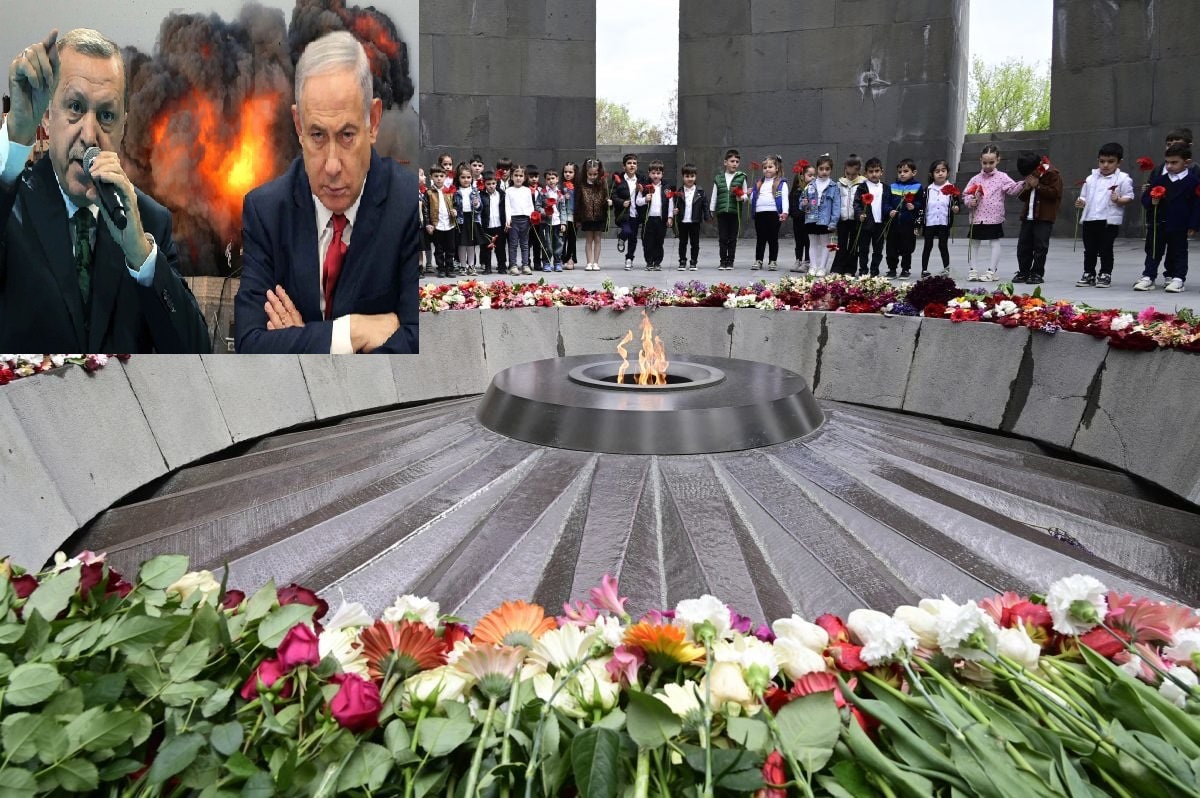


Alwaght- The age-old strategy of "divide and rule" has long been a staple of diplomacy, particularly wielded by colonial powers to expand their spheres of influence. And in today's era, this tactic is alive and well, just as it was in the days of empire. The Israeli cabinet's recent decision to recognize the Armenian genocide committed by the Ottoman Empire between 1915 and 1923 fits squarely into that playbook. To view this merely as a historical, moral, or human-rights gesture would be naive.
The regime's foreign ministry has hailed the move as "historic," and Israeli officials are framing it as a stand for historical truth and justice for the victims. But the timing of the decision, the regional upheavals of recent months, and Armenia's notably tepid response all point to a different reality: Tel Aviv is weaponizing the Armenian genocide file as a geopolitical bargaining chip and a tool for settling regional scores.
Though the cabinet greenlit the plan only days ago, and it still needs final Knesset approval to become official policy, the political will to go down this road had been taking shape for months. The clearest signal came back in late August 2025, when Benjamin Netanyahu broke new ground by explicitly labeling the massacres of Armenians, Assyrians, and Greeks under the Ottoman Empire as genocide.
Growing confrontation with Turkey: When history is weaponized
This latest decision by Tel Aviv should be seen as the next link in a chain of upheavals triggered by the collapse of Israeli-Turkish relations after the Gaza war, and the emergence of a new geopolitical order stretching from the Eastern Mediterranean and the Levant all the way to the South Caucasus. In this new order, even historical grievances are being repurposed as tools in security and political rivalries.
Over the decades, the two countries' relationship had seen its share of ups and downs, but never fully ruptured. That changed after the Gaza war, pushing ties into uncharted territory. The Turkish President Recep Tayyip Erdogan did not just accuse Tel Aviv of committing genocide in Gaza, he branded the regime a "terrorist state." Ankara went on to claim it had halted a significant portion of its economic and trade ties with the Israeli regime and closed its airspace to Israeli aircraft.
In recent months, the Turkish leader and his AK Party officials have repeatedly framed Zionist ideology as a threat to Turkey's national security. Erdoğan even declared that the fight against Zionism is not just about defending Palestine, it is part of a broader struggle for the survival of the Turkish nation.
Into this volatile mix steps the Armenian genocide file, now effectively weaponized as a historical and political pressure lever for Israel against Turkey. It is an issue Ankara has been hypersensitive about for over a century, treating any formal recognition by foreign governments as a hostile act.
Turkey's Foreign Ministry fired back swiftly, accusing Israel of using the Armenian genocide recognition to whitewash its genocide against the people of Gaza. Vice President Cevdet Yılmaz echoed that line, calling the cabinet's move a desperate attempt to cover up its own crimes.
Israeli Foreign Minister Gideon Sa'ar has insisted the decision is not "retaliatory" against Turkey. But coming at a moment of peak tensions between the two sides, and given the blunt language Israeli officials have been using about Turkish policy, the political calculus behind this move leaves little room for doubt.
Seen through this lens, Tel Aviv is sending Ankara a clear and unmistakable message: just as Turkey wields the Gaza file and genocide allegations against Israel on the international stage, Israel can just as easily turn Turkey's most sensitive historical wound into a political pressure point of its own.
Boosting Israeli foothold in Caucasus and Central Asia
The second dimension of this decision lies in the geopolitical contests playing out across the South Caucasus, and Israel's calculated push to expand its footprint there.
In recent years, Tel Aviv has been pursuing a two-pronged strategy: on one hand, breaking out of its regional isolation through normalization deals with neighboring states; on the other, reinforcing its security posture by building influence along the geopolitical periphery of the Islamic Republic, which it views as the single greatest existential threat. Within that framework, Israeli regime has trained its sights on Central Asia and the Caucasus, looking to open new channels of engagement.
The developments of the past few years, particularly since the Second Nagorno-Karabakh War, have turned the South Caucasus into one of the most contested arenas for regional and extra-regional powers. Russia, Turkey, Iran, the United States, the EU, and Israel are all jockeying to lock in their positions.
Yet the hostile dynamic between Azerbaijan and Armenia, coupled with Baku's strategic alliance with Ankara, makes this recognition move a delicate and potentially disruptive gambit within Israel's existing regional alliances.
Over the past two decades, Tel Aviv has built a deep strategic partnership with Azerbaijan, including military, intelligence, and energy cooperation that has become a cornerstone of Israel's regional policy. But the Israelis know that relying solely on the Baku axis won't secure a lasting presence in the Caucasus. Opening parallel channels with Armenia could give Tel Aviv far greater geopolitical flexibility, especially as Yerevan gradually drifts away from Russia and actively scouts for new security and political partners.
Seen in this light, recognizing the Armenian genocide may well be part of a broader Israeli effort to pry open doors in Yerevan, strengthen its hand in the emerging calculus of the Caucasus, and perhaps even extend its reach into Central Asia down the line.
Grouping in Palestinian case
Another likely objective behind this decision is Israel's attempt to claw its way out of the international isolation it now faces over Gaza.
Tel Aviv is currently reeling under a avalanche of global accusations that include war crimes, genocide, you name it. Governments, human rights organizations, UN rapporteurs, and perhaps most critically, world public opinion, especially in the West, have leveled unprecedented criticism against Israel.
In such climate, recognizing the Armenian genocide could be a bid to rehabilitate Israel's moral image: to cast the regime as a champion of genocide victims, a nation that refuses to stay silent in the face of historical atrocities.
But there may be a deeper geopolitical calculus at play here, one tied to the Israeli right's long-standing ambition to bury the 2002 Arab Peace Initiative once and for all. That initiative, it's worth recalling, promised the creation of an independent Palestinian state with East Jerusalem as its capital. The Netanyahu-led hardline cabinet is determined to erase even the faintest trace of that blueprint. And one of the most effective ways to entrench that erasure is to secure international legitimacy for moving Israel's capital from Tel Aviv to Jerusalem, a move already greenlit by the US during Trump's first term. So, by formally recognizing the Armenian genocide, and by extension, drawing closer to Yerevan, Israel may well be laying the groundwork for a similar push: leveraging that moral and political capital to eventually gain broader acceptance for Al-Quds (Jerusalem) as its capital.
When Yerevan reads Israel's mind
Perhaps the most telling sign that this decision is politically driven lies in Armenia's conspicuously tepid response.
Contrary to Yerevan's usual practice of enthusiastically welcoming foreign recognition of the Armenian genocide, this time Armenian officials have held back. Prime Minister Nikol Pashinyan had even warned earlier, explicitly, that the issue must not be turned into a "geopolitical bargaining chip."
This Armenian position is driven in several hard realities.
First, Armenia knows full well that Israel has been one of Azerbaijan's key arms suppliers in recent years. A significant chunk of Baku's military edge in the Second Nagorno-Karabakh War was built on Israeli technology and equipment.
Second, Yerevan sees the timing of this move as driven less by historical or moral conviction and more by the escalating rift between Israel and Turkey.
Third, Pashinyan's government has been pursuing a normalization track with Turkey over the past few years. With the recent breakthroughs between Baku and Yerevan, the prospect of reopening borders and restoring diplomatic ties between Armenia and Turkey is more tangible than ever. The last thing Yerevan wants is for the genocide file to be dragged back into the arena of regional power rivalries.
And fourth, from the perspective of a large swath of Armenia's political class, a country accused of committing widespread atrocities against civilians in Gaza simply lacks the moral standing to pose as a defender of genocide victims.
Regional consequences for Tel Aviv
This decision by the Israeli cabinet carries implications that reach far beyond bilateral tensions between Tel Aviv and Ankara.
First, it is likely to escalate political and diplomatic friction between the two sides, though history suggests Ankara tends not to fully sever ties even with countries that have formally recognized the Armenian genocide.
Second, it could upset the delicate balance in the South Caucasus and complicate Israel's relationship with Azerbaijan, especially if Baku interprets the move as Tel Aviv backpedaling on its longstanding strategic alignment.
Third, this episode underscores a broader trend: in the emerging regional order, historical grievances are no longer relics of the past, they have become live ammunition in geopolitical rivalries.
Ultimately, the Israeli cabinet's recognition of the Armenian genocide is less a historical or moral statement than a reflection of the profound geopolitical shifts reshaping a region that stretches from the South Caucasus to the Eastern Mediterranean.
That is why, today more than ever, the Armenian genocide case is not merely a historical question, it is a strategic battleground, woven into the very fabric of a reordering region where even the historical memory of nations is now fair game in geopolitical competitions.